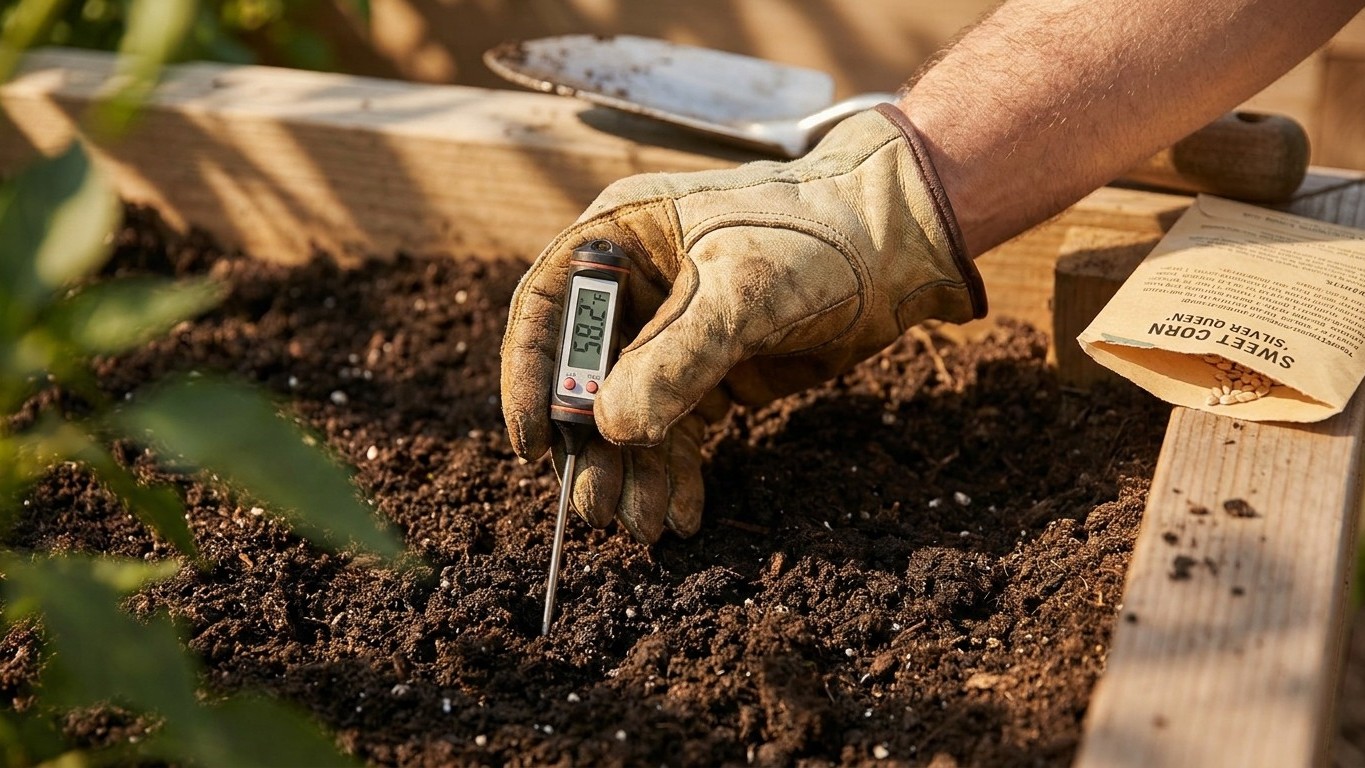

Sweet corn goes into Saskatchewan soil once the ground itself reaches 60°F, not on the calendar date of the last frost. Around Saskatoon that frost date averages May 18, but soil rarely catches up to 60°F for weeks after that. From there, a 60 to 90 day variety needs to finish before the first fall frost, averaging September 18. That leaves a real but narrow window, one that rewards a soil thermometer more than a wall calendar.
The short answer
Here’s what actually decides the planting date: soil temperature, not air temperature. The average last spring frost at the Saskatoon reference station lands on May 18, but that figure is a mean, not a promise. In roughly half the years on record, frost has shown up later than that date, which means anyone treating May 18 as a green light is gambling on the wrong half of the odds. Corn seed sitting in soil colder than 60°F doesn’t just grow slowly, it can rot before it ever sprouts, so the frost date and the planting date are two separate questions entirely.
Soil warms on its own schedule. Prairie ground, especially anything with clay content or lingering snowmelt, holds onto cold well after the air has turned mild. That lag between a frost-free morning and a soil reading of 60°F isn’t published as a fixed number for this region, so the only reliable method is a soil thermometer pushed a few inches into the row before seed goes in, not a date circled in advance.
Once that threshold is met, the countdown starts. Sweet corn needs 60 to 90 days from planting to harvest, and that stretch has to close out before the first fall frost, averaging September 18 here. Measured frost to frost, May 18 to September 18 works out to 123 days on the calendar. But planting never happens right at the spring frost date, it happens once soil catches up to 60°F, which trims real usable growing days down from that 123-day ceiling to something noticeably smaller.
Summer heat matters too. The Saskatoon station averages 0.0 days a year at or above 90°F, meaning this climate almost never delivers the kind of heat load that pushes corn through its stages quickly. A 60 to 90 day estimate on a seed reflects testing under warmer, longer summers in many cases, so growth here can run toward the slower end of that range simply because the days rarely get hot enough to speed things along. Add that to the shortened window created by late soil warming, and the margin for a long-season variety gets thin fast.
Does a late variety fit here?
The 60 to 90 day range covers two very different bets. One end asks for a short, forgiving season. The other asks for nearly the full stretch between soil warm-up and the average first frost, with almost no room for a cool August or a slow-starting spring.
A 60-day variety
A variety at the short end of that range has real breathing room in Saskatchewan. Even accounting for planting happening several weeks after the May 18 frost average, once soil work its way up to 60°F, a 60-day corn maturing from there still lands well before the September 18 average first frost. That buffer matters because the fall frost date is also a mean rather than a guarantee, so a crop that finishes with weeks to spare can absorb a frost that arrives earlier than average without losing the harvest. Given the region’s cool summers, with essentially zero days a year above 90°F, this shorter type is the one built for the actual heat budget available here rather than one borrowed from a warmer growing region.
A 90-day one
A 90-day variety is a much tighter fit, and honestly, it doesn’t reliably fit in this territory. Push planting back to whenever soil finally clears 60°F, add a full 90 days of growth, and harvest lands right up against the average September 18 frost line, sometimes past it. Since that fall frost date is a midpoint rather than a floor, an early frost in any given year can cut the season short before ears finish filling. Layer on the fact that zero days a year reach 90°F here, which slows corn development compared with warmer regions where that 90-day figure was likely established, and the real days-to-maturity locally often stretches longer than the number on the packet. Saskatchewan gardeners choosing a 90-day type are working without a margin, and in a region where both the spring and fall frost dates are averages rather than sure things, that’s a hard bet to recommend.
What goes wrong here
- Soil sown too cold. Seed dropped in the ground right at the May 18 average frost date almost never lands in soil that’s actually reached 60°F yet. The remedy is simple but requires patience: check soil temperature directly with a thermometer a few inches down and wait for a genuine 60°F reading rather than trusting the frost date as a stand-in for soil readiness.
- A variety too late for the season. Choosing a 90-day type in a region where soil warms slowly and summers rarely top 90°F means the crop is racing a frost line it may not beat. The remedy is matching variety length to the shorter end of the 60 to 90 day range, since that’s the only version of the window this climate reliably delivers.
- Sweetness lost to timing, not weather. This one has nothing to do with frost or soil. Sweet corn types (su, se, and sh2) lose their distinct sweetness if two types tassel at the same time nearby, since cross-pollination changes the kernel’s sugar content. There’s no published isolation distance to lean on here, so the fix is scheduling: stagger plantings so tasseling windows don’t overlap, or grow only one type of sweet corn per season, and always plant in blocks of three or more rows rather than a single thin line, since block planting is what makes pollination reliable in the first place.
Common questions
Is May 18 a safe date to plant sweet corn in Saskatchewan?
No. May 18 is the average last spring frost at the Saskatoon reference station, and in roughly half the years on record frost has arrived later than that date. Sweet corn also needs soil at 60°F, which typically lags well behind the frost date, so planting on the frost date alone risks both cold soil and a lingering frost.
How do I know when soil has actually reached 60°F?
A soil thermometer pushed a few inches into the row is the only reliable check. There’s no single published local date for when Saskatchewan soil crosses that threshold, since it depends on soil type, moisture, and how the spring is running that particular year.
Why do zero days above 90°F matter for corn?
Corn development speeds up with heat and slows down without it. A climate that averages zero days a year at or above 90°F simply doesn’t deliver the heat load that pushes corn through its growth stages quickly, which is why maturity here can run longer than the days-to-harvest number printed for a variety.
Can I grow two different sweet corn types in the same garden?
Only if their tasseling windows don’t overlap. The sweetness of su, se, and sh2 types depends on tassels not shedding pollen at the same time nearby, so staggering planting dates or sticking to a single type through the season is the safer route, since no isolation distance is published to fall back on instead.