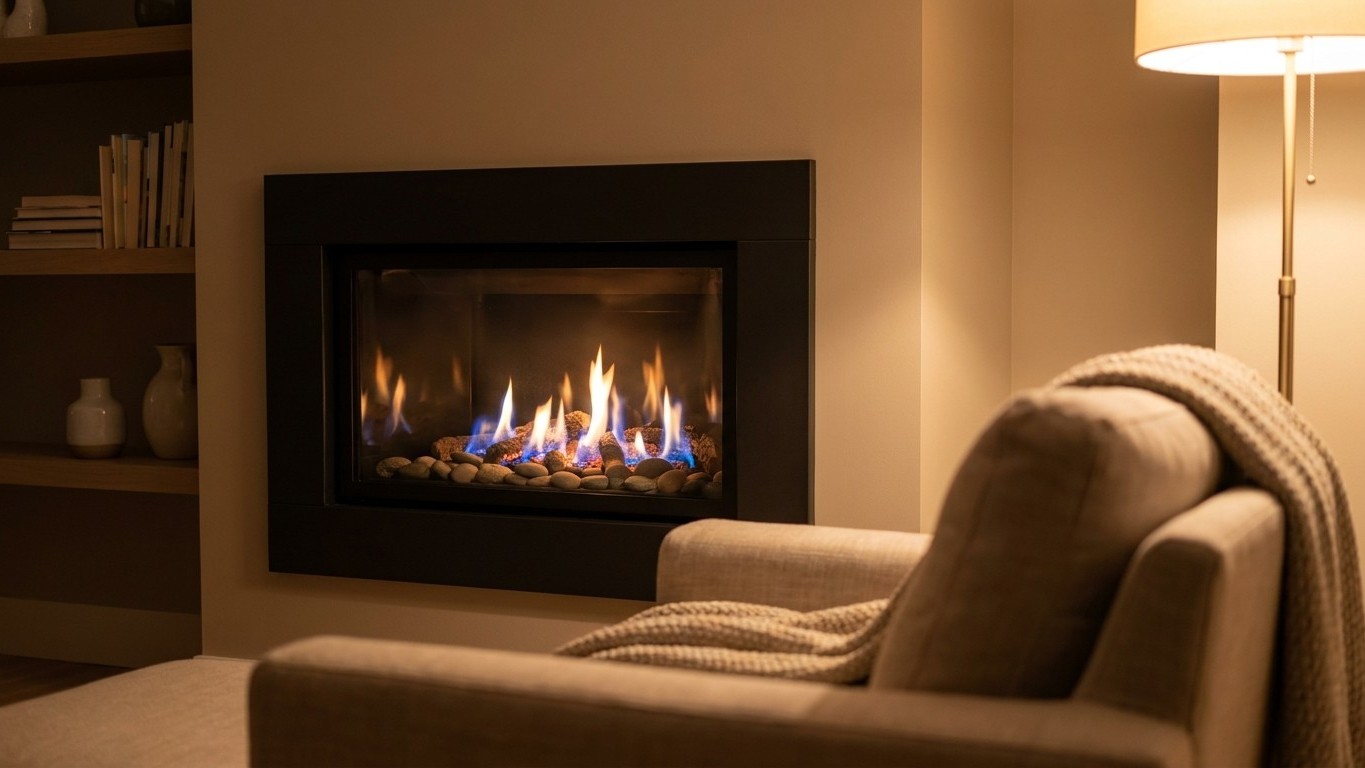

A gas fireplace’s job is simple: put real flame heat into a room without hauling wood or building a chimney fire. But the answer to how one actually works splits into two different appliances the moment you ask where the exhaust goes. A vented model sends combustion products outside through a flue or a direct-vent terminal. A vent-free model releases them, water vapor included, straight into the room. That single fork decides the ignition hardware, the safety equipment, and the service schedule that follow for the life of the unit.
What the appliance is for
At its core, a gas fireplace exists to deliver on-demand flame with none of the labor a wood stove asks for. Flip a switch or press a remote button and heat starts within seconds, not the twenty minutes a cold wood fire needs to catch. That makes it a natural fit for homes without an existing masonry chimney, for additions and finished basements where running a traditional flue is impractical, and for anyone who wants supplemental heat in one room without running the furnace to warm the whole house.
The vented-versus-vent-free split already narrows where the unit can go. A vented appliance needs a path to the outdoors, whether that’s an existing chimney fitted with a liner or a direct-vent system routed through an exterior wall. A vent-free appliance needs no such path, which is exactly why it can sit on an interior wall a vented unit never could, but that flexibility comes with tradeoffs covered in detail on the venting page in this guide.
Ignition is the second piece of the puzzle, and it’s not one-size-fits-all. Some units keep a small standing pilot burning around the clock, others use electronic ignition that lights the flame only when called for, and the difference changes standby gas use, battery or electrical dependence, and whether the fireplace still works during a power outage. That comparison, and which ignition type suits a given household, is answered on the ignition systems page rather than here.
The third question every owner eventually runs into is upkeep. A gas fireplace never produces ash to shovel, but that doesn’t mean it runs untouched for twenty years. Burners drift out of adjustment, glass fogs, gaskets age, and vent systems need periodic inspection regardless of fuel type. What needs checked, how often, and what crosses the line into a job for a licensed technician is the subject of the maintenance page linked at the end of this article.
Put together, the appliance suits a specific kind of household: one that wants fast, controllable heat in a defined space, is willing to trade the smell and crackle of real wood for convenience, and is prepared to treat the unit as a piece of home equipment with its own inspection calendar rather than a decorative object that runs itself.
Choosing one
The first decision a buyer faces is whether the unit will be vented or vent-free, and it’s not a preference so much as a constraint set by the house itself. A home with no viable path to the outdoors leans toward vent-free by default, while a home under construction or mid-renovation has room to choose either. Because that choice touches indoor air quality directly, it deserves its own read before anything else; the vent-free safety page in this guide walks through what changes when combustion products stay indoors.
The second decision is ignition type, and it’s easy to overlook until the power goes out or the gas bill arrives higher than expected. A standing pilot burns a small amount of gas continuously, which some owners accept for the reliability of a flame that lights instantly even without electricity, while electronic ignition trims that standby consumption at the cost of needing power to start. The ignition systems page breaks down which setup fits a household that prioritizes storm-readiness versus one chasing lower monthly gas use.
The third decision is where and how the unit gets installed, since a retrofit into an existing chimney, a new direct-vent run through a wall, and a vent-free insert dropped into an existing firebox all carry different costs and different contractor requirements. That comparison, along with what a typical installation involves, belongs on the installation page rather than in this overview.
None of these three decisions stands alone. Picking vent-free narrows the safe placement of the unit and raises the stakes on ventilation and carbon monoxide monitoring. Picking a standing pilot over electronic ignition changes long-term running cost. Picking a retrofit over new construction changes the installation budget more than it changes the appliance itself. Working through the venting question first tends to make the other two decisions faster, since it eliminates entire product categories before ignition or installation cost ever enters the conversation.
What to know before it runs
The vented-versus-vent-free split isn’t a footnote here, it’s the fact that decides everything else about running the appliance safely. A vented gas fireplace carries combustion products outside through a flue or direct-vent terminal, the same way a furnace does. A vent-free unit has no outside vent at all; according to the U.S. Consumer Product Safety Commission, it depends entirely on ordinary room ventilation to keep combustion byproducts from building up, and inadequate airflow or a maladjusted burner, combined with the normal drop in room oxygen as fuel burns, can let dangerous levels accumulate.
That risk is exactly why unvented heaters carry a specific safety device today. The CPSC notes that currently manufactured unvented gas-fired room heaters are required, under the industry’s voluntary standard, to include an oxygen depletion sensor that shuts off the gas supply before carbon monoxide can reach a life-threatening level in the room. It’s worth getting the history straight: this isn’t a current federal mandate. The CPSC had a mandatory standard requiring the sensor, but revoked it in 1984, by which point 95 to 100 percent of manufacturers were already building the sensor into their units on their own. The safeguard exists today because the industry kept it, not because Washington requires it.
Carbon monoxide follows the same rule on this appliance as it does everywhere in the home: it has no color and no smell, so a working alarm is the only way a household detects it. That’s a reason some owners lean toward a vented appliance in the first place, or toward an electric fireplace, which burns nothing and produces no carbon monoxide at all. None of the sources behind this guide specify a mounting height, a distance from the appliance, or a replacement interval for the alarm itself, so don’t take a number from anywhere else and assume it applies here.
| Feature | Vented | Vent-free |
|---|---|---|
| Combustion byproducts | Carried outdoors via flue or direct-vent | Released into the room |
| Outside vent required | Yes | No |
| Depends on room ventilation | No | Yes |
| Oxygen depletion sensor (per industry voluntary standard) | Not applicable | Required on current models |
Keeping it running
Nothing about a gas fireplace runs forever untouched. Even without ash or creosote, the burner assembly, the glass, the gasket seals, and the vent path all age, and a vent-free unit adds the oxygen depletion sensor to that list of parts that need periodic attention. A flame that’s yellow instead of blue, a unit that clicks repeatedly before lighting, or glass that fogs faster than it used to are the kinds of signs that something in the system has drifted out of adjustment.
Some of that upkeep sits squarely with the homeowner. Wiping down glass, keeping the area around the appliance clear, and testing the carbon monoxide alarm on a regular schedule don’t require a license. But burner adjustment, checking the vent path for blockage or damage, and servicing anything involving the gas line itself cross into territory that calls for a licensed technician, not a weekend project. That boundary between what an owner can reasonably handle and what needs a professional is exactly what the maintenance and servicing page in this guide walks through in detail, including how often a full inspection makes sense for each appliance type.
The bigger picture is that a gas fireplace trades the physical labor of a wood stove for a different kind of responsibility: knowing which parts of the system are simple checks and which ones aren’t, and not treating “no ash to clean” as the same thing as “nothing to maintain.”
Common questions
Do all gas fireplaces need a chimney?
No. Only vented models need a path to the outdoors, whether that’s an existing chimney with a liner or a direct-vent system through an exterior wall. Vent-free models don’t vent outside at all and rely on room ventilation instead.
Is a vent-free gas fireplace safe to run all day?
The specifics of safe use depend on ventilation, burner adjustment, and the presence of a working oxygen depletion sensor, all covered on the dedicated vent-free safety page in this guide rather than as a blanket yes-or-no here.
Why does my pilot light stay on when the fireplace isn’t running?
That’s a standing pilot ignition system, which keeps a small flame burning continuously so the fireplace can light instantly. Electronic ignition systems, by contrast, only ignite the flame when the unit is switched on, trading that instant readiness for lower standby gas use.
How do I know if my gas fireplace needs a technician?
Anything touching the gas line, the burner adjustment, or the vent path itself calls for a licensed technician rather than a homeowner fix. The maintenance page in this guide breaks down which checks are safe to do yourself and which ones aren’t.