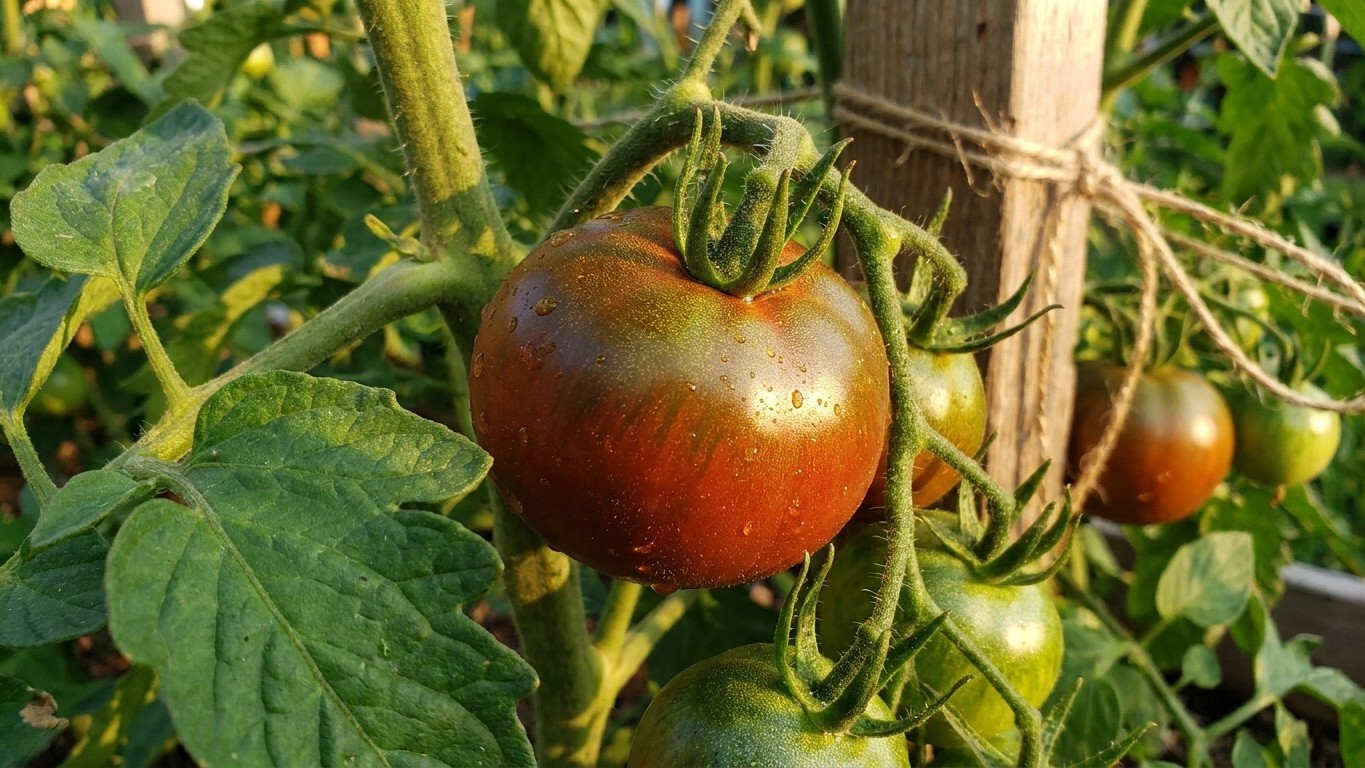

Carbon is a full-season slicing tomato that needs 76 days from transplant to reach a ripe, dark brick-red fruit with olive-green shoulders. That number decides almost everything else: whether a short-season garden can finish the crop, how much staking work the vine demands, and what disease pressure the plant has to shrug off on its own, since no resistance package is published for it.
What Brandywine actually is
Carbon is an heirloom, and it grows as an indeterminate vine, meaning it keeps stretching, flowering, and setting fruit right up until frost stops it rather than finishing in one flush. That single fact settles the support question before anything else does: a stake or a short cage will not hold a plant that could still be producing new growth in September. Gardeners who grow it commit to a tall cage or a sturdy stake system from the start, not as an afterthought once the vine outgrows a small trellis.
The fruit itself runs 10 to 14 ounces, a solid slicing size rather than a paste or salad tomato, and the flesh delivers the rich flavor and meaty texture typical of the classic black tomato group. In the kitchen it’s built for eating fresh off the vine: the fruit resists cracking and cat-facing, the scarring and puckering that ruin so many heirloom tomatoes right at the blossom end, so a bigger share of what sets actually reaches the cutting board instead of the compost pile.
The maturity figure, 76 days, is counted from transplant into the garden, not from the day the seed goes into starting mix. That distinction matters more than it sounds. Add three to four weeks of indoor growing time before transplant, and the real gap between sowing and first ripe fruit stretches well past two and a half months. Anyone comparing this figure to a different variety’s catalog number should check that both are measured the same way, because “days to maturity” isn’t standardized the same way across every seed source.
Where it ripens in time, and where it is a gamble
Seventy-six days from transplant sounds modest next to some 90-day beefsteaks, but the arithmetic that actually matters isn’t the catalog number alone. It’s that number set against how long a garden stays frost-free, minus the two or so weeks tomatoes typically wait after the last frost for soil to warm past the point where roots grow instead of sulk. Here’s how to run it for your own yard: take your local frost-free window in days, subtract roughly 14 for the soil-warming delay, then subtract the 76 days to maturity. What’s left over is your picking margin, the number of days you actually get to harvest before the first fall frost cuts the vine down.
In a garden with a wide frost-free season, say something in the range of 160 to 180 days, that math leaves 70 to 90 days of harvest. That’s a long, comfortable stretch: first ripe fruit arrives with plenty of summer left, and the vine keeps producing through most of it. Regions with long, warm growing seasons, much of the South, the Mid-Atlantic, and California’s inland valleys among them, generally fall into this category, and a 76-day tomato there is one of the easier heirlooms to fit into a normal planting calendar.
The math gets tighter in short-season country. A frost-free window of 100 to 110 days, common across parts of the Upper Midwest, northern New England, and higher-elevation mountain valleys, leaves only 15 to 25 days of margin once the soil-warming delay and the 76-day clock are both subtracted. That’s not zero, but it’s thin: a cool spring that pushes transplant a week later, or an early fall frost that arrives ahead of the average, can erase the harvest almost entirely. Gardeners in that position aren’t locked out of growing Carbon, but they gain real insurance from starting transplants a bit larger and more advanced indoors, using row cover or wall-o-water protection to get plants in the ground sooner without waiting for soil to warm on its own, and picking fruit at the first hint of color to finish ripening indoors rather than risking a frost taking the last of the crop.
No published frost-date figures are cited here for specific cities or stations; the honest version of this advice is to pull your own site’s average first and last frost dates from a local extension office or a personal planting log, then run the same subtraction. The math travels; the exact dates don’t, because they vary by county and even by yard.
The two ways a season goes wrong
A long frost-free window on paper doesn’t guarantee a good tomato season, and two separate limits explain why. In the north, even a season that stays frost-free for 140 or 150 days can still be short on accumulated warmth if much of it runs cool. Tomato flowers won’t set fruit reliably once nighttime temperatures drop below 50°F, so a string of chilly nights in early summer, common at higher elevations and near the Great Lakes, can stall a plant that otherwise has plenty of calendar time left. The frost date says one thing; the thermometer at 2 a.m. says another.
In the south, the opposite failure shows up in the middle of summer. Once daytime highs push consistently above roughly 86°F, tomato pollen turns sterile and flowers drop without setting fruit at all. That’s why growers in hot climates typically don’t treat their long season as one continuous run; they plant a spring crop that finishes before the worst heat arrives, accept a fruitless lull through the hottest weeks, then set out a second round for an autumn crop once temperatures ease back down.
For a 76-day variety like Carbon, the northern cold-night limit is the more relevant risk. Its relatively moderate maturity window means it’s often planted and harvested inside the cooler shoulder months in short-season regions, exactly when the 50°F threshold is most likely to bite. In the deep South, the same 76-day speed is an advantage: the crop can be timed to mature and finish picking before the summer heat sterility window closes it down, or to slip into a second planting once that window passes.
What it resists, and what it does not
No disease resistance package is published for Carbon. That’s worth stating plainly rather than glossing over, because it means the plant carries no catalog-graded protection against the common tomato diseases that resistance codes typically cover, things like verticillium wilt, fusarium wilt, or nematodes. Where other varieties list a resistance letter code backed by breeding, this one simply doesn’t, and treating an absence of data as if it were quiet protection is the kind of assumption that costs a harvest.
That gap changes the practical approach to growing it. Without built-in resistance to fall back on, the usual cultural safeguards carry more weight than they would for a resistant hybrid: rotating tomatoes out of the same bed for at least two to three years, avoiding overhead watering that splashes soil-borne spores onto lower leaves, and giving the vine enough airflow through disciplined pruning and spacing so foliage dries quickly after rain or dew. None of that guarantees a clean season, but it’s the main lever available when the variety itself isn’t doing any of the resisting.
It’s also worth noting what this means for garden planning. A grower choosing between a resistant hybrid and an heirloom like Carbon is trading some measure of insurance for the flavor and texture this variety is grown for in the first place. That’s a reasonable trade for a lot of home gardens, but it’s a decision made with eyes open, not a assumption that heirloom automatically means hardy.
Growing it without the usual mistakes
Because Carbon is indeterminate, the growing plan has to account for a vine that keeps working all season instead of finishing in one flush. A single stake will fall short by midsummer; a tall cage, at least 5 to 6 feet, or a stake-and-string trellis system built to be extended as the plant grows, holds up better over a full season of new growth stacking on top of old.
Spacing needs to reflect that same sprawling habit. Crowding indeterminate vines close together traps humidity in the canopy, which is exactly the kind of damp, still air that lets foliar disease take hold, a bigger concern here given the lack of any published resistance. Giving each plant real air room between it and its neighbors does more heavy lifting than most gardeners expect.
Feeding follows the fruiting pattern rather than the calendar. Nitrogen-heavy fertilizer should taper off once the first fruit sets; a vine pushed to keep producing leafy growth late into the season puts energy into vines instead of into finishing the fruit that’s already hanging, and with an indeterminate habit that mistake is easy to repeat all summer if a grower keeps feeding out of habit rather than watching the plant.
The timing mistake this variety specifically invites is treating 76 days as the whole story and planting late because “there’s plenty of season left.” Since the vine won’t stop producing until frost does it for them, gardeners often start too late, assuming a mid-length maturity number buys more slack than it does, only to find the vine is still loaded with green fruit when the first cold snap arrives. Getting transplants in as early as soil temperature safely allows is the real safeguard, not a long frost-free calendar on its own.
Common questions
Is Carbon the same thing as a Cherokee Purple tomato?
No. Carbon is its own heirloom variety with distinct fruit coloring, dark brick red with olive shoulders, and its own maturity figure. It belongs to the broader black tomato flavor category but isn’t identical to other black-fleshed heirlooms sold under different names.
Can Carbon be grown in a container?
Its indeterminate habit means it needs a large container, at minimum 15 to 20 gallons, along with a tall support inside the pot. A small patio pot with a short cage will struggle to support the full season of vine growth this variety produces.
Why does the 76-day figure matter more than the seed packet’s “average” tomato timing?
Because it’s the number that determines whether the harvest window closes before or after the first fall frost in a given garden. Using a rough average instead of this variety’s actual figure can lead to a planting date that leaves too little margin in shorter-season regions.
Does the lack of disease resistance mean Carbon is fragile?
Not necessarily fragile, but unprotected. It has no catalog-listed resistance to lean on, so its outcome depends more heavily on rotation, spacing, and watering practices than a variety bred with resistance genes would.