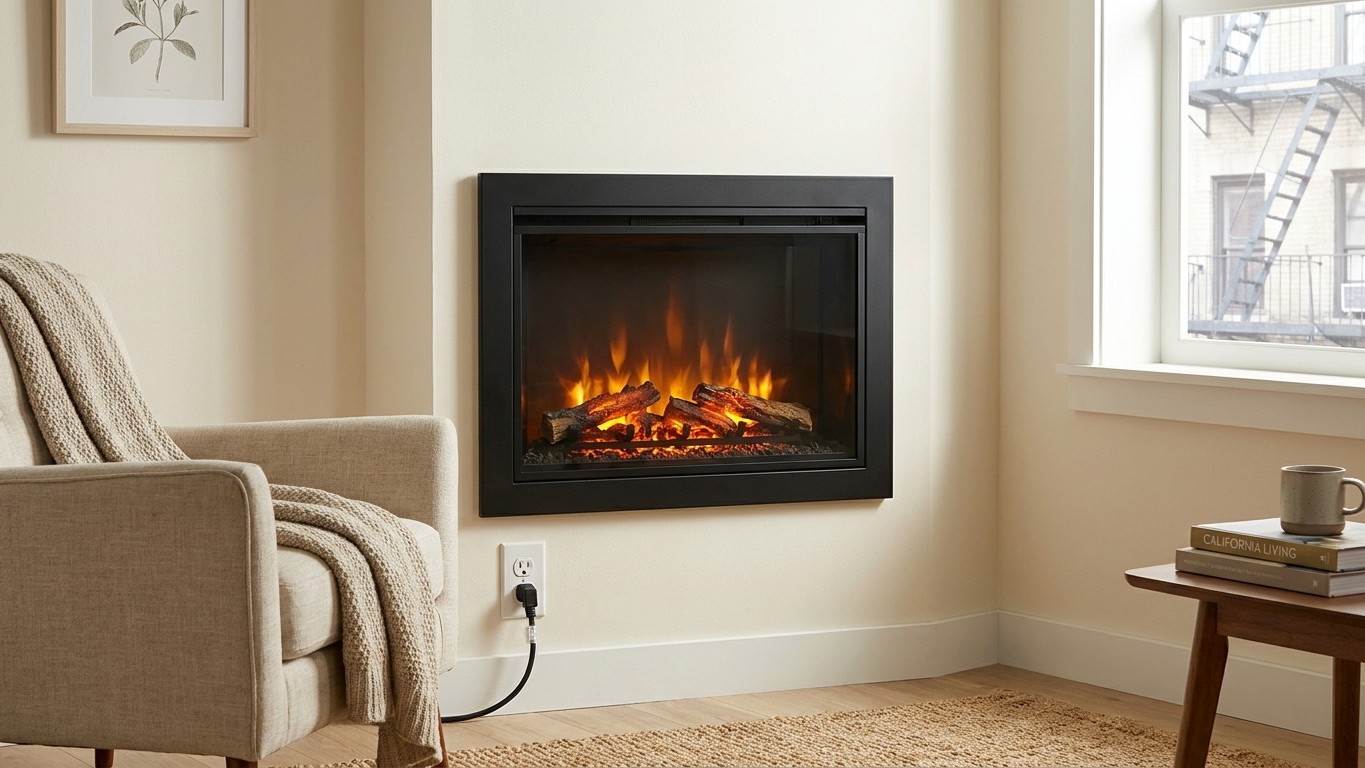

An electric fireplace heats one room, not a whole house. Built to the same 1,500-watt ceiling as any plug-in space heater, it delivers around 5,000 Btu per hour through a resistive element and a fan, while the visible flame is a light effect with no heat output of its own. Running cost depends on your electricity rate and how many hours it’s on, not on the size of the flame display.
What the appliance is for
This is an appliance for supplemental heat and atmosphere, not for keeping a whole floor plan warm through a January cold snap. A family in a two-bedroom rental who wants a fireplace look in the living room, a homeowner who wants to take the chill off a converted garage office, a renter who can’t touch the gas line or run a flue: these are the households an electric fireplace suits. It plugs into a standard outlet, needs no venting, and can be unplugged and moved to a new apartment without a permit or an inspector.
Where it doesn’t fit as well is the household trying to replace a furnace or heat an open-concept great room. At roughly 5,000 Btu per hour, one unit warms a single room of modest size, and heating a larger or drafty space usually means running more than one unit or accepting that the room stays cooler than a gas or wood system would leave it. That trade-off, how much floor area a given wattage can realistically cover, is worth working out before you buy, and it’s covered in detail on the page about how much space an electric fireplace can actually heat.
The decisions this raises
Once the basic job is clear, a handful of follow-up questions tend to come up in order. How much will it add to a power bill if it runs most evenings? That’s answered with real numbers on the cost to run an electric fireplace page. Does it make sense next to a gas insert or a wood stove for the same room? The comparison of upfront cost, upkeep, and heat output sits on the electric vs. gas and wood fireplace page. And once one is installed, what actually needs attention over the years, dust in the fan, a bulb or LED strip that dims, a flame effect that starts to look tired? That’s the subject of the maintenance page linked further down.
None of those questions have a single answer that fits every home. A studio apartment and a drafty farmhouse den ask different things of the same 1,500-watt unit. What stays constant is the mechanism: an electric fireplace is a heater with a flame effect layered on top, not a fire with a heater layered on top. Understanding that distinction is what makes the rest of the buying decision, and the safety picture, make sense.
Choosing one
Most buyers land on three real decisions, and each has its own answer page in this guide rather than a quick rule of thumb here.
The first is sizing: does the room need the full 1,500 watts running most of the time, or is a lower setting enough to take the edge off? Because every plug-in unit tops out at the same wattage on a standard 120-volt circuit, the real variable is square footage and how well-insulated the room is, not brand or price tier. The heating capacity page walks through how to match a room’s size to realistic expectations, so you’re not surprised when a large open room stays cooler than the flame display suggests.
The second decision is format: insert, wall-mounted, mantel package, or a freestanding stove-style cabinet. This is largely a furniture and layout choice rather than a performance one, since the heating element and wattage cap are the same across formats. That said, a built-in insert changes how much clearance and framing work is involved, while a freestanding unit is closer to plug-and-go.
The third is running cost over a heating season, since two units with identical sticker prices can cost noticeably different amounts to operate depending on local electricity rates and how many hours per day the household actually runs it. That math, including how it compares to a portable space heater doing the same job, is broken down on the running cost page. Between those three questions, size for the room, format for the space, and cost for the budget, most buyers can narrow the field without needing to compare every model on a showroom floor.
What to know before it runs
The safety picture here is shorter than it is for gas or wood, and that’s worth saying plainly rather than glossing over. An electric fireplace burns nothing. There’s no flue, no combustion air requirement, no carbon monoxide to test for, and no water vapor produced by a flame. Every safety question that dominates the pages about gas inserts and wood stoves, venting, gas line integrity, creosote, chimney draft, simply doesn’t apply to a plug-in electric unit. That’s a legitimate reason some households choose electric over the alternatives, not a lesser feature.
What does still apply is the same clearance rule that governs any heat-producing appliance in a home, electric or not. The U.S. Fire Administration puts it directly: “Keep anything that can burn at least 3 feet from all heat sources including fireplaces, wood stoves, radiators, space heaters or candles.” That distance matters for an electric fireplace exactly as it matters for a portable heater, because the heat comes from the same kind of resistive element and fan, not from the flame effect on the display. Curtains, upholstered furniture pushed too close, stacks of mail or blankets near the unit, all fall under that same 3-foot rule.
It also helps to remember what the flame effect is and isn’t doing. The moving light display is cosmetic, run independently of the heater, and can usually be left on with the heat turned off. That’s convenient for mild evenings when you want the look without the wattage draw, but it also means the flame brightness tells you nothing about how much heat the room is getting. The heat output is fixed by the wattage setting, full or half power on most units, not by how large or lifelike the flame looks. Treating the display as a heat gauge is the one common misunderstanding worth correcting before the unit is even plugged in.
Keeping it running
Because there’s no combustion, there’s no chimney to sweep and no gas line to have inspected, which puts most of the upkeep for an electric fireplace squarely in owner territory rather than technician territory. Dust buildup in the fan housing, a flame-effect bulb or LED strip that dims over time, a remote that needs new batteries, these are the routine items, and none of them require a service call under normal circumstances.
The line where it’s worth calling in a technician is narrower than for gas or wood, but it exists: anything involving the internal wiring, a unit that trips a breaker repeatedly, or a built-in insert that was wired into a dedicated circuit rather than simply plugged in. Those situations call for an electrician rather than a DIY fix, the same as they would for any hardwired household appliance. For everything else, the day-to-day cleaning, seasonal checks, and troubleshooting for common quirks like a flickering effect or a fan that’s louder than it used to be, the maintenance guide covers what an owner can reasonably handle without outside help.
Common questions
Can an electric fireplace heat an entire house?
No. Built at or below roughly 1,500 watts on a standard 120-volt circuit, it puts out about 5,000 Btu per hour, enough for one room, not a whole home. Households wanting whole-house heat need a furnace or a heating system sized for that job, with the electric fireplace serving as supplemental heat in one space.
Does the flame effect use extra electricity or add heat?
The flame display runs on its own low-power lighting and can usually be operated independently of the heater. It adds negligible cost and produces no heat itself, since the room’s warmth comes entirely from the resistive element and fan, not from the visual flame.
Is an electric fireplace safer than a gas or wood-burning one?
In one specific sense, yes: it burns nothing, so there’s no flue, no carbon monoxide risk, and no combustion byproducts to manage. The same general fire-safety rule still applies, though, keeping combustible items at least 3 feet away, per U.S. Fire Administration guidance, since the heating element itself still produces real heat.
Do electric fireplaces need professional installation?
Most plug-in models don’t. They connect to a standard outlet like any other appliance. Built-in units wired to a dedicated circuit are the exception, and that wiring work should go to a licensed electrician rather than being handled as a DIY project.