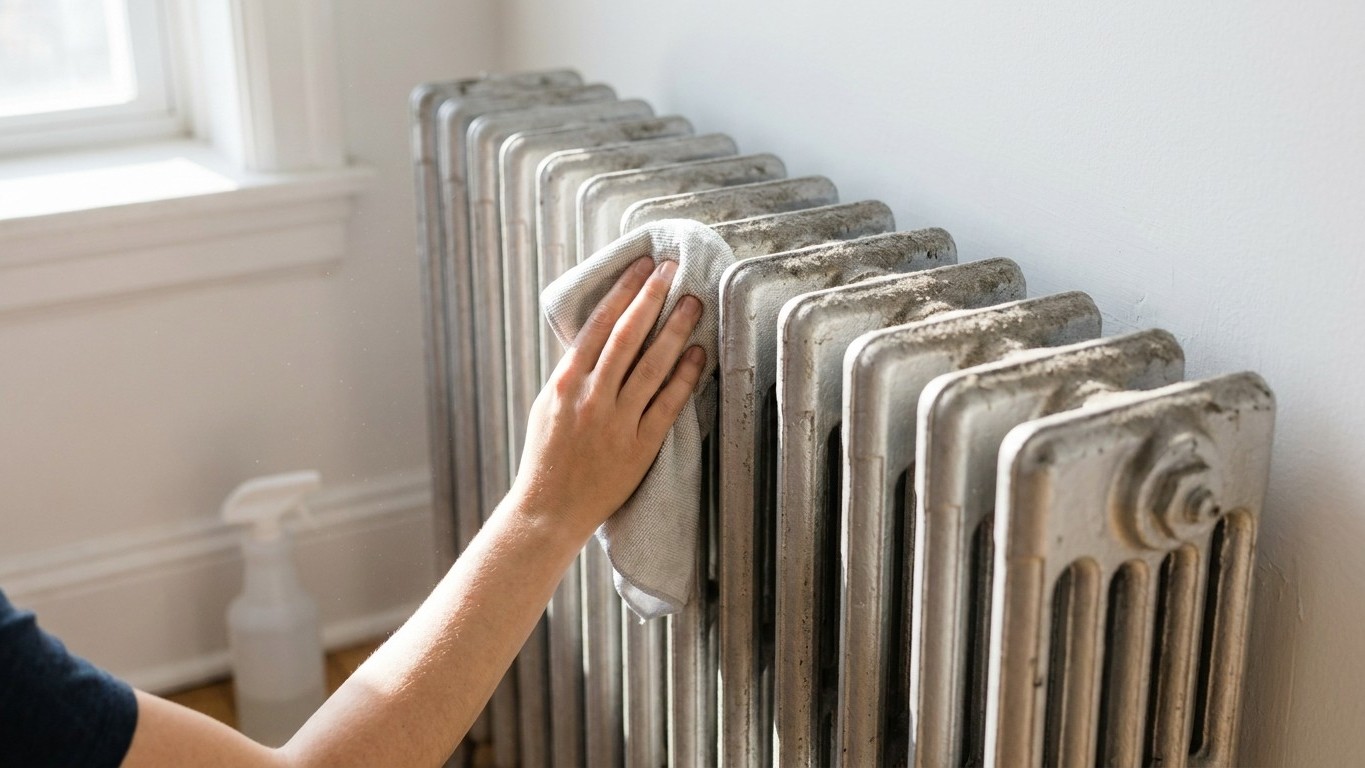

Three things move the needle on an old radiator, and none of them cost money: clear it and clean it, get the trapped air out and balance the loop it sits in, and only then consider a reflective panel behind it. Do them in that order. Most rooms that feel weak get most of their heat back from step one alone, before anyone touches a bleed key or buys foil.
The free things, first
Start with the basics, because a radiator is not a heating system on its own. It is the metal box a boiler pushes heat into, as steam or as hot water, and most of what makes a room feel cold has nothing to do with that metal and everything to do with what is piled around it or clogging the space inside it.
Here is the order, and it is the advice:
- Clear the top. Books, laundry, a plant, a stack of mail: anything sitting on a radiator blocks the column of warm air that is supposed to rise straight up into the room. Move it all off, permanently if you can.
- Pull furniture away from the front. A couch or a bookcase pushed against a radiator does two things at once: it blocks the convection current the radiator relies on, and it soaks up heat that should be reaching the middle of the room. Leave a real gap, not a few inches.
- Clean the face and the top. Dust settles as a fine, cake-like layer on horizontal surfaces and it insulates the metal exactly the way a blanket would. Wipe it down with a damp cloth, not a dry duster that just moves it around.
- Clean between the columns. This is the step people skip. Cast-iron and steel column radiators have narrow gaps between each section, and dust builds up in there just as fast as on the top, quietly slowing the air that is supposed to move through and around the radiator. A long, narrow brush (a radiator brush or even a bottle brush) run between each column, followed by a vacuum with a crevice attachment to pull out what gets loosened, clears the path. Do this once a year at the start of the heating season, more often if you have pets or live somewhere dusty.
None of this involves the boiler, a plumber, or a single tool beyond a cloth and a brush. It also does not fix a radiator that is genuinely undersized or starved of hot water, but it removes every excuse that has nothing to do with heat output itself, and it is worth doing before assuming the problem is more complicated than a dirty radiator.
Then the air, and the balance
Before anything else here: a steam radiator does not have a bleed valve, and it should never be opened as if it were a hot-water one. Steam systems vent air through a small automatic air valve on the radiator itself, not a manual key, and forcing one open the way you would a hot-water bleed valve can let steam or hot water out where it should not go. Hot-water radiators, by contrast, do have a manual bleed valve, usually a small square-socket screw near the top on one end, and that is the one meant to be opened by hand.
Trapped air is the classic reason a hot-water radiator is warm at the bottom and cool at the top, or cool all over on one end. Air rises to the highest point in the radiator and sits there, blocking hot water from filling that space, so the metal around it never gets hot enough to radiate. Bleeding lets that pocket of air escape and lets water take its place. If that is the symptom you are seeing, the site’s dedicated guide to bleeding a radiator walks through the actual mechanics of doing it safely on a hot-water system.
Balancing solves a different problem: one radiator running hot while another, further along the same loop, barely warms up at all. On a multi-radiator hot-water loop, water takes the path of least resistance, and radiators closer to the boiler (or with a wider-open valve) can grab most of the flow, leaving the last one in the loop starved. Balancing means adjusting the valves so each radiator gets a fair share of hot water relative to its size, rather than the first ones in line hogging it. The site’s guide to balancing radiators covers the valve-by-valve process for getting that even. Bleeding and balancing fix different symptoms, and knowing which one you have is what decides which guide to open next.
The foil behind it: what it does and does not do
Reflective foil behind a radiator shows up on nearly every list of radiator tips, and it is usually oversold. The idea itself is sound: a radiator mounted on a wall sends roughly half its heat forward into the room as radiant warmth, and the other half backward, straight into the wall behind it. A panel with a reflective foil face, mounted between the radiator and that wall, bounces some of that backward heat back into the room instead of letting the wall simply absorb it.
Where this actually matters is narrow and specific: an uninsulated exterior wall directly behind the radiator. That is the case where heat pushed into the wall has a real chance of continuing straight through to the outside, lost for good, and a reflective panel intercepts some of it before that happens. An old house with solid masonry or an uninsulated stud wall on an outside face is exactly this situation.
Where it does close to nothing is an internal wall, or an exterior wall that has already been insulated. An internal wall usually backs onto another heated room, so heat that passes through it is not wasted, it is just warming the next room over rather than this one. And a wall that already has insulation in the cavity is already doing most of the job a reflective panel is meant to do, slowing heat loss through the wall itself, so the panel has very little extra to reflect. There is no fixed number for how much a foil panel saves, because it depends entirely on the wall behind it: an uninsulated brick exterior wall in an old house is a different case from an insulated 2×4 wall built to modern code, and the panel’s effect scales with how much heat that wall was losing in the first place. It is a cheap, quick fix worth doing on the right wall, and largely a waste of an afternoon on the wrong one.
When the radiator is not the problem
A radiator that has been cleared, cleaned, bled, and balanced, and still cannot warm the room, is not hiding some fourth trick. It is telling you something about the room, or about the system as a whole, that no amount of maintenance on the radiator itself will fix. Either the room is losing heat faster than that one emitter can replace it, or the radiator was undersized for that room from the day it was installed.
This matters more in some parts of the country than others, because steam and hot-water systems are heavily concentrated in the oldest housing stock in the country. According to the U.S. Energy Information Administration’s 2020 Residential Energy Consumption Survey, these systems are still common in Alaska (36% of homes), New York (35%), Rhode Island (33%), Maine (31%), Massachusetts (26%), New Hampshire (25%), New Jersey (25%), and Vermont (25%), against just 1% of homes in California. Twenty-seven states sit below 5%. That pattern is not a regional taste for radiators; it tracks directly with homes built before forced-air ducting became the standard, which means it also tracks with drafty windows, thin wall insulation, and other envelope problems that push against whatever the radiator is trying to do.
| State | Share of homes with steam or hot-water heat |
|---|---|
| Alaska | 36% |
| New York | 35% |
| Rhode Island | 33% |
| Maine | 31% |
| Massachusetts | 26% |
| New Hampshire | 25% |
| New Jersey | 25% |
| Vermont | 25% |
| California | 1% |
Before assuming the radiator itself needs replacing, work through the cheaper explanations first:
- Check for drafts around the windows and door nearest that radiator; a cold draft can outpace what a fully working radiator supplies.
- Look at the wall behind the radiator for signs of it being an uninsulated exterior wall, which is the case where the foil panel above actually helps.
- Confirm the radiator’s valve is fully open and that the room isn’t simply the last one on an unbalanced loop, which points back to the balancing guide above.
- Ask whether the room’s radiator looks small relative to the room’s size and ceiling height compared with radiators in similarly sized rooms elsewhere in the house; a mismatch there is a sizing problem, not a maintenance one, and it’s worth having a heating contractor confirm before considering any replacement.
Common questions
Why is my radiator hot at the bottom but cold at the top?
That is the signature of trapped air on a hot-water system: air rises to the top of the radiator and blocks water from filling that space. Bleeding the radiator, on a hot-water system only, generally clears it.
Can I bleed a steam radiator the same way as a hot-water one?
No. Steam radiators vent air through a small automatic air valve, not a manual bleed key, and they should not be opened the way a hot-water radiator is.
Does covering a radiator with a decorative shroud reduce its output?
A solid enclosure that blocks airflow across the front and top will reduce the convection current the radiator depends on, which lowers how much heat actually reaches the room even though the radiator itself is working fine.
Is a reflective panel worth installing on every radiator in the house?
Only where the wall behind the radiator is an uninsulated exterior wall. On an internal wall, or a wall that already has insulation, the panel has very little heat left to reflect.