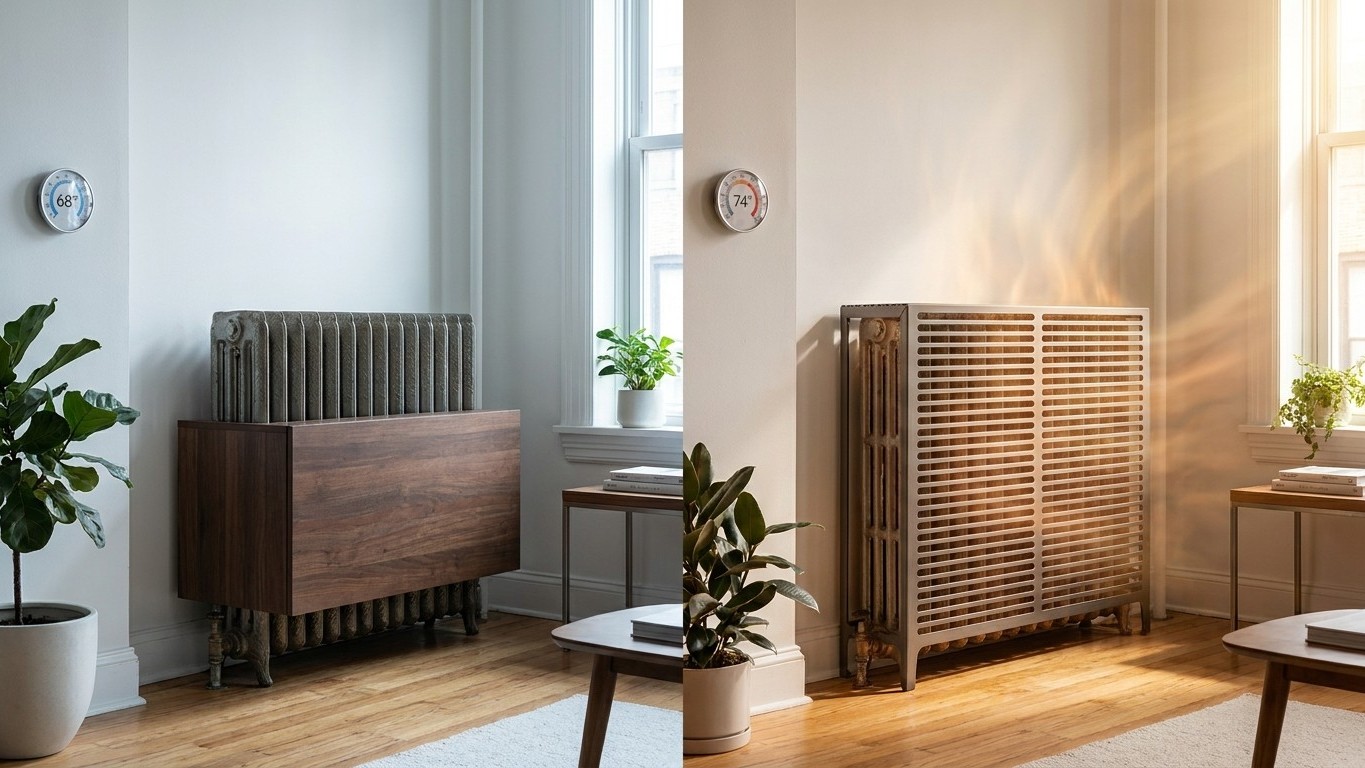

Yes, you can hide a radiator without losing heat, but only if the cover respects how the unit actually works. A radiator warms a room in two ways at once: it radiates heat directly to anything in its line of sight, and it drives a rising current of warm air up its face. Paint it, declutter around it, or pick the right furniture, and you lose nothing. Box it in solid on all sides, and you’re paying for heat that never leaves the cabinet.
The constraint every idea has to respect
A radiator isn’t the heating system itself. It’s the metal surface a boiler pushes heat into, as either steam or hot water, depending on the setup. Every complaint about a radiator running cold in spots, or not heating a room evenly, traces back to that steam-or-hot-water loop, not to the metal panel or column sitting against the wall. That distinction matters here because a steam radiator has no bleed valve and should never be opened like a hot-water one, a fact worth knowing before you build anything around it that limits access for service.
Back to the heat itself. Radiant heat is straightforward: it travels in straight lines, like light, and warms whatever surface it hits, including your skin if you’re standing close, or a wall if the radiator faces one. Anything solid placed between the radiator and the open room blocks that path entirely. The second mechanism, convection, is less obvious but does more of the actual work in most rooms. Air touching the hot surface warms up, becomes less dense, and rises. As it rises it pulls cooler air in from below to replace it, creating a steady loop that circulates warmth through the room rather than leaving it stacked against one wall.
This is why the real question isn’t whether you can hide a radiator. Of course you can. The question is what that particular method costs you in lost radiation, blocked convection, or both. A thin curtain doesn’t block radiant heat much but can trap the rising air behind it. A solid wood box blocks both. An open shelf blocks almost nothing. Once you start sorting ideas by which mechanism they interfere with, the good options and the expensive ones sort themselves out almost automatically.
Framing it this way also explains why so much generic decorating advice on this topic falls flat. Advice that says “just build a cabinet around it” without mentioning airflow gaps is advice that will leave a room cooler at the far end and the cabinet itself uncomfortably warm to the touch. The fix isn’t complicated. It just requires knowing which parts of a cover matter and which don’t.
The ways that cost you nothing
Start here before spending money or losing a single degree of comfort. These four changes work with both mechanisms instead of against them.
- Paint it the color of the wall. A radiator that visually disappears into its background stops reading as “the ugly thing in the room” without changing a single physical property that affects heat output. Radiant and convective performance depend on surface temperature and airflow, not on color, so a wall-matched finish is purely cosmetic and entirely free.
- Keep it clean. Dust buildup on radiator fins and surfaces insulates the metal slightly, which dulls both the radiant surface and the convection current passing over it. A radiator caked in dust simply can’t transfer heat as efficiently as a clean one, so wiping it down is maintenance that pays for itself immediately, not a decorating trick.
- Clear the clutter. Stacks of mail, dropped laundry, or a plant pot sitting directly on top all block radiant lines of sight and interrupt the rising air column right where it’s strongest. Removing them costs nothing and restores full output instantly.
- Choose furniture with open legs and open backs for that wall. A sofa or bookcase with raised legs lets the convection loop continue underneath it, and an open-backed piece lets radiant heat pass through rather than absorbing it into solid wood or upholstery that then re-radiates slowly, unevenly, and mostly toward the wall instead of the room.
None of these four ideas trade heat for looks. They work precisely because they leave both mechanisms intact: the radiant sightline stays open, and the air column keeps rising unobstructed. That’s the entire test for whether a fix belongs on this list or the next one. If you’re only going to do one thing on this page, painting a radiator to match the wall usually delivers the biggest visual change for the smallest effort, and it costs exactly nothing in comfort.
The ways that cost you something
Every idea below interferes with one mechanism, the other, or both. That doesn’t make them off-limits. It means the penalty is real and worth knowing before you commit to it, and it means a well-built version costs far less than a poorly built one.
| Method | What it blocks | How much it matters | How to reduce the cost |
|---|---|---|---|
| Full cabinet cover | Radiant sightline and convection, both sides | Significant if sealed top and bottom | Use louvered or perforated front panels, and leave a generous open gap top and bottom for air to enter and exit |
| Shelf over the top | Upward convection path if too low or too shallow | Moderate, depends on height and depth | Mount it a few inches above the radiator with a shallow depth, never flush against the top |
| Decorative screen in front | Radiant sightline mostly, some convection if solid | Moderate | Choose an open-weave or slatted screen rather than a solid panel |
| Long curtains falling over it | Convection, trapping warm air behind the fabric against the window | Significant in cold weather when curtains are drawn | Tie curtains back above the radiator, or use sill-length panels on that window instead |
| Sofa pushed against it | Both radiant sightline and convection, directly and at close range | Significant, and it also heats the furniture unevenly | Leave a few inches of clearance, or turn the piece so an open-backed side faces the radiator |
The cabinet is the case worth explaining a little more, because it’s also the most requested. A solid box with a tight-fitting door blocks both mechanisms almost completely, turning the radiator into a slow oven that eventually leaks a little heat out through the cracks, long after the room needed it. A cover built with a generous open top, an open or louvered bottom, and a front made of slats or perforated metal rather than solid wood behaves very differently. Air still enters low, rises past the hot surface, and exits through the top opening into the room. Radiant heat still escapes through the gaps in the front panel, just at a somewhat reduced intensity. That version costs a fraction of what a sealed box costs, which is the whole argument for building it right rather than avoiding covers altogether.
One more practical note for anyone planning a cover: whichever design you choose, leave a way to reach the radiator’s valves. Hot-water radiators need periodic access to their bleed valve, and steam radiators, which have no bleed valve at all, still need access to their air vent for the same reason. A cover that requires disassembly just to service the unit is a design mistake independent of the heat question entirely.
The shelf that helps
Most additions around a radiator cost something. One genuinely helps, and it happens to be the simplest: a shelf mounted a short distance above a radiator that sits under a window.
Without a shelf, the warm air rising off the radiator runs straight up into the cold glass behind the curtain, loses much of its heat to that cold surface, and drifts back down before it ever reaches the middle of the room. A shelf positioned correctly intercepts that rising column and redirects it forward, out into the room, instead of letting it dead-end against the window. It’s a small architectural nudge to a current of air that was already moving, not a new heat source.
What makes a shelf work rather than hinder is the gap above the radiator and the depth of the shelf itself. Mount it too low, tight against the top of the unit, and it behaves like the solid cover in the table above, trapping the rising air instead of redirecting it. Leave a clear space of a few inches between the top of the radiator and the underside of the shelf, and keep the shelf itself relatively shallow rather than a deep, furniture-like ledge, and the air has room to move up and then out past the front edge into the room.
One caution matters more than the shelf’s design: what goes on top of it. A shelf turned into storage for books, framed photos, or a row of plants defeats its own purpose, since anything sitting on the surface blocks the very air current the shelf was meant to redirect. Keep it clear, or nearly so, and let it do one job.
It’s worth being honest about the size of this effect. A shelf over a radiator doesn’t transform a cold room into a warm one, and it isn’t a substitute for a properly sized radiator or a well-balanced heating system. What it does is stop heat from being wasted on cold window glass and send more of it toward the middle of the room, where people actually sit. Modest, real, and free once the shelf is already there for other reasons, like holding curtains open or finishing a window seat.
Common questions
Can I put a TV stand or bookcase directly in front of a radiator?
Furniture placed close in front blocks radiant heat and interrupts the rising air column, the same penalty a sofa carries in the table above. If the piece has an open back and sits a few inches off the radiator rather than flush against it, the effect is reduced but not eliminated.
Do radiator covers reduce heat output enough to raise heating bills?
A sealed cabinet cover can measurably cut how much heat reaches the room, since it blocks both radiant lines of sight and the convection loop. A cover built with open top and bottom gaps and a slatted or perforated front reduces that effect substantially, which is why design matters more than the decision to cover at all.
Is it safe to paint an old radiator in a period home?
Have the existing paint tested for lead before sanding, scraping, or repainting an older radiator, rather than assuming it’s safe based on the home’s age alone. This applies to the surrounding trim and walls as well, not just the metal itself.
Do reflective panels behind a radiator actually help?
A reflective panel installed on the wall behind a radiator can redirect radiant heat that would otherwise be absorbed into an exterior wall back into the room, which is most relevant on an uninsulated exterior wall. It has no effect on the convection loop, so it addresses only one of the two mechanisms discussed above.