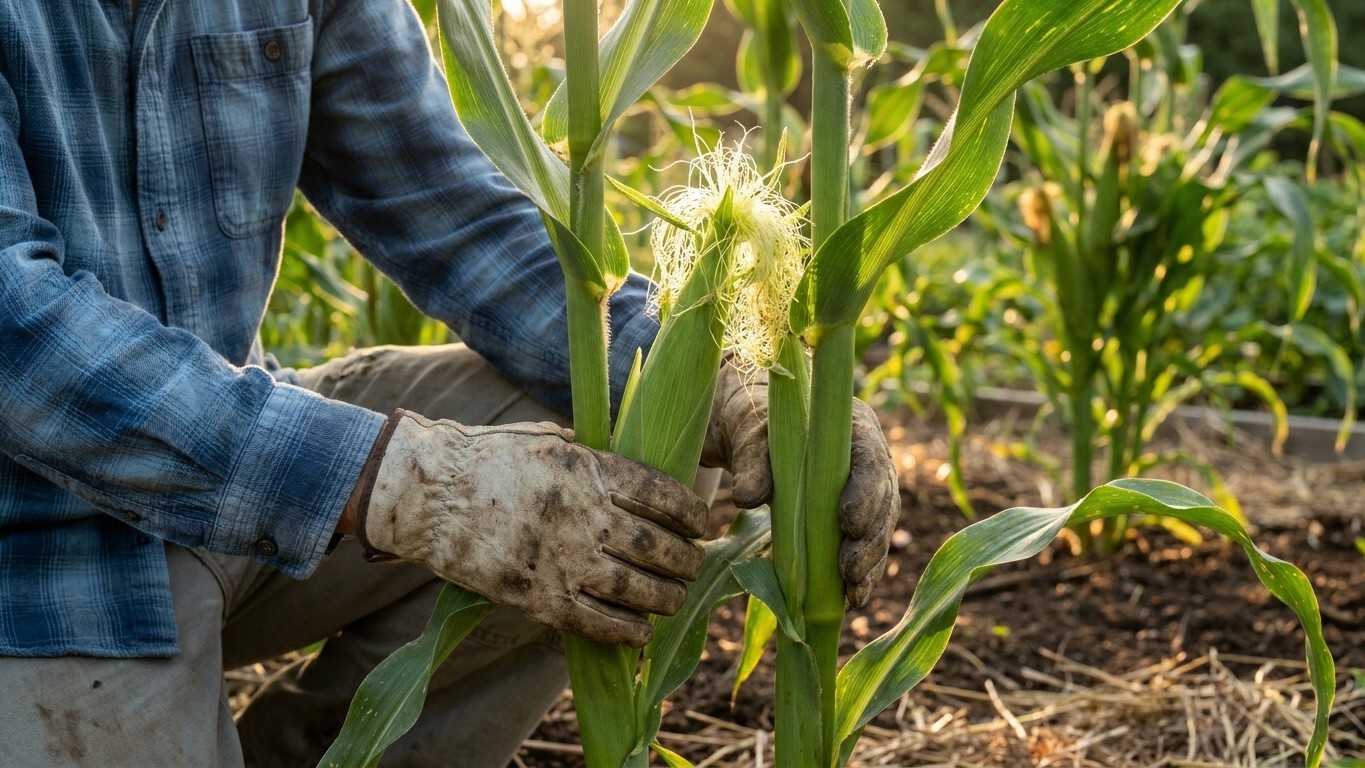

Sweet corn runs on two separate timers, and mixing them up is the single biggest reason gardeners either pull ears too early or watch them turn starchy on the stalk. Utah State University Extension puts the first clock at 60 to 90 days from planting, depending on variety, and the second at just 17 to 24 days from the moment silks appear. One tells you if the crop fits your season. The other tells you which week to walk out with a basket.
The short answer
According to Utah State University Extension’s guide, Sweet Corn in the Garden, sweet corn has a maturity range of 60 to 90 days from planting depending on variety, and ears mature in 17 to 24 days from silk emergence. Those are not two ways of saying the same thing. They’re two different questions with two different answers, and a gardener who only tracks one of them is missing half the picture.
The planting-to-maturity window (60 to 90 days) is a season-length question. It tells you whether the variety you’ve chosen has enough warm weeks to go from seed to harvest before fall weather shuts things down. A short-season type finishing near 60 days works in places with a compressed growing window. A longer type stretching toward 90 days needs a longer stretch of warm months to get there. This number is what you check against your local frost-free period before you ever put seed in the ground.
The silk-to-harvest window (17 to 24 days) is a different tool entirely. It only starts counting once you see silks, those pale threads emerging from the tip of each developing ear. From that point, the kernels inside are filling with starch and sugar, and the clock runs fast: barely two and a half weeks to just over three weeks before the ear is at its peak. This is the number that actually gets you to the garden at the right moment, because “60 to 90 days from planting” is too wide a window to tell you which specific day to check an individual ear.
Both numbers come from the same source, and both matter for different decisions. The planting clock is about whether your garden and your climate can produce a crop at all. The silk clock is about precision, telling you when to start checking ears closely instead of guessing. Gardeners who only watch the calendar from planting day often either pick too early, when the whole 60-to-90-day range hasn’t yet elapsed but the silks have long since told a different story, or too late, waiting for some fixed date instead of watching what’s happening on the plant itself.
Treat the two clocks as a sequence, not a substitute for one another. Use the planting-to-maturity range to decide if a variety is even viable for your season. Once silks show up on your plants, switch your attention to the shorter window and start watching the ears directly, because that’s the number that decides the actual harvest day.
What actually decides it
Sweet corn’s two clocks don’t run in a vacuum. Several conditions push them faster or slower, and understanding those conditions is what turns two published number ranges into a workable harvest plan.
Soil and air temperature at planting
Utah State University Extension specifies soil and air temperatures above 60 F for best germination and plant growth. This is a separate threshold from the last frost date, and conflating the two is a common mistake. Frost risk ends on one date; soil actually warms to a corn-friendly temperature on a later date, sometimes considerably later, because soil holds cold longer than air does. Planting into ground that’s still cool but frost-free can mean slow, uneven germination, seed rot, or stunted early growth, all of which push the eventual maturity date later than the variety’s stated range would suggest.
Variety selection within the 60-to-90-day range
The width of that maturity range, a full month of difference between the fastest and slowest types, means variety choice is itself a scheduling decision. A gardener with a shorter growing season needs to lean toward the lower end of that range to get a reliable harvest before cold weather returns. Someone with a long, warm season has more flexibility and can choose from anywhere in the range based on flavor or texture preference rather than being forced into a fast-finishing type.
What happens after silk emergence
Once silks appear, the 17-to-24-day window is driven by what’s happening inside the husk, not by anything visible from outside the plant until the very end. Kernels are converting sugars and starches, and that process runs on its own internal schedule regardless of how many total days have passed since planting. This is why two plants of the same variety, planted the same day, can still reach peak ripeness on slightly different days: whichever plant put out silks first will also reach the end of its 17-to-24-day window first.
Type mixing and tassel timing
There’s a third factor that doesn’t affect either clock’s length but affects the quality of what you harvest at the end of it. Different sweet corn types (standard sugary types, sugary-enhanced types, and supersweet types) can cross-pollinate when they tassel at the same time, and the result is often starchy, tough kernels instead of the tender, sweet ones the variety was bred to produce. The fix isn’t a measured distance; it’s timing. Staggering planting dates so different types don’t tassel simultaneously, or grouping same-type plantings together, keeps pollen from crossing where it matters.
How to do it
- Check soil and air temperature before planting. Wait until both are consistently above 60 F. This is a separate milestone from your last frost date and typically arrives afterward, so don’t plant on the frost date alone.
- Choose a variety that fits your season length. Match the variety’s stated maturity, somewhere in the 60-to-90-day range, to how many warm weeks your garden reliably gets. Shorter-season gardens should lean toward the faster end of that range.
- Plant in blocks of three or more rows rather than a single long row. This shape of planting improves pollination because wind-carried pollen has a better chance of reaching silks across a block than down a thin single line.
- If growing more than one type, stagger planting dates. Space out sowing so that different sweet corn types don’t tassel at the same time, which avoids the cross-pollination problem that leads to starchy, disappointing ears.
- Watch for silk emergence on each planting. Once silks appear, start the second clock mentally: 17 to 24 days from that date is your harvest window for that specific planting.
- Begin checking ears closely as the silk-clock window approaches. Look for three signs together: dry, brown silks; husks that are still moist and green; and milky juice when a kernel is punctured. All three need to be present, not just one.
- Harvest promptly once the three signs align. Waiting past this point doesn’t improve the ear; it just moves the crop from peak sweetness toward starchier, tougher kernels.
- Move harvested ears toward cooking or cold storage quickly. Sugar leaves the kernel fastest at high temperatures, so the sooner ears are cooled or cooked, the more of that sweetness survives.
What goes wrong
- Planting before soil hits 60 F. Seed sits in cold, damp ground and either rots or germinates unevenly, which drags out the whole maturity timeline beyond what the variety’s stated range suggested. The remedy is simple: confirm soil and air temperature above 60 F before sowing, rather than relying on the calendar alone.
- Confusing the last frost date with the 60 F soil threshold. These are two different milestones, and the soil one arrives later. Planting the moment frost risk passes, without checking soil temperature separately, is a common way to end up with weak, slow-starting plants. Check both, not just one.
- Tracking only the planting-to-maturity number and ignoring silks. A gardener who just counts days from planting and picks on a fixed calendar date, without watching for silk emergence, will often harvest at the wrong point in the ear’s development. Once silks show up, switch to counting from that date instead.
- Judging ripeness from a single sign instead of all three. Brown silks alone don’t mean an ear is ready, and neither does husk color alone. The remedy is checking all three together: dry brown silks, husks still moist and green, and milky juice from a punctured kernel. Skipping any one of the three risks an early or overripe pick.
- Letting different sweet corn types tassel at the same time. When standard, sugary-enhanced, and supersweet types pollinate each other, the resulting kernels often turn starchy instead of sweet. Stagger planting dates for different types so their tasseling doesn’t overlap.
- Leaving harvested ears out in the heat. Sweet corn loses sugar from the kernel rapidly at high temperatures, and even under optimal conditions it holds for about five days at most before losing sweetness with each additional day. The remedy is getting ears cooled or cooked as soon as possible after picking, especially on hot days.
- Assuming a longer-season variety will still ripen in a short-season garden. Choosing a variety near the 90-day end of the range without checking whether the local season actually provides that many warm weeks leads to a harvest that never quite finishes. Match variety maturity to season length before planting, not after.
Common questions
Do both clocks apply to every sweet corn variety?
Yes. Utah State University Extension’s maturity figures, the 60-to-90-day range from planting and the 17-to-24-day range from silk emergence, describe sweet corn generally, with the exact number within each range depending on the specific variety planted.
Which clock should I trust if they seem to disagree?
They don’t actually disagree, because they answer different questions. The planting clock tells you whether the crop fits your season at all. The silk clock tells you which specific week to start checking ears. Once silks appear, the silk clock becomes the more precise, actionable one.
Is 60 F soil the same as my last frost date?
No. Soil warms more slowly than air, so the point at which soil and air temperatures are both consistently above 60 F comes after the last frost date, sometimes well after. Treating the two as interchangeable is a common planting mistake.
Can I tell an ear is ready just by looking at the silks?
Not reliably on their own. Ripeness depends on three signs appearing together: dry, brown silks; husks that are still moist and green; and milky juice from a punctured kernel. Checking silks alone, without the other two signs, risks pulling an ear too early or too late.