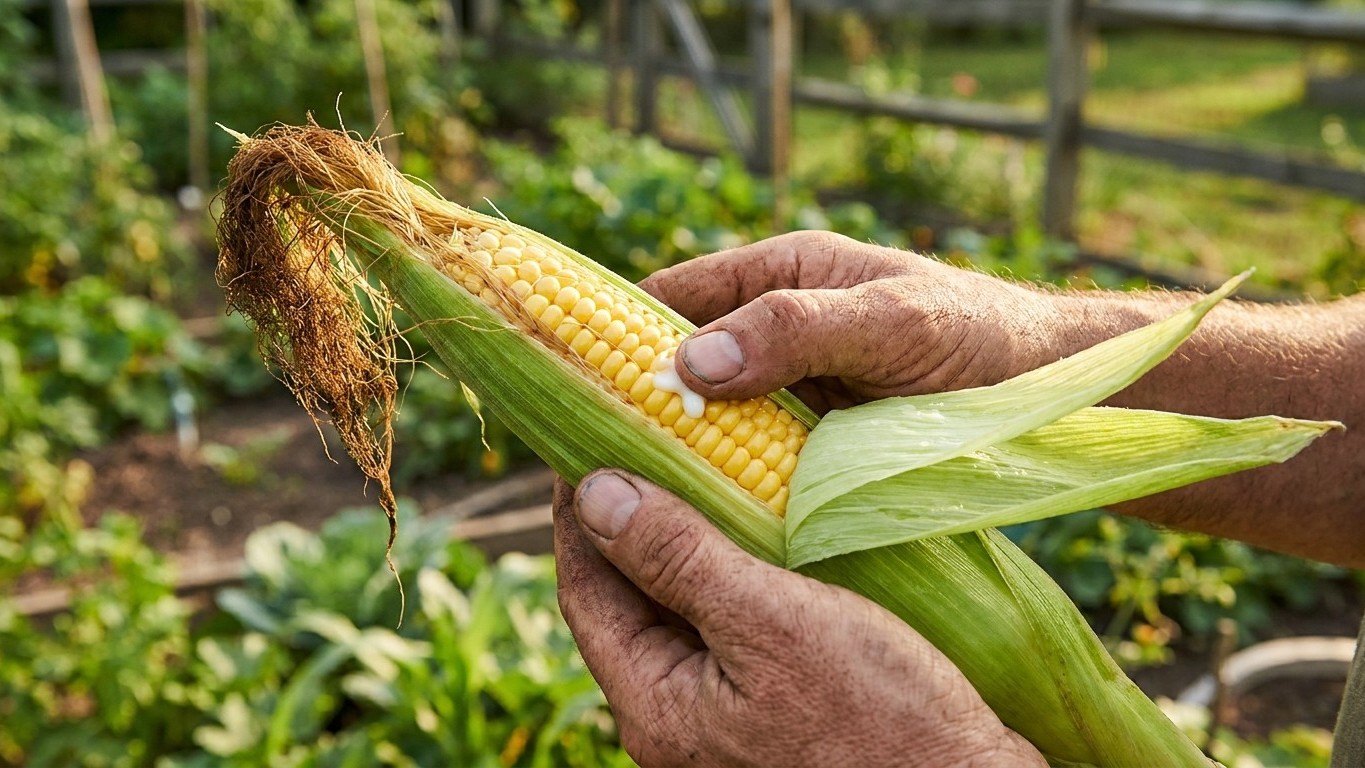

All three signs have to show up at once: silks gone dry and brown, husks still moist and green, and a punctured kernel weeping milky juice. Utah State University Extension is explicit that this is a package, not a checklist you can pass with two out of three. Miss one, and the ear is either underripe or already sliding past its peak.
The short answer
Utah State University Extension lays out the standard this way: “Ears are mature when silks are dry and brown. The husks should appear moist and green. Kernels in the tip of the ear should be plump and release milky juice when punctured.” Read that sentence twice and notice what it does not say. It does not say dry silks alone mean ready. It does not say green husks alone mean ready. It links three separate observations into one verdict, and the verdict only holds when all three point the same direction.
That matters because each sign, taken alone, lies in a different way. Silks can dry and brown from heat stress or a dry spell well before the kernels underneath have actually filled out. Husks can stay green for days after the ear inside has already gone starchy and tough, especially in a cool stretch of weather. And a kernel near the tip can look plump without actually releasing that thin, milky fluid when you break the skin, meaning the sugar-to-starch conversion inside hasn’t reached the sweet window yet. Any one test, run by itself, produces false positives often enough that a gardener relying on it will pull ears too early or too late on a regular basis.
Running all three together closes those gaps. Dry brown silks tell you pollination finished and the ear has had time to develop. Moist green husks tell you the plant hasn’t shut the ear down from drought or disease. Milky juice from a punctured kernel is the direct physical confirmation that sugar content is where it needs to be, rather than an inference from the outside of the husk. When a gardener checks all three and they agree, there’s very little ambiguity left. When they disagree, the smart move is to wait a day or two and check again rather than gamble on the sign that happens to look best.
What actually decides it
The three-sign test works because it tracks three different biological events that happen in sequence but at slightly different speeds. Understanding why each sign shows up when it does explains why skipping any one of them causes trouble.
Two clocks that answer different questions
Sweet corn runs on two separate timers, and conflating them is one of the most common mistakes home growers make. One clock runs from planting to harvest, roughly 60 to 90 days depending on the variety and the season, and it answers a single question: does this planting fit inside your growing season at all. The second clock starts the moment silks first emerge, running about 17 to 24 days before the ear is likely ready, and it answers a completely different question: which week should you actually be out in the garden checking ears. A gardener who only tracks days-from-planting will walk out to the patch on the calculated date and find silks still green, because that number was never meant to predict the exact picking day. The silk-emergence clock is the one worth marking on paper once tassels appear.
Water during the window that matters most
Utah State University Extension notes that water needs are critical during tasseling, silking, and ear formation, and that soils should be maintained near field capacity through that stretch. This is the window when the plant is building the kernel structure that later determines whether a punctured kernel yields milky juice or something thinner and starchy. A dry spell that hits during tasseling and silking doesn’t just stress the plant cosmetically; it directly shortchanges ear fill, which is exactly what the milky-juice test is designed to catch.
Nitrogen on a schedule, not a guess
Feeding follows its own timing. Extension guidance calls for side-dressing sweet corn with a half pound of 21-0-0 per 100 square feet when plants reach knee high, around the 8 to 10 leaf stage, with another quarter pound when the first tassel or silks appear. Nitrogen arriving late, after the plant has already committed resources to tasseling, does less to improve ear fill than the same nitrogen applied on schedule.
How to do it
- Mark the date the first silks appear on each planting block, since that’s the start of the 17-to-24-day window rather than the planting date.
- Starting near the end of that window, walk the rows and look at silk color first. Wait until they’ve gone dry and brown rather than just dark or wilted at the tip.
- Peel back a small section of husk on a candidate ear without fully stripping it. Check that the husk underneath is still moist and green, not dry or yellowing.
- Locate a kernel near the tip of the ear and puncture it with a fingernail. Look for milky juice rather than a clear watery fluid or a dry, doughy interior.
- Only harvest if all three signs agree. If any one is off, close the husk back over the ear and check again in a day or two.
- To pick, grasp the ear firmly and snap downward while twisting the ear, separating it cleanly from the stalk.
- Move harvested ears out of the sun immediately and refrigerate them without husking, since the husk protects moisture and slows sugar loss until you’re ready to cook.
What goes wrong
- Trusting silk color alone. Dry brown silks can show up before the kernels have actually filled, especially after a hot, dry stretch. Remedy: always follow up with the husk check and the puncture test before pulling the ear.
- Judging by husk color alone. A husk can stay green for a while after the ear inside has gone starchy, particularly in cool weather. Remedy: never skip the milky-juice test, since it’s the only direct read on kernel sugar.
- Different sweet corn types tasseling together. When su, se, and sh2 types tassel at the same time in the same garden, cross-pollination between them can leave ears starchy and tough regardless of how ripe they otherwise look. Remedy: stagger plantings so the different types don’t tassel during the same stretch, arranging each type in its own block rather than mixing types row by row.
- Letting picked ears sit warm. Clemson Extension notes that “sweet corn loses sugar from the kernel rapidly at high temperatures” and that even under optimal conditions, corn “can be stored for about five days, but will lose sweetness with each day of storage.” That five-day figure is a ceiling under ideal cold storage, not a promise, and it shrinks fast in warm conditions. The genotype matters here too: standard sugary (su) types lose sweetness fastest, sugary enhanced (se) types hold it longer, and supersweet (sh2) types hold it longest of the three. Remedy: refrigerate immediately, keep ears husked until use, and treat any day above that cold-chain as sugar already lost.
- Skipping the critical watering window. Letting soil dry out during tasseling, silking, or ear formation shortchanges kernel fill even if the outward signs look close to right. Remedy: keep soil near field capacity through that stretch rather than watering on a fixed schedule regardless of stage.
- Fertilizing off schedule. Nitrogen applied too early or skipped at the knee-high and tasseling stages leaves the plant without the resources it needs right when ear formation is happening. Remedy: side-dress with the half-pound rate at knee high and the quarter-pound rate when tassels or silks first appear.
Common questions
Can I use just the milky-juice test and skip the others? Utah State University Extension frames all three signs as a single test, not three independent options. A punctured kernel can look milky on an ear whose husk has already started drying out, which is a separate sign that the ear may be past its best window. Checking all three keeps the read reliable.
Is 60 degree soil temperature the same as the last frost date? No. Soil warms to that mark well after the last frost has passed in most areas, so planting by soil temperature and planting by frost date are two different decisions, not one.
How long can I keep sweet corn before cooking it? Refrigerated and left unhusked, sweet corn can hold for several days, but Clemson Extension’s data puts the practical ceiling at about five days under optimal cold conditions, with sweetness dropping every day past picking.
Why do the silk-emergence and planting-date clocks give different pictures? They’re answering different questions. The 60-to-90-day planting clock tells you whether the crop fits your season at all. The 17-to-24-day silk clock tells you which week to actually go check ears once tassels have appeared. Relying on only one of them is how gardeners end up checking a patch too early or too late.