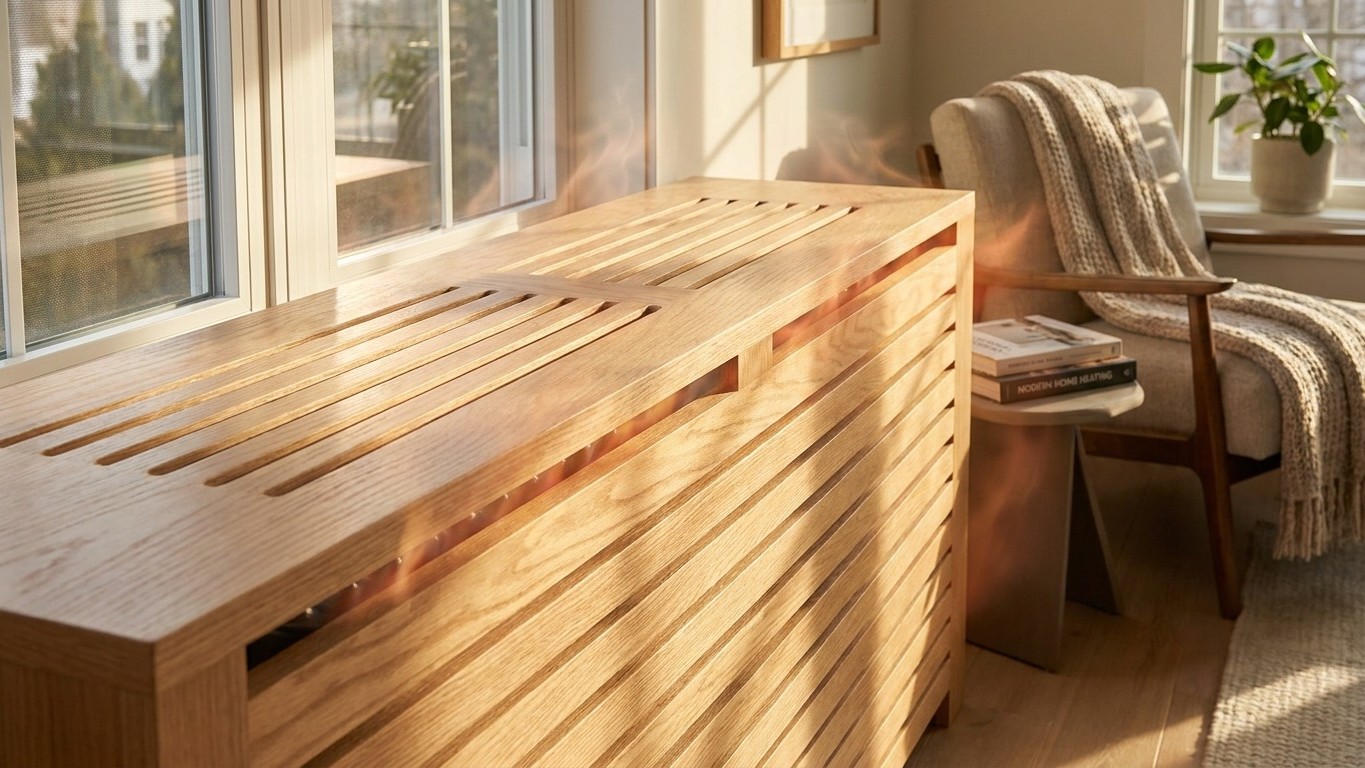

A radiator cover changes how a room feels warm, not how much heat the boiler sends into the room. Whether that trade-off costs you anything in comfort depends on one thing: whether air can still move through the cover freely. A well-vented cover barely dents output. A tight, solid box can drop it enough that you notice the room never quite gets there, and the thermostat head buried inside makes the problem worse before you even find out why.
What a cover does to the heat
Start with what’s actually inside that metal or wood box. A radiator is not a heating system on its own, it’s the part of the loop the boiler pushes heat into, either as steam or as hot water, and every fault that shows up in this room traces back to that loop, not to the metal panel itself. That distinction matters again later, so hold onto it: a steam radiator and a hot-water radiator behave differently once you start closing them in, and one of them has no bleed key at all.
A radiator heats a room two ways at once. Roughly half its output radiates directly, as infrared, to whatever surfaces it can “see”: your legs under the desk, the wall across the room, you standing near it. The other half works by convection, pulling cool air in at the bottom, warming it against the fins or the panel, and pushing that warmed air back out the top in a steady rising current. Cut off either mechanism and the room feels the difference.
A cover blocks the radiant half almost entirely. Whatever panel or slats sit between you and the radiator, that surface becomes the thing radiating to the room, not the hot metal behind it, and a cover panel never gets as hot as the radiator it’s hiding. That loss is basically fixed, whatever the cover is made of.
The convective half is where the design of the cover decides everything. An enclosure that’s open across the top and has real clearance at the bottom acts almost like a chimney: cool air draws in low, rises past the warm radiator, and exits through the top opening, often faster than it would with no cover at all, since the shape can concentrate the draft. Close either end, or shrink it down to a few slots, and that convective loop chokes. The air sits inside the box, warms slightly, and stalls, and the room reads that as a radiator that’s underperforming, because it is.
The building-science explanation for why radiant and convective transfer behave this differently is laid out by the U.S. Department of Energy in its overview of radiant heating, which is worth a look if you want the physics rather than the shorthand.
So the honest version isn’t “covers are bad” or “covers are fine.” A cover with generous top and bottom openings costs you the radiant contribution and not much else. A solid cover, or one with a narrow decorative grille standing in for real ventilation, costs you both, and that’s usually the one someone bought because it looked like furniture.
What separates a good cover from a bad one
Most covers on the market, and most people building their own, get judged on how they look in the room. The five things that actually determine how much heat gets through are dimensions and gaps, none of which show up in a product photo. Check these against a cover before you buy it, or before you finish building one.
| Feature | What it does | What to look for |
|---|---|---|
| Top opening | Lets the convective current escape; this is the exhaust for the warm air rising off the radiator | An opening running most of the width of the cover, not a narrow slot or a solid lid with a few punched holes |
| Bottom clearance | Feeds cool air in at floor level so the convective loop can start; without it, the cover has no intake | A real gap between the bottom of the cover and the floor, running the full width, not just corner cutouts |
| Front openness | Determines how much of the radiant heat still reaches the room through the front face | Expanded metal mesh, wide louvers, or slatted grilles beat solid panels or fine decorative perforations every time |
| Depth in front of the radiator | Affects how much the enclosed air can circulate before it has to exit; a cramped box traps heat close to the radiator | Enough clearance between the radiator face and the cover front that air isn’t compressed into a thin layer |
| Contact with the radiator | Any point where the cover touches the radiator becomes a conduction path and a rattle point, and it blocks airflow at that spot | Cover stands clear on its own frame or legs, never resting against the radiator itself |
None of these require a technical background to check. Stand in front of the cover, or the radiator it’s supposed to fit, and look for daylight at the top, daylight at the bottom, and enough open front that you can feel warm air moving through it once the system’s running. If a cover fails two or more of these, expect the room to run cooler than it did without it, regardless of what the listing promises.
Depth matters more than people expect, especially with covers built to double as shelving or a window seat. The deeper the box in front of the radiator, the more that trapped layer of air has to travel before it reaches the top opening, and the longer it sits there absorbing heat that should be radiating into the room. A shallow, open frame beats a deep, finished cabinet almost every time on performance, even if the cabinet looks nicer.
The head behind the cover
This is the part that catches people in January, and it has nothing to do with output. It’s about where the radiator’s control senses temperature.
Most radiators with a thermostatic radiator valve have the sensing element built into the valve head itself, sitting right at the radiator, reading the air immediately around it. That’s the design assumption: the air next to the radiator tracks the room closely enough to control it. Enclose that radiator in a cover, and the assumption breaks. The valve head is now sealed inside a box with its own trapped, slow-moving air, and that air heats up well before the rest of the room does, simply because it’s a few inches from a hot radiator with nowhere fast to go.
The valve reads that pocket of warm air, decides the room has reached its target, and closes the flow of hot water into the radiator, sometimes within minutes of the system firing. The room itself never got there. It’s still cold, the radiator behind the cover is barely warm to the touch, and the thermostat on the wall across the room is reporting a temperature the valve never saw. Every part of the system is doing exactly what it’s designed to do, and the result is a cold room with a radiator that seems to have stopped working.
This isn’t a hot-water-only problem, but it does depend entirely on having a thermostatic valve on that radiator, which steam systems typically don’t use in the same way, so check which family you’re dealing with, hot water or steam, before assuming this applies to yours. If it’s hot water with a TRV, the fix isn’t removing the cover. It’s moving the sensor. A remote sensor head separates the temperature-sensing bulb from the valve body on a length of capillary tubing, so you mount the sensor on the wall or elsewhere in the room, away from the trapped air, while the valve itself stays at the radiator controlling flow. Some setups instead move control to a separate wall thermostat wired to a valve actuator, which does the same job electronically. Either way, the goal is the same: get the sensing point out of the box. For more on how these valves are supposed to work and what options exist for relocating the sensor, see our guide to thermostatic radiator valves.
If you build one
Building a cover yourself, or having one custom-made to fit an odd-shaped radiator, gives you control over exactly the dimensions that matter, which is more than you get from most off-the-shelf options. The physics from the earlier sections translate into five practical rules.
- Keep the top open across its full width. A narrow vent or a few cutouts is not the same as a continuous opening, and it’s the single biggest factor in whether convection keeps working.
- Leave the bottom clear down to the floor. This is the intake side of the loop; starve it and the top opening has nothing to draw from.
- Make the front as open as the design allows. Mesh, wide slats, or louvers all beat a solid panel, and every bit of open front recovers some of the radiant heat a cover otherwise blocks entirely.
- Keep the frame off the radiator itself. Any contact point becomes a conduction path, a rattle, and a spot where airflow stalls.
- Make it removable, or hinged, or otherwise easy to lift away entirely.
That last point is the one people skip, and it’s the one that turns a cover from a design choice into a long-term maintenance problem. A hot-water radiator needs to be bled occasionally to clear air that collects at the top and blocks circulation, using the bleed key on the valve; a steam radiator has no bleed key and should never be opened the way a hot-water one is, since it’s venting air through a separate air valve rather than trapping water. Either type needs its fins or panel cleared of dust periodically, since a coated radiator convects less efficiently the same way a covered one does. A cover permanently screwed to the wall or built as one fixed piece makes both of those routine jobs into a small demolition project, and most people just stop doing them. Build it, or buy it, so it lifts off in one motion.
Common questions
Do radiator covers reduce heat output?
They cut the radiant portion of the output almost always, since the cover panel itself becomes the visible warm surface instead of the radiator. Whether they also cut the convective portion depends entirely on whether the top and bottom are open enough for air to circulate freely.
Can a cover make a room colder even if the radiator is working?
Yes, most often because a thermostatic valve head sealed inside the cover is sensing trapped warm air rather than the room, and shutting off the radiator early. The radiator can be functioning correctly and the room still won’t reach temperature.
Is it safe to put a cover on a steam radiator?
The airflow rules are the same, but steam radiators vent through a separate air valve rather than a bleed key, and that valve needs to stay accessible and unobstructed by the cover, the same way a hot-water bleed point does.
What if the radiator is under an old painted windowsill or in a period home?
Don’t assume the old paint on the radiator, the sill, or the surrounding trim is lead-free. In a home built before the 1980s, have it tested before sanding, cutting, or otherwise disturbing it to fit a cover.