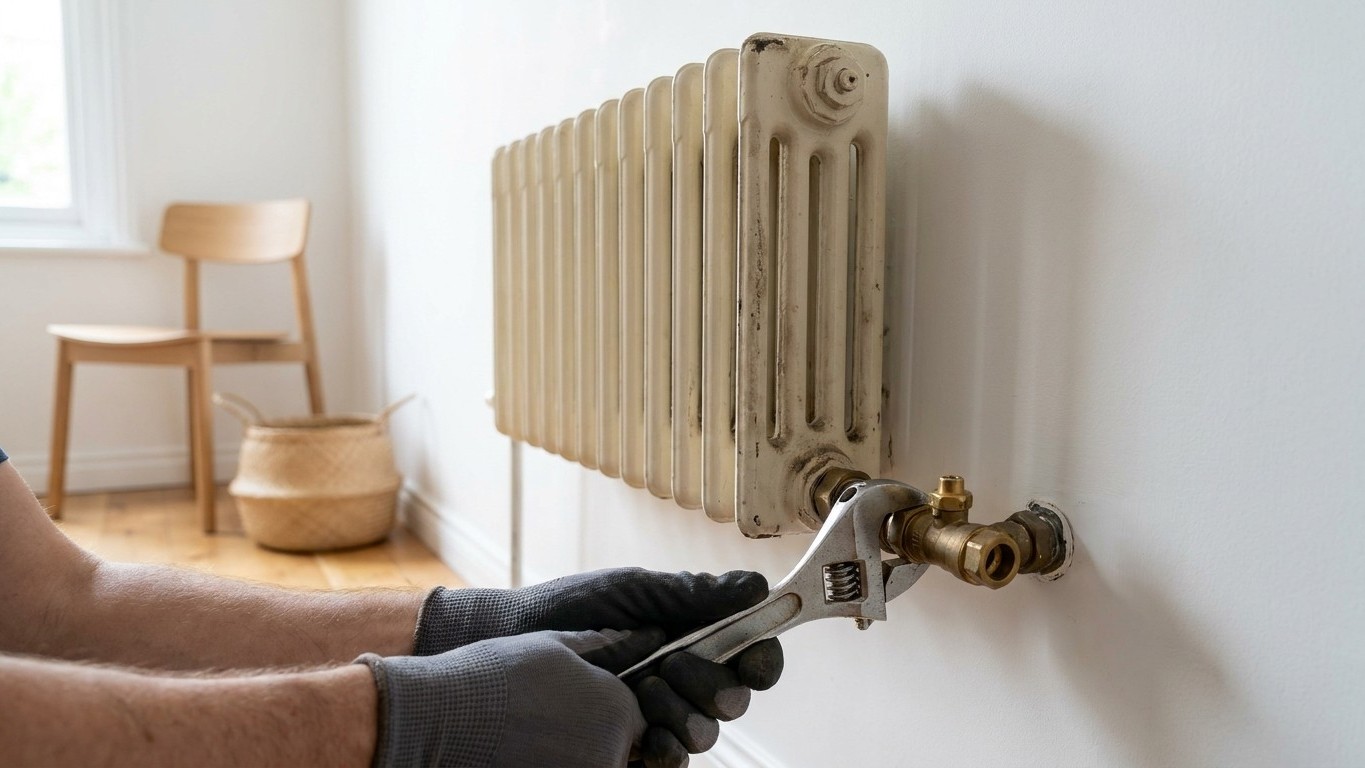

Replacing a radiator means taking it off the system it belongs to, not just unbolting it from the wall. The job runs isolate, drain or seal off the valves, disconnect the unions with the radiator supported, lift the old one out, fit the new one on the same connections, refill, and bleed. What changes the difficulty is the system behind it: whether it runs on steam or hot water, whether it can be isolated at the radiator alone, and whether the replacement matches the original in size and position.
Which system, and what that changes
A radiator is not a heating system. It is the object in the room that a boiler pushes heat into, either as steam or as hot water, and every fault that shows up at the radiator is usually a fault of that loop, not of the cast iron or steel panel itself. Surveyors and technicians file it under one category for a reason: “steam or hot water system.” That distinction has to be settled before any instruction gets followed, because a steam radiator has no bleed key and must never be opened up the way a hot-water one is.
On a hot-water system, the radiator sits on a pumped loop under pressure. Water is pushed through by a circulator pump, and the radiator is simply a stop along that loop, isolated by two valves, one on each end. Draining is local, refilling is local, and the physics are forgiving: air gets trapped at the top and is released with a bleed key, water pressure is topped up at the boiler, and the job stays contained to that one room.
Steam heat works on a different logic entirely. There is no pump. Steam rises through the pipe, fills the radiator, gives up its heat, and condenses back into water that has to drain back out through the very same pipe it came in on. That only works if the radiator is pitched at a slight angle, tilted back toward the supply valve, so gravity pulls the condensate home. Get that slope wrong on reinstall, even by a small amount, and water pools inside the radiator instead of draining. The result is banging and hammering in the pipes as trapped steam collapses against standing water, and it is the single most common way this particular job goes wrong. It is not a cosmetic detail to fix later. It is the difference between a radiator that heats quietly and one that knocks every time the heat cycles on.
Why this comes first
Every step downstream, how the radiator is isolated, whether it needs a bleed valve at all, how it has to sit when it goes back in, depends on which of these two systems is behind the wall. A homeowner who treats a steam radiator like a hot-water one, or vice versa, is set up to redo the job.
Like for like, or something different
Before any tool comes out, there is a decision to make: replace exactly what was there, or change something about it. Each option carries a different set of checks, and skipping them is how a homeowner ends up with a radiator that looks fine and heats the room poorly.
| Option | What has to be checked |
|---|---|
| Same size and type | Pipe centers still line up; valve type and thread match; floor and wall surface are undamaged underneath |
| Modern panel radiator replacing a period unit | Output for the room, not just physical fit; pipe centers on a panel radiator are usually different from a cast-iron one and may need adapting |
| Different position, moved under a window | New pipe run required; floor or wall opened up; whether the move crosses a joist or a finished floor |
| Removing an emitter altogether | Whether the loop can be capped and balanced without that radiator, and what happens to heat distribution in the rest of the room and the rooms around it |
The one that gets skipped most often is output. A radiator that is smaller, a different shape, or a different material than the one it replaces may simply not push out enough heat to keep that room comfortable in January, even if it fits the same footprint and connects to the same pipes. “It looks about the same” is not a check. Matching output to the room is a question that needs an actual answer, and that answer comes from whoever is doing the installation running the numbers for that specific room, not from eyeballing the old unit against the new one in a showroom or online listing.
Moving a radiator under a window, a common request in older homes being renovated, sounds simple until the pipe run is factored in. New pipework has to travel from the existing supply point to the new location, which usually means opening a section of floor or wall that was otherwise untouched. That is a different job than a straight swap, and it should be scoped as one before a contractor gives a number for it.
Removing a radiator entirely, rather than replacing it, changes the balance of the whole loop. Every radiator on a system is part of how heat gets distributed, and pulling one out without capping and rebalancing properly can leave neighboring rooms running hotter or colder than they did before. This is a system decision, not a single-room one, and it is worth raising directly with whoever services the boiler.
The sequence
Once the system type is confirmed and the decision on like-for-like versus different is made, the physical job follows a fixed order. Here is what it looks like from start to finish:
- Isolate the radiator, on a hot-water system that means closing both valves; on a system that cannot be isolated locally, the loop has to be drained instead. Let it cool fully before touching anything.
- Drain the radiator down, either to a point below it using the valves, or via the system’s drain point if local isolation is not possible.
- Protect the floor and surrounding surfaces. A drained radiator still holds residual water, and old fittings can weep once disturbed.
- Break the unions at each end while the radiator is fully supported, not hanging on the pipework. This is where most old, corroded fittings resist and need steady, controlled force rather than a sharp pull.
- Lift the radiator clear. A cast-iron radiator, even drained, is heavier than it looks and holds residual water in its internal channels, this step takes two people, not one, and rushing it is a genuine lifting hazard.
- Fit the new radiator onto the same connections, checking alignment and, on a steam system, the correct pitch back toward the supply valve before anything is tightened down.
- Reconnect the unions, refill the system, and bleed the radiator, on hot-water systems, to clear trapped air. Steam radiators are not bled the same way and should be handled according to that system’s own venting, not a hot-water routine.
There is a clear point where a homeowner should stop and call in a licensed professional: anything that involves soldering joints, altering the pipework itself, or a system that cannot be isolated at the radiator and requires draining down further into the loop. Those tasks carry risk to the rest of the heating system, and a mistake there affects more than one room.
What makes this job expensive or cheap
Nothing in this job has a fixed price, and anyone quoting a flat number before seeing the radiator and the system behind it is guessing. What can be said honestly is what drives the cost up or down, and those are the questions worth asking before getting a quote.
Access is the first driver. A radiator with valves that isolate cleanly and a straightforward union connection is a different job from one where the whole system has to be drained because there is no local shutoff. Reusability of the existing valves matters too, valves in working order that thread onto the new radiator save both time and a parts cost; valves that are seized or the wrong type add a step.
Pipe centers, the distance between the two connection points, decide whether the new radiator bolts straight on or whether an adapter or a section of new pipe is needed to bridge a mismatch. This comes up constantly when a period cast-iron radiator is being swapped for a modern panel type, since the spacing conventions are rarely the same.
Floor work is the other major swing factor. A radiator staying in its original position, on its original pipes, involves no floor disturbance at all. A radiator moving location, or a floor that has to come up to reach corroded pipework underneath, is a materially bigger job with more labor and more materials, regardless of the radiator itself.
Finally, scope matters, whether this is one radiator being replaced in isolation or part of a wider system change touching several rooms. A single swap and a whole-house radiator replacement are not the same project even if each individual radiator install looks similar. A written quote, based on someone actually looking at the system, is what settles the real number. Asking about access, valve condition, pipe centers, and floor work upfront is how that quote comes back accurate rather than revised halfway through the job.
Common questions
Can I replace a radiator myself without draining the whole system?
Yes, if the radiator has its own isolating valves at both ends, allowing it to be sealed off and drained locally. If it does not, the loop has to be drained further back, which is a bigger job and usually one to hand to a professional.
Does a steam radiator need to be bled like a hot-water one?
No. Steam radiators don’t have a bleed key and shouldn’t be opened the same way a hot-water radiator is. Air venting on a steam system works through a different mechanism built into the radiator or the line, and treating it like a hot-water unit is a common and avoidable mistake.
Will a smaller replacement radiator heat the room as well as the old one?
Not necessarily. Physical fit and heat output are two separate questions, and a radiator that fits the same wall space may not match the old unit’s output. That calculation needs to be done for the specific room by whoever is installing it.
Is a banging radiator after replacement a sign something was done wrong?
On a steam system, yes, most often it means the radiator isn’t pitched correctly back toward the supply valve, so condensate isn’t draining as it should. Rechecking the slope usually resolves it.