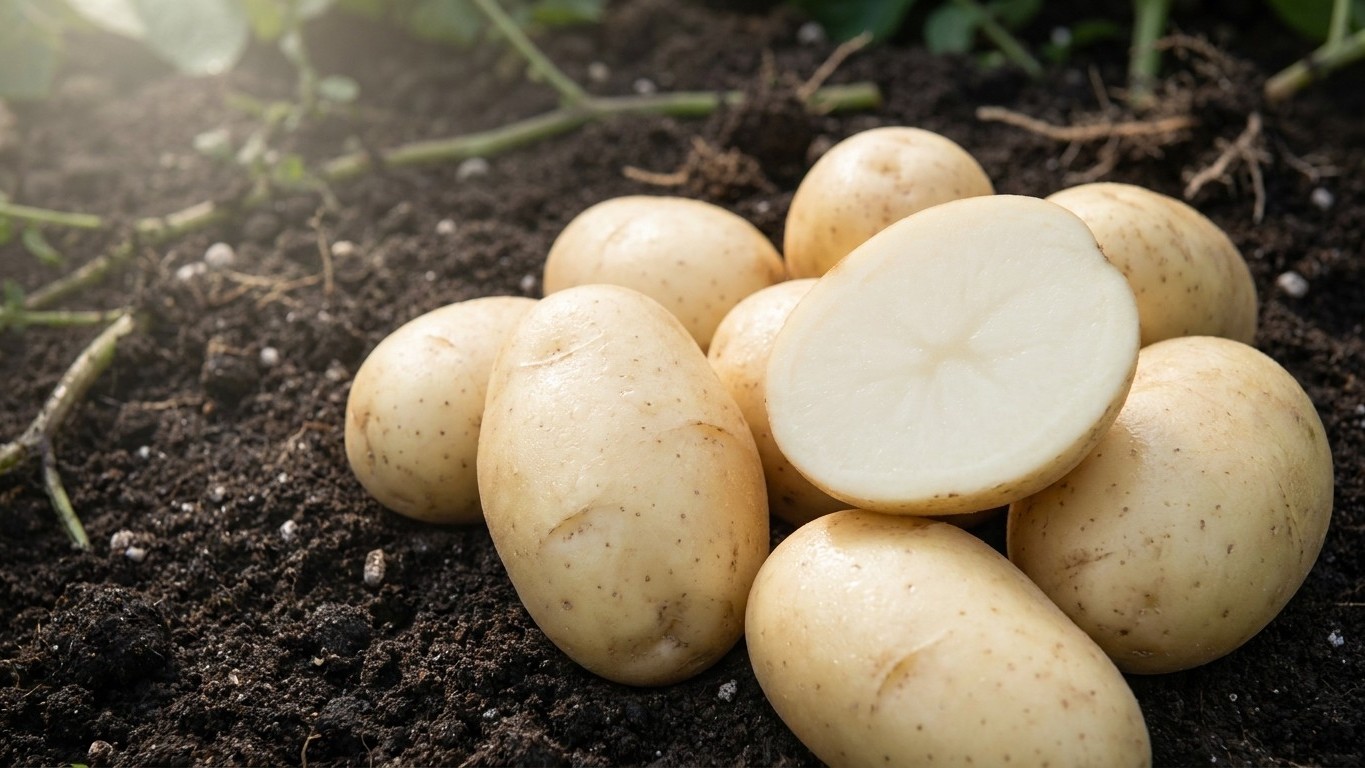

The Kennebec potato carries white skin over white flesh, and University of Maine Cooperative Extension classes it as a mid-season variety. Its published kitchen use is dual: baking and boiling. No source lists a days-to-maturity figure for it, and no source calls its flesh waxy or floury, so neither term belongs in an honest description of this potato.
The short answer
Bulletin #2077 from the University of Maine Cooperative Extension, titled Growing Potatoes in the Home Garden and authored by Steven B. Johnson, is the reference document behind every fact in this article. It lists Kennebec with white skin and white flesh, a distinction worth pausing on because the two columns often diverge in the same table. Red Norland, for instance, shows red skin over white flesh in that same bulletin, so a gardener who identifies a variety by flesh color alone will misname half the potatoes in a seed catalogue. Skin is what a shopper or a grower recognizes at a glance, in the store bin or freshly dug from the row, so Kennebec is properly described as a white-skinned, white-fleshed potato rather than just “a white potato.”
The bulletin also places Kennebec in the mid-season class. That single word, season class, is the piece of information that actually plans a garden. It replaces the days-to-maturity number that a lot of gardeners look for and that neither Utah State University Extension nor the Maine bulletin publishes for this variety. Season class tells a grower roughly when in the year a variety is set up to fill tubers relative to spring planting and the arrival of summer heat, without pretending to a precision that the research does not support.
On use, the bulletin lists Kennebec for baking and boiling. That is a published fact, not a texture guess. It means the tuber is suited to the direct heat of an oven and to the wet heat of a pot, two very different cooking methods that a single variety can handle well. It does not mean the potato is best mashed, best fried, or best suited to any preparation not named in the source. Sticking to what is published, rather than translating it into kitchen slang like waxy or floury, keeps the description accurate and keeps it useful for someone deciding what to plant based on how they actually cook.
Where it suits, and where it does not
Season class only matters because of a hard physiological limit: Utah State University Extension notes that tuber set and tuber fill stop once soil temperature climbs above 90 degrees Fahrenheit. Below that ceiling, a potato plant keeps building the starchy tubers a gardener is after. Above it, the plant may look green and healthy above ground while doing almost nothing useful below it. That single number is the real geography of potato growing in the United States, more than any hardiness zone map.
An early variety is built to race against that ceiling. It sets and fills tubers fast, so a grower in a region where summer soil temperatures blow past 90 degrees by midsummer can still get a harvest by digging before the heat shuts things down. A late variety works the opposite way: it needs a long stretch of soil that stays under that ceiling, which suits regions with cool, extended growing seasons and works poorly where summer arrives early and hard.
Kennebec sits in between, as a mid-season variety. That places it with growers who have a season long enough to avoid rushing, but who still can’t count on soil staying below 90 degrees Fahrenheit all summer long the way a far-northern or high-elevation garden might. The table below lays out how the three season classes relate to that ceiling, in general terms drawn from the same USU Extension threshold.
| Season class | Relationship to the 90°F soil ceiling | Suits |
|---|---|---|
| Early | Sets and fills tubers before soil regularly crosses the ceiling | Regions with a short cool window before summer heat arrives |
| Mid-season (Kennebec) | Needs a moderate stretch of soil under the ceiling, not the shortest window but not the longest either | Regions with a solid spring-into-early-summer growing stretch before peak heat sets in |
| Late | Requires soil to stay under the ceiling for an extended period | Cool, long-season regions where summer soil temperatures rarely spike |
A gardener weighing whether Kennebec fits their yard should think less about a calendar date and more about how long their soil realistically stays under that 90-degree mark. Where summers turn hot and dry early, a mid-season variety can still work if it goes in the ground early enough to bank most of its growth before the heat arrives, but it has less margin than an early type planted in the same spot.
In the kitchen
Baking and boiling, the two uses the University of Maine bulletin publishes for Kennebec, describe two different jobs at the stove, and the fact that one variety covers both is worth taking at face value rather than dressing up with texture language the source never used.
Baking means dry, direct heat, typically an oven set well above 350 degrees Fahrenheit, with the tuber left whole in its skin. A cook reaching for a baking potato wants something that holds its shape through a long, dry cook and delivers a tender interior once split open at the table. That is the job Kennebec is published to do.
Boiling asks something different: full submersion in water, at a rolling simmer, until a fork slides in easily. A potato bound for boiling often ends up in potato salad, in a pot destined for mashing, or simply served whole alongside a roast. The bulletin’s listing of Kennebec for boiling means the variety holds up through that wet-heat process without the source making any claim about how it falls apart or holds together once mashed, since that detail isn’t part of the published record.
What a home cook can reasonably take from this dual listing is flexibility. A pantry stocked with Kennebec doesn’t need a second variety on hand for one method and a different one for the other. That’s a practical point for anyone planning a garden around what they’ll actually cook, not around a flavor or texture claim dressed up as fact. If a recipe calls specifically for a variety known for a particular starch behavior under high heat, or one suited to frying, that’s a different question altogether, and one this bulletin simply doesn’t answer for Kennebec. The honest answer is: baking, boiling, both documented, nothing more claimed.
Growing it
Growing a mid-season variety like Kennebec follows the same broad sequence as any potato crop, but timing each stage against that 90-degree soil ceiling from Utah State University Extension is what makes the difference between a full harvest and a disappointing one.
- Plant as soon as soil can be worked in spring. A mid-season variety needs a solid run of cool-to-moderate soil before summer heat arrives, so pushing planting earlier rather than later widens the window before the ceiling becomes a factor.
- Set seed pieces at a consistent depth, cut side down, in soil that has been loosened well below where the tubers will form. Shallow, compacted planting beds shorten the useful root zone right when the plant needs room to expand.
- Hill soil around the stems as the plant grows, building a mound that keeps developing tubers covered and shaded. Hilling also helps moderate soil temperature near the tubers, which matters directly given how tuber fill responds to heat.
- Water consistently through the mid-season stretch, since even soil that’s below the temperature ceiling can still stress a plant if it dries out during the exact weeks tubers are filling.
- Watch soil warmth as summer advances. Because Kennebec sits in the mid-season class rather than the early one, it doesn’t have the same built-in head start against rising heat, so a grower in a warmer region benefits from tracking soil conditions rather than assuming the calendar alone will protect the crop.
- Lift the crop once vines begin to yellow and die back, the visible sign that tuber growth has finished for the season. Digging before that point on a mid-season variety risks pulling tubers that haven’t finished filling out.
None of this replaces a days-to-maturity countdown, because neither university source publishes one for Kennebec. Watching the season class against soil conditions, rather than a date on a seed packet, is the method both extensions actually support.
Common questions
Is Kennebec a waxy or floury potato?
Neither term appears in the University of Maine bulletin or the Utah State University Extension material used here. What is published is its use for baking and boiling, and that’s the accurate way to describe it.
How many days does Kennebec take to mature?
No specific number is published by either source. What is published instead is its season class, mid-season, which describes its general timing relative to soil conditions rather than a fixed day count.
What color is Kennebec potato flesh and skin?
Both are white, according to University of Maine Bulletin #2077. That’s worth stating clearly since flesh and skin color are separate traits that don’t always match in other varieties.
Can Kennebec grow in a hot summer climate?
It can, provided enough of the season stays under the 90 degree Fahrenheit soil threshold identified by Utah State University Extension for tuber set and fill. As a mid-season variety, it has less margin against late-arriving heat than an early variety would, so timing planting early in the spring matters more.