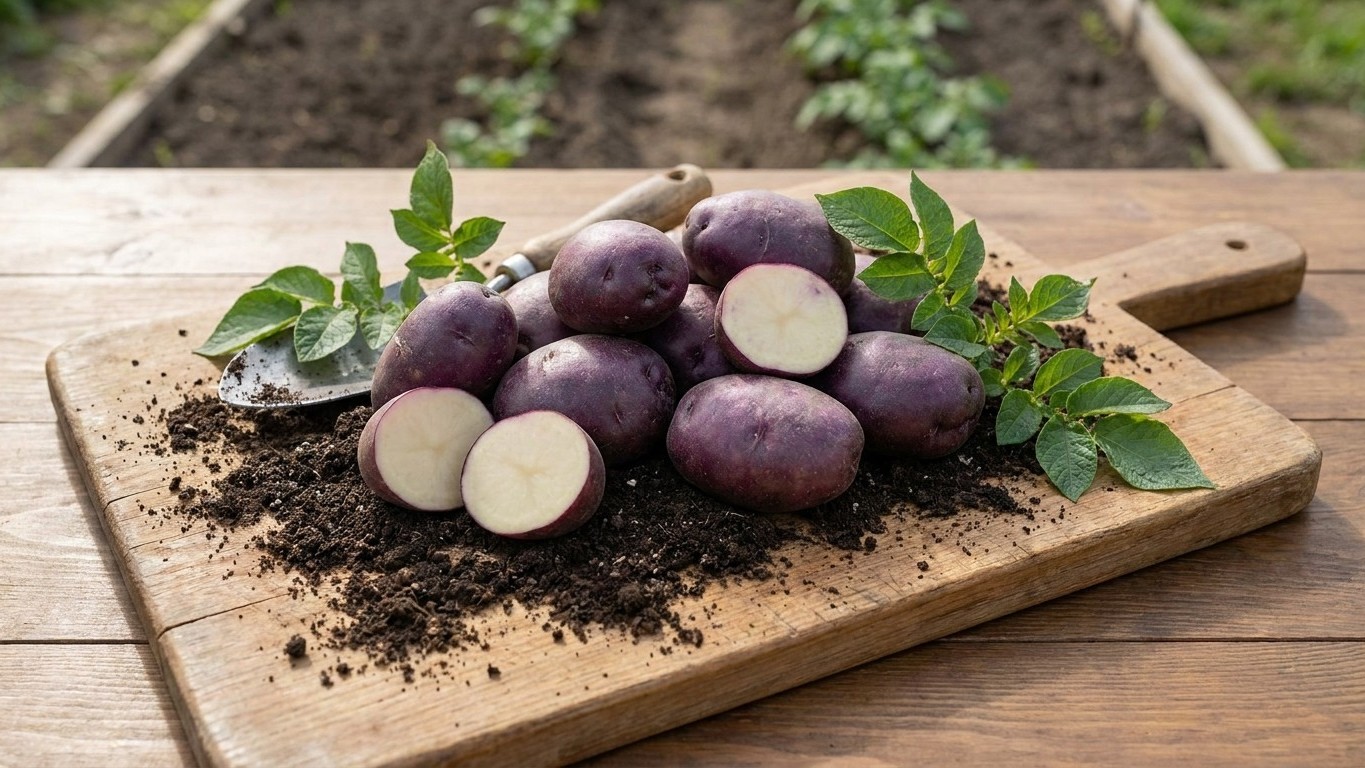

Caribe is a purple-skinned potato classified as a mid-season variety, grown for baking and boiling, according to University of Maine Cooperative Extension Bulletin #2077. The bulletin does not publish a flesh color for this variety, so any claim about a specific interior shade goes beyond what the source actually states. What it does confirm is the skin, the season class, and the kitchen use.
The short answer
Bulletin #2077, compiled by Steven B. Johnson for the University of Maine Cooperative Extension, lists Caribe with a purple skin and a mid-season classification. That single line matters more than it looks. Skin color is how most gardeners actually identify a variety in the field, at the market, or in a seed catalog photo, and purple is a distinctive enough shade that it separates Caribe from the more common red- or white-skinned varieties sold under similar names.
What the bulletin does not do is assign a flesh color to this entry. Skin and flesh are two separate columns in the source table, and they frequently disagree with each other across varieties. Red Norland, for example, carries red skin over white flesh in that same table. Because Caribe’s flesh column is blank in the published data, describing its interior color as anything specific, pale, yellow, or otherwise, would be inventing a fact the university never measured or at least never printed. The honest answer is that flesh color for Caribe is not published.
The season class is the other half of the identity. Mid-season sits between the quick-maturing early types and the long-season late varieties. That placement is not a minor footnote. It tells a gardener roughly how much of the growing calendar this crop needs relative to other potatoes, without pinning down an exact day count, because neither Bulletin #2077 nor Utah State University Extension publishes a specific number of days to maturity for any variety. Season class is the tool both institutions actually give growers to plan around.
On the kitchen side, the bulletin lists Caribe’s use as baking and boiling. That is a dual-purpose designation, not a texture claim. The source never uses the words waxy or floury for this variety, and repeating those terms here would be putting language in the university’s mouth that it never used. What can be said, reliably, is that this potato is grown with the stove in mind for two specific cooking methods, and the rest of this article works from that fact rather than around it.
Where it suits, and where it does not
Season class only becomes useful once it is measured against something. Utah State University Extension notes that tuber set and tuber fill both stop once soil temperatures climb above 90 F. That threshold is the real geography of potato growing in the United States, more than hardiness zones or frost maps. An early variety can be planted, grown, and dug before the hottest weeks of summer push soil temperatures past that ceiling. A late variety needs the opposite: a long stretch of the season that never gets there, or a climate where soil simply doesn’t heat up that far to begin with.
A mid-season variety like Caribe sits between those two demands. It needs more time in the ground than an early type, but it does not require the extended, cool-running season that a late variety depends on. That makes it a workable choice across a wider range of the country than either extreme, but it also means it is more exposed to a hot midsummer than an early variety would be. Gardeners in regions where soil temperatures reliably stay under that 90 F mark through most of the growing season, the northern tier of states, higher elevations, and areas with a long, moderate spring, give a mid-season variety room to finish its job without the crop stalling out from heat stress underground.
Where the picture gets harder is in regions with an early, sharp heat spike, the kind seen across much of the southern and southwestern United States. There, soil temperatures can cross that 90 F threshold well before a mid-season crop has finished bulking up its tubers, and tuber set and fill simply stop while the plant sits in ground too warm to keep working. In those climates, an early variety dug ahead of peak heat, or a fall crop planted to mature in cooler weather, does the job a mid-season variety cannot.
| Season class | Time to dig relative to summer heat | Best fit |
|---|---|---|
| Early | Before peak summer heat arrives | Short seasons, regions with an early hot spell |
| Mid (Caribe) | Needs a season that stays under the 90 F soil ceiling most of the way through | Northern states, cooler summers, moderate elevations |
| Late | Needs the longest stretch under that ceiling | Cool, long-season climates |
None of this replaces a soil thermometer and a look at the local climate record. But the season class printed on the seed tag or in the extension bulletin is the shorthand that tells a gardener, before a single seed potato goes in the ground, whether the local summer is likely to cooperate.
In the kitchen
Bulletin #2077 lists Caribe’s use as baking and boiling, which puts it in the flexible middle of the potato world rather than at either extreme. A cook reaching for it to bake does not need to do anything unusual: scrub the skin, prick it, and roast it whole in a hot oven the way any baking potato gets treated, letting the purple skin crisp while the inside cooks through. Because flesh color is not published for this variety, there’s no way to say in advance exactly what that interior will look like once it’s cut open, only that the university lists baking as one of its intended uses.
Boiling is the other listed use, and that covers a wider range of everyday cooking than the word suggests. Cubed and boiled for a potato salad, simmered whole for mashing, or added to a pot of soup or stew, this is where a dual-purpose variety earns its keep in a kitchen that doesn’t want to stock two different bags of potatoes for two different dishes. A gardener who grows Caribe is not committing to one narrow use the way they would with a variety listed for chipping or fries only.
What matters here is sticking to what the source actually says rather than translating it into texture language the bulletin never uses. Waxy and floury are common terms in cooking writing, and they usually track with starch content, but Bulletin #2077 does not assign either term to Caribe. Saying it is waxy or floury would be a guess dressed up as a fact. Saying it is used for baking and boiling is simply repeating what the extension service published, and that distinction is the difference between quoting a source and inventing on top of it.
Practically, that means a cook can treat Caribe as a general, all-purpose kitchen potato: reliable in the oven, reliable in the pot, without needing to match it to one specialty dish the way a single-use variety would demand.
Growing it
Growing a mid-season variety follows the same broad sequence as any potato crop, but the timing at each step needs to respect that 90 F soil ceiling rather than race against it the way an early variety’s schedule does.
- Plant once soil has warmed but well ahead of peak summer heat. Seed potatoes go into soil that has warmed enough to sprout reliably, but the planting date should still leave a full mid-length season of growth before soil temperatures are expected to climb toward that 90 F mark.
- Hill the plants as stems grow. Mounding soil around the base of the plants as they reach several inches tall covers developing tubers, keeps them from greening in sunlight, and gives the crop the loose, cool root zone it needs while the season’s heat is still building.
- Keep the soil consistently moist through tuber set and fill. This is the stretch of the season where the 90 F threshold matters most, since heat stress and inconsistent watering both interfere with tuber development at the same time.
- Watch soil temperature as summer peaks, not just the calendar. A mid-season crop needs more time in the ground than an early variety, so the grower’s job is to track whether the local soil is staying under that ceiling long enough for the crop to finish, not simply to count weeks since planting.
- Lift the crop once the foliage has died back. As with most potato varieties, the visible sign that tubers have finished sizing is the plant’s own foliage yellowing and collapsing, at which point digging can begin.
Because neither Utah State University Extension nor University of Maine’s Bulletin #2077 publishes a specific days-to-maturity figure for Caribe, there’s no shortcut number to circle on a calendar. The season class is the tool the sources actually give, and it works best paired with a soil thermometer and a realistic read on when the local summer tends to turn hot.
Common questions
Is Caribe a waxy or floury potato?
Neither term is published for this variety. University of Maine Bulletin #2077 lists its use as baking and boiling, not a texture category, so describing it as waxy or floury would go beyond what the source actually states.
What color is Caribe potato flesh?
Not published. The bulletin lists a purple skin for this variety but leaves the flesh color column blank, and skin and flesh are tracked separately in that source, so one cannot be assumed from the other.
How many days does Caribe take to mature?
No specific number is published by either Utah State University Extension or University of Maine’s Bulletin #2077. What is published is a mid-season classification, which describes its relative place in the growing calendar rather than an exact day count.
Can Caribe be grown in a hot climate?
It depends on how long soil stays under the 90 F threshold that Utah State University Extension identifies as the point where tuber set and fill stop. As a mid-season variety, Caribe needs a longer stretch under that ceiling than an early variety would, which makes it a better fit for regions with a moderate, longer-running summer than for areas with an early, sharp heat spike.