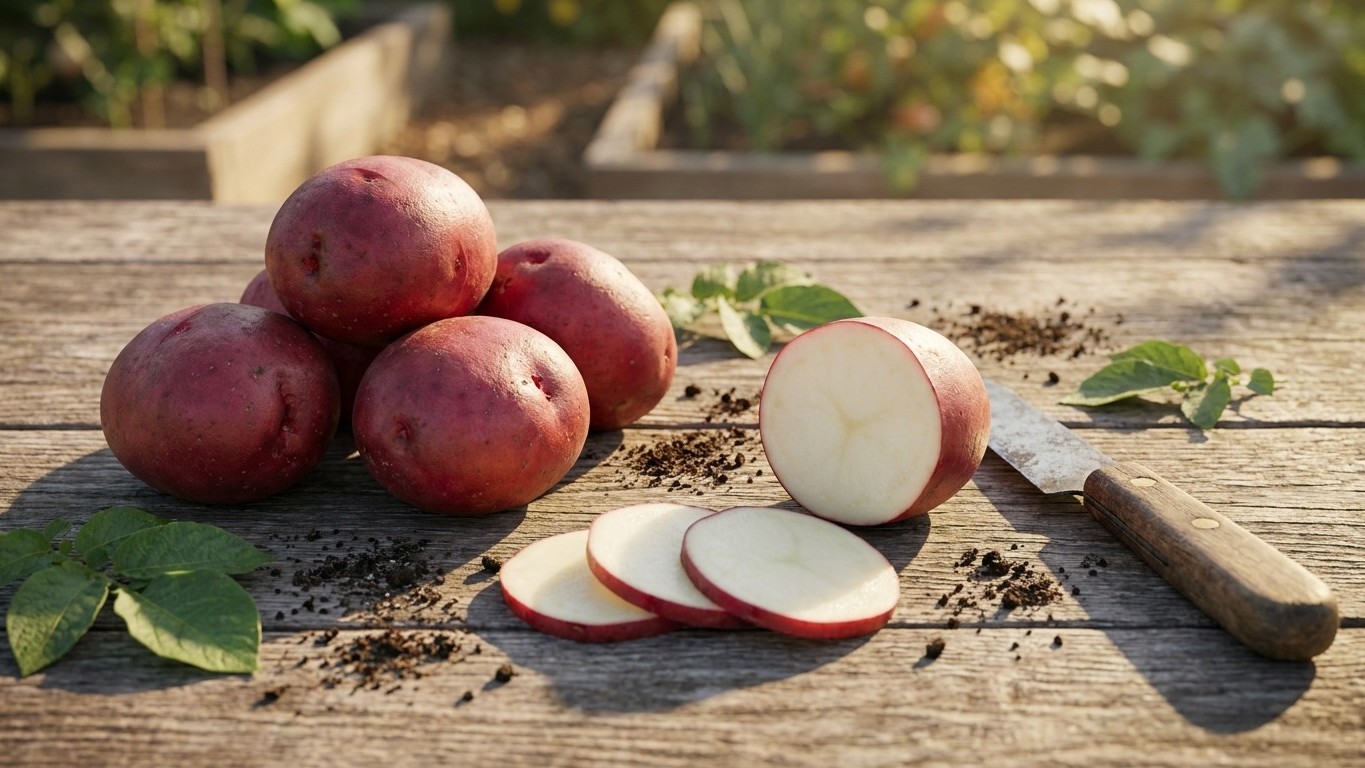

Red Norland is a mid-season potato with red skin and white flesh, and the University of Maine’s Cooperative Extension lists its kitchen use as boiling. That’s the published record. No source here gives a days-to-maturity number, and none calls the flesh waxy or floury, so this page sticks to what’s actually on file.
The short answer
Start with the name, because a lot of confusion around this potato comes from mixing up two things that sound like they should match but don’t. The University of Maine Cooperative Extension, in Bulletin #2077, Growing Potatoes in the Home Garden, publishes four separate columns for each variety it covers: flesh color, skin color, season class, and kitchen use. For Red Norland, those four entries read white flesh, red skin, mid-season, and boiling.
That’s worth sitting with for a second, because the name of the potato tells you about the skin, not the inside. Cut a Red Norland open and you’ll find pale white flesh under that red jacket. Gardeners who expect a red interior because of the name are working from an assumption the bulletin doesn’t support. Skin and flesh are recorded separately because they genuinely can disagree, and here they do.
Season class is the second piece of the puzzle, and it’s the one that decides whether this variety even makes sense for a given garden. Mid-season sits between the early types that get dug in high summer and the late types that stay in the ground into fall. It’s a middle path, not a fast crop and not a storage marathon.
Kitchen use is the fourth column, and it’s the one home cooks actually care about at dinnertime. The bulletin lists Red Norland for boiling. That’s a specific, published recommendation, not a texture label. No university source used here describes this potato as waxy or as floury; those are kitchen-adjacent terms that get applied casually to varieties all the time, but they don’t appear in the extension literature this page draws from, so they don’t appear here either.
Put together, the short answer is this: a red-skinned, white-fleshed, mid-season potato that the University of Maine Cooperative Extension recommends for boiling. That’s four facts, sourced to one bulletin, and it’s the foundation everything else on this page builds from.
Where it suits, and where it does not
Season class isn’t a trivia detail. It’s the single number that determines whether a potato variety has any business in a particular garden, and the mechanism behind it is soil temperature, not calendar dates. Utah State University Extension documents that tuber set and tuber fill stop once soil temperatures climb above 90 F. That threshold is the real geography of potato growing in the United States, more than any hardiness zone map.
Here’s how that plays out across season classes. An early variety races through its life cycle and can be dug and harvested before the hottest stretch of summer ever pushes soil past that 90 F ceiling. A late variety does the opposite: it needs a season that stays cool enough, long enough, for tuber development to keep running without hitting that wall. Mid-season varieties sit in between, needing a season warm enough to get going but not so short that the plant runs out of time before the ceiling shuts tuber growth down.
Red Norland belongs to that middle category. It isn’t built for a garden where soil temperatures spike early and stay there through midsummer, the way they do in much of the Southwest and the Gulf Coast. In those regions, a mid-season variety risks having its tuber-filling window cut short right as it should be doing its most productive work. It also isn’t a variety suited to the very short, cool growing windows of the far north, where an early type would have a better shot at reaching harvest before frost closes things out.
Climates that fit the profile
The sweet spot for a mid-season variety is a growing region with a moderate length season, warm soil in spring and early summer, but without prolonged stretches where soil temperature sits above that 90 F mark for weeks on end. Much of the northern and mid-latitude United States fits that description reasonably well, particularly areas with cooler nights that keep soil temperatures from climbing as high as they do in low-elevation desert or deep-South growing regions.
Gardeners in hotter regions aren’t necessarily out of luck, but the mid-season timing means paying close attention to planting date, aiming to get the crop in the ground early enough that the bulk of tuber development happens before the hottest weeks arrive. That’s a scheduling problem, not a variety problem, and it’s the same math every mid-season potato has to solve wherever it’s grown.
In the kitchen
The University of Maine Cooperative Extension lists Red Norland’s kitchen use as boiling, and that single word carries more practical weight than it might seem to at first glance. It’s a direct answer to a question a lot of home cooks ask without realizing there’s a published answer waiting for them: what do I actually do with this potato once it’s out of the ground?
Boiling as a listed use points toward the kind of cooking where the potato goes into a pot of water, simmers until fork-tender, and comes out ready for the table with minimal fuss. Think potato salad, boiled new potatoes finished with butter, or chunks added straight into soups and stews where they need to hold together through a simmer without turning to mush or falling apart at the edges.
That’s different from a recommendation built around a dry-heat method like baking, which asks more of a potato’s structure over a longer, hotter cooking process. The bulletin doesn’t list baking as a use for this variety, so this page won’t suggest it as one either. What it does say, plainly, is boiling, and that’s the guidance worth following if the goal is matching the potato to its intended kitchen role rather than guessing.
None of this is a statement about texture in the technical sense some cooks use, the waxy-versus-floury language that shows up constantly in produce aisles and recipe blogs. That vocabulary isn’t part of the University of Maine’s published record for this variety, so it isn’t part of this answer. What’s actually documented is simpler and more useful in practice: this is a potato bred and evaluated with boiling in mind, and that’s the use a home cook can plan a meal around with confidence, straight from an extension bulletin rather than a guess.
For a household deciding what to plant based on how the harvest will actually get used at the stove, that’s a meaningful data point. A garden that leans heavily on potato salad, soups, and simple boiled sides has a documented match here. A kitchen built around baked potatoes as the primary use case is better served looking at a variety where baking is the listed recommendation.
Growing it
Mid-season timing shapes every stage of growing Red Norland, from the day seed potatoes go into the ground to the day the crop comes out. The steps below follow that mid-season logic in order.
- Plant once soil has warmed but before the hottest stretch of summer arrives. Because tuber set and fill stop above 90 F soil temperature, per Utah State University Extension, the planting window for a mid-season variety needs to give the crop enough runway to develop before that ceiling becomes a factor. Planting too late in a region prone to early summer heat shortens the productive window before it even starts.
- Space and cover seed pieces to encourage even emergence. Consistent planting depth and spacing help the crop come up together, which matters more for a mid-season variety than for an early type, since there’s less slack in the schedule to let stragglers catch up before soil temperatures climb.
- Hill soil around the stems as the plants grow. Hilling protects developing tubers from sun exposure, which causes greening, and it gives the plant more room underground for tubers to form and expand during the window when soil temperature is still favorable for growth.
- Watch soil temperature through the middle of the season. This is the mid-season checkpoint that matters most. If soil temperatures are trending toward that 90 F threshold, the crop is approaching the point where tuber development slows or stops, and timing the eventual harvest becomes a matter of watching the plants rather than counting days, since no days-to-maturity figure is published for this variety.
- Lift the crop once foliage begins dying back. Rather than working from a calendar count, mid-season varieties are typically harvested based on plant signals, foliage yellowing and dying down, which indicates the tubers below have finished bulking and are ready to come out of the ground.
That sequence, plant with the 90 F ceiling in mind, hill for protection and room, monitor soil temperature through the growing window, and harvest by plant signal rather than a fixed date, is the practical version of what “mid-season” means for a gardener standing in the dirt rather than reading a bulletin.
Common questions
Is Red Norland a red potato all the way through?
No. The University of Maine Cooperative Extension lists red skin and white flesh as two separate, published characteristics for this variety. The color in the name describes the skin, not the interior.
How many days does Red Norland take to mature?
Neither Utah State University Extension nor the University of Maine Cooperative Extension publishes a days-to-maturity figure for this variety. What is published, and what this page relies on, is its season class: mid-season.
Is Red Norland a waxy or floury potato?
Neither term appears in the university sources used here. What’s published instead is a kitchen use, boiling, which is a more specific and sourced recommendation than either texture label.
Can Red Norland be grown in a hot climate?
It can be attempted, but its mid-season timing means it needs enough of the growing period to fall before soil temperatures climb past 90 F, the threshold Utah State University Extension identifies for stopping tuber set and fill. In regions where that threshold arrives early and holds for weeks, a mid-season variety has less margin than an early one.