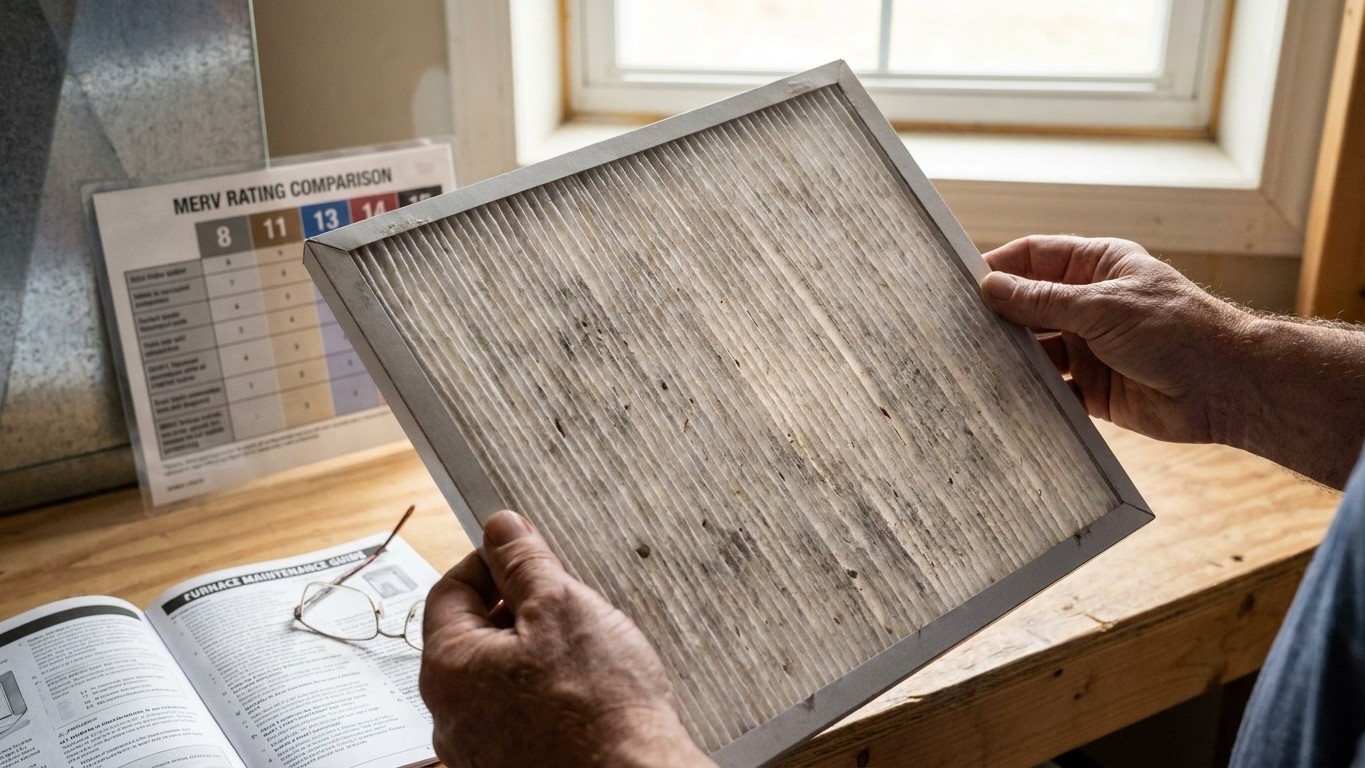

The right furnace filter isn’t the one with the highest MERV number you can find. It’s the one that matches the size and airflow capacity your specific furnace was built to handle. A filter rated for a hospital operating room can choke a residential blower motor design meant for a much lighter load. The manufacturer’s manual, not the filter aisle, is what actually answers this question.
The filter protects the furnace first

Most homeowners assume the filter’s job is to clean the air they breathe. That’s backwards. The filter sits in the return duct to keep dust, lint, and debris out of the blower motor and away from the heat exchanger. Those two components are expensive to replace and sensitive to buildup. A furnace that pulls in unfiltered air will accumulate grime on the blower wheel, throw off its balance, and eventually force the motor to work harder just to move the same volume of air.
Cleaner indoor air is a real benefit filtration provides, and for people with allergies or asthma it matters. But it’s a secondary function layered onto a system engineered around mechanical protection, not air purity. The furnace was designed around a specific static pressure, meaning a specific amount of resistance the blower motor can push against before it starts to strain. The filter is one part of that pressure equation.
This distinction changes how you should shop. If you pick a filter purely because the packaging promises to trap smaller particles, you’re optimizing for the wrong goal. You need something that also respects the pressure drop the equipment was built around. A filter that’s excellent at air quality but poorly matched to the furnace’s airflow design doesn’t protect the machine. It can quietly work against it, one heating cycle at a time.
Think of it less like buying an air purifier and more like buying an oil filter for a car. Nobody chooses an oil filter based solely on how fine the mesh is. They check what the engine was built to accept. The furnace filter works the same way. Filtration quality matters, but only within the range the equipment can tolerate without straining the motor or reducing the volume of air moving through the system. That range is set by the manufacturer, not by the filter box.
This is why two identical-looking homes with the same furnace can end up with very different maintenance histories. One owner replaces a manufacturer-recommended filter on schedule. The other keeps upgrading to denser filters chasing better air quality, without checking whether the blower can actually push enough air through them. The second furnace runs hotter, cycles more, and wears out components faster, even though nothing about the filtration itself was wrong on paper.
Why the densest filter can make things worse
Filter density and airflow resistance move together. A denser filter, meaning one built to trap smaller particles, has a tighter weave or more pleated surface area packed into the same frame. That tighter structure is exactly what makes it good at filtration. It’s also exactly what makes it harder for air to pass through.
Every furnace is engineered around an expected level of resistance across the whole duct system, including the filter. Swap in something built for a much finer filtration standard and left in place for months, and the added resistance doesn’t just slightly slow the airflow. It can meaningfully choke it. U.S. ENERGY STAR states plainly: “Airflow problems can reduce your system’s efficiency by up to 15 percent.” That’s not a minor rounding error in a utility bill. That’s the system working harder to deliver the same amount of comfort.
What reduced airflow actually does to the equipment
In winter, a furnace starved of airflow runs its heat exchanger hotter than intended, because less air is passing over it to carry heat away efficiently. Over time that added heat stress shortens the life of the very component that’s most expensive to replace. In summer, the same restricted airflow across the coil on a heat pump or paired air conditioner can cause the coil to ice over, since there isn’t enough air moving across it to keep temperatures balanced. Both problems trace back to the same root cause: a filter denser than the system was designed to breathe through.
This is the part where it’s tempting to reach for a specific MERV number as a safe answer. There isn’t one. Filtration needs vary by household, by regional air quality, by whether anyone in the home has respiratory sensitivities, and most of all by what the specific furnace and blower motor were engineered to handle. A filter that works beautifully in one house’s system can be genuinely counterproductive in another, even if both furnaces look similar from the outside.
The equipment manufacturer’s own documentation, the same manual or paperwork that specifies the correct filter size, is what settles this. It typically states the range of filtration levels the blower was designed around. That’s the document worth pulling out before buying anything, not a general chart promising higher numbers mean better protection. Denser isn’t better. Matched is better.
Size, thickness and which way round
Once the filtration question is settled by the manufacturer’s guidance, the rest comes down to fit. Three practical steps prevent almost every common installation mistake.
- Read the size off the old filter’s frame instead of measuring the slot. The frame edge is printed with the exact dimensions the manufacturer intended, and it accounts for the slight clearance built into the housing. Measuring the opening yourself can produce a size that’s technically close but not exact, which creates the gap problem described below.
- Check whether the slot accepts a thicker filter. A thicker filter, when the housing is built to accept one, can offer the same level of filtration with less resistance to airflow, because there’s more surface area spread across a longer path for air to pass through. Not every furnace housing has room for this, but where it does, it’s worth taking advantage of.
- Fit it with the arrow pointing toward the blower. Every disposable filter has an airflow direction arrow printed on the frame. That arrow needs to point the way air travels through the system, which is toward the furnace and blower, not toward the return grille.
A reversed filter is the single most common installation error, and it does real damage over time. Installed backwards, the filter’s structural support ends up on the wrong side of the airflow. Pleated filters are built with a stiffer backing meant to hold the material’s shape against the pressure of air pushing through in one direction. Reversed, that same pressure pushes against the unsupported side of the pleats, and the material gradually collapses inward, reducing the effective surface area and choking airflow even further. It can look fine from a glance and still be failing from the inside.
The other quiet failure is a filter that’s slightly too small for its slot. Air always follows the path of least resistance, and a gap around the edges of an undersized filter gives it exactly that. Instead of pushing through the filter media, a portion of the return air slips around the frame entirely. That air carries whatever dust and particles it picked up straight past the filter and into the blower and heat exchanger, unfiltered. Visually the system looks like it has a filter installed and working. Functionally, part of the airflow is bypassing it completely.
How often, honestly
U.S. ENERGY STAR sets a clear baseline: “Inspect, clean, or change air filters once a month in your central air conditioner, furnace, and/or heat pump.” That guidance names all three pieces of equipment together, which matters, because a filter serving a combined heating and cooling system is under load in both seasons, not just during winter months.
Once a month is the honest starting point, but it isn’t a rigid rule that applies identically to every household. A thicker filter, especially one with more pleated surface area, generally has more capacity to trap particles before it becomes restrictive, so in a clean house with no pets it can sometimes go longer between changes without causing the airflow problems described earlier. A household with dogs or cats shedding into the return air, or a home mid-renovation with drywall dust in the air, works through filter capacity much faster and needs checks more often than the calendar suggests.
Rather than guessing at an interval, there’s a simple physical test that beats any fixed schedule. Pull the filter out and hold it up toward a window or a light fixture. If light passes through the material clearly, it still has capacity left. If you’re looking at a gray or brown mat with no light getting through at all, it’s done, regardless of how many weeks it’s technically been in place. That visual check takes about ten seconds and tells you more than any generic timetable can.
Common questions
Does a higher MERV rating always mean better filtration?
It generally means finer particle capture, but that benefit only helps if the furnace’s blower motor was designed to push air through that level of resistance. A rating higher than what the manufacturer specifies can reduce airflow rather than improve overall performance.
Can I use a thicker filter than the one currently installed?
Only if the filter housing has the physical depth to accommodate it. Some furnace cabinets are built with a slot sized for one specific thickness, and forcing a thicker filter in can prevent the door or panel from closing properly, which creates its own airflow leak around the seal.
What happens if I install the filter backwards?
The pleats lose their structural support against airflow pressure and gradually collapse inward over time. This narrows the effective surface area the air passes through, which increases resistance and can strain the blower motor even though a filter is technically in place.
Is checking the filter monthly really necessary if it still looks clean?
ENERGY STAR’s monthly guidance covers inspection as well as replacement, meaning a quick check rather than always changing it. Some months the filter genuinely doesn’t need replacing yet. The light test settles that question faster than any fixed calendar reminder can.