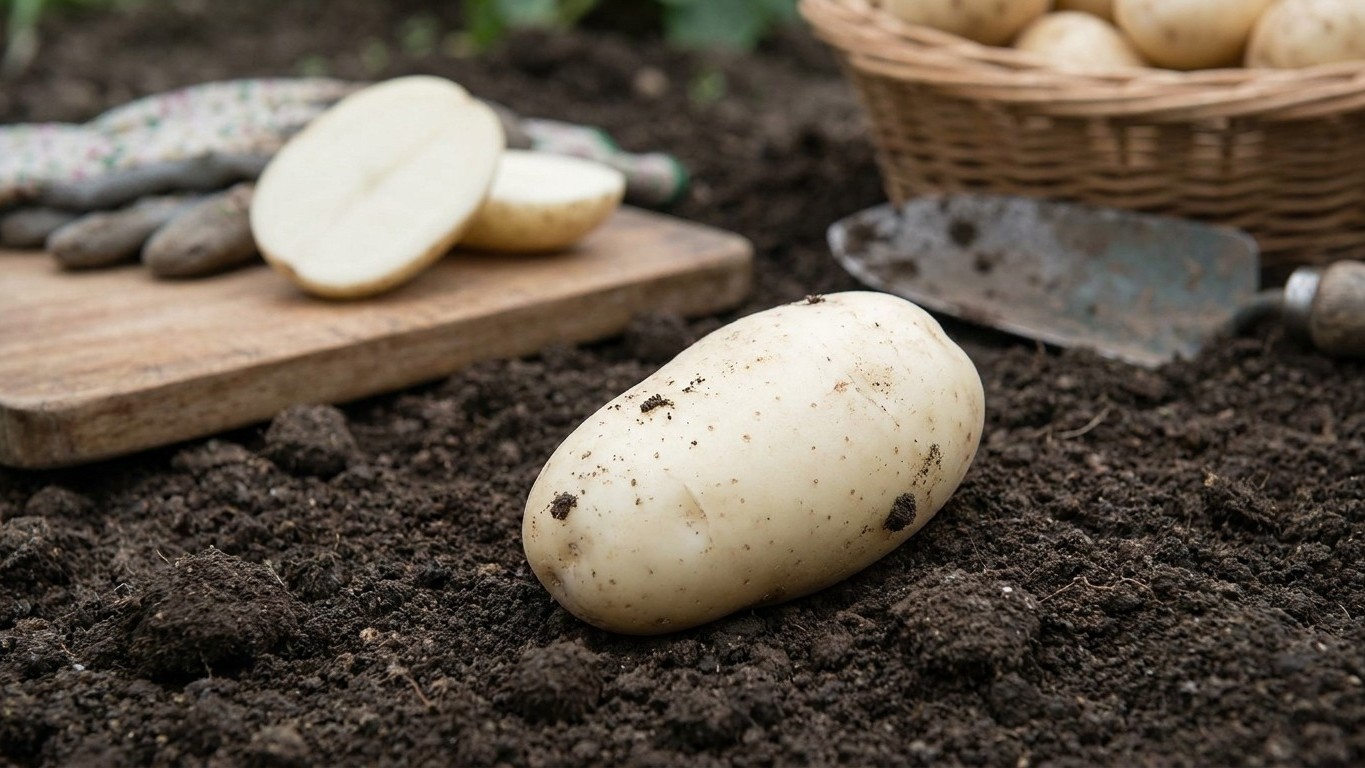

Superior is an early-season potato with white skin and white flesh, listed for baking and boiling in University of Maine Cooperative Extension Bulletin #2077. That single line covers what it looks like, when it comes out of the ground, and what to do with it at the stove. The rest of this page fills in why each of those four facts matters more than a seed catalogue photo ever could.
The short answer
Start with the skin, because that’s what you’ll actually see at the market or pull out of your own soil: Superior has white skin. The flesh underneath is also white, which is worth stating separately because the two traits are recorded as different columns in the University of Maine bulletin and they don’t always match. Plenty of white-fleshed varieties wear red or russet skins, so a grower who only knows “white flesh” can’t identify Superior in a bin of mixed potatoes. The skin is the visual signature; the flesh is what shows up on the cutting board.
Season class is the other half of the identity, and Superior sits in the early group. That single word, early, tells you more about how this variety behaves in the ground than almost any other spec sheet entry. It doesn’t mean the potato is ready in some fixed number of days. Neither Utah State University Extension nor the University of Maine bulletin publishes a days-to-maturity count for Superior or for any variety, and any number floating around online for this or another potato didn’t come from either of those sources. What “early” does tell you is where this variety fits in a rotation, and how it responds to weather, which the next section covers in detail.
Then there’s the use, and this is where a lot of potato write-ups get sloppy. The bulletin lists Superior’s use as baking and boiling. It does not call the variety waxy or floury, and neither does any other university extension source used for this page. Those texture words get thrown around constantly in kitchen writing, but they’re not what the extension bulletin publishes, so they don’t belong here. What’s published is a use category, and a use category is something you can act on at the stove without guessing at starch content.
Put together, that’s the whole published identity: white skin, white flesh, early season, baking and boiling. Four data points, one source, no invented specifics filling the gaps.
Where it suits, and where it does not
Season class exists because soil temperature, not the calendar, is what actually stops a potato plant from making tubers. Utah State University Extension notes that tuber set and tuber fill shut down once soil temperatures climb above 90 F. That threshold is the real geography of potato growing, and it’s why the early/mid-season/late distinction matters more than any regional planting chart.
An early variety like Superior sets and fills its tubers on a shorter internal clock relative to a late variety, which means there’s more room to get the crop dug before summer heat pushes soil past that 90 F mark. In a region where soil temperatures climb fast and stay high for weeks, that’s a real advantage: the plant can do its underground work in the cooler stretch of the season and be out of the ground before the heat locks in. A late-season variety asks for the opposite: a season that stays under that ceiling for a longer stretch, which usually means a cooler summer climate or a higher-elevation garden where soil doesn’t bake the way it does at lower, hotter sites.
Reading your own soil, not just your hardiness zone
Hardiness zone maps are built around winter minimums, not summer soil temperature, so they don’t tell you much about whether an early or late variety fits your garden. What matters is how hot your soil actually gets in the weeks after planting, and how long it stays there. A raised bed in full sun behaves differently than a shaded row against a north wall, even on the same property. Gardeners in hot-summer regions gain the most from an early variety like Superior, because the tuber-forming window closes before the worst of the heat arrives. Gardeners in consistently cool, short-summer regions have more flexibility, since even a late variety may never see soil cross that 90 F line.
None of this is a substitute for watching your own thermometer. A soil thermometer pushed a few inches into the row during the hottest part of the afternoon will tell you more about whether Superior fits your ground than any regional generalization.
In the kitchen
Baking and boiling, side by side on the same use line, is a broader recommendation than it looks at first glance. It means Superior isn’t being steered toward one narrow application. A baked potato with white skin and white flesh holds together on a sheet pan through a standard oven bake, comes out with a tender interior, and takes butter, sour cream, or chili the way any baking potato does. That’s the published use, not a texture claim layered on top of it.
Boiling covers a different set of dinners: potato salad, a pot of boiled new potatoes with herbs, or potatoes destined for mashing after they’ve softened in water. Because the bulletin lists both uses rather than one, a cook working with Superior has latitude to choose the method that fits the meal rather than hunting for a variety that “only” does one thing.
What the source doesn’t do is tell you whether the potato will hold a firm, waxy bite after boiling or break down into a fluffy, floury texture. Those words show up constantly in kitchen writing about potatoes, but they’re not part of the University of Maine’s published data for Superior, and repeating them here would hand the reader a claim that reads like it came from the university when it didn’t. The honest version is simpler: the source says bake it, and it says boil it. Anyone cooking with Superior for the first time can treat those two methods as the tested ground, and judge texture for themselves in their own kitchen rather than relying on a label nobody printed.
Growing it
Growing an early-season variety like Superior follows the same basic sequence as any potato crop, but the timing decisions at each step lean toward getting the plant through its tuber-forming window before soil heat becomes a problem.
- Plant early in the workable season. Because Superior is classed as early, there’s an advantage to getting seed potatoes into the ground as soon as the soil can be worked and isn’t waterlogged, rather than waiting for a later planting date the way a gardener might with a late-season variety.
- Space and set depth for even emergence. Standard potato spacing in rows gives each plant room to develop tubers without crowding, and setting seed pieces a few inches deep gets them into soil that warms and cools less dramatically than the surface.
- Hill as the plants grow. Mounding soil up around the stems as the foliage reaches several inches tall covers developing tubers, keeps them from greening in sunlight, and adds a layer of cooler soil right where the tubers are forming, which matters most in the weeks before soil temperature starts climbing toward that 90 F threshold.
- Watch soil temperature, not just the calendar, as summer builds. Because tuber set and fill stop above 90 F, checking soil temperature under the hill during hot stretches gives a better read on how much productive time is left than counting days on a calendar.
- Lift before the heat shuts things down. The early classification is the reason to plan the harvest for the cooler side of the season rather than pushing the crop into the hottest weeks, when a late variety might still be filling but an early one has already done its main work.
This sequence isn’t unique to Superior, but the early classification is what shifts every step earlier relative to a mid-season or late variety, and it’s the reason growers in hot-summer regions often reach for early varieties in the first place.
Common questions
Is Superior a waxy or floury potato?
Neither word is published for Superior. The University of Maine Cooperative Extension bulletin lists its use as baking and boiling, not a texture category, so any claim calling it waxy or floury is going beyond what the source actually states.
How many days does Superior take to mature?
No days-to-maturity figure is published by Utah State University Extension or the University of Maine bulletin for this variety. What’s published instead is the season class: early. That tells you where the variety fits relative to soil-temperature limits, which is the figure that actually governs planting and harvest timing.
Does Superior have red or white skin?
White skin. Superior’s flesh is also white, but skin and flesh are recorded separately in the source data, and for many varieties they don’t match, so it’s worth checking both rather than assuming one from the other.
Where does the variety information for Superior come from?
The skin color, flesh color, season class, and kitchen use cited here come from University of Maine Cooperative Extension Bulletin #2077, Growing Potatoes in the Home Garden, by Steven B. Johnson. The 90 F soil-temperature limit on tuber set and fill comes from Utah State University Extension.