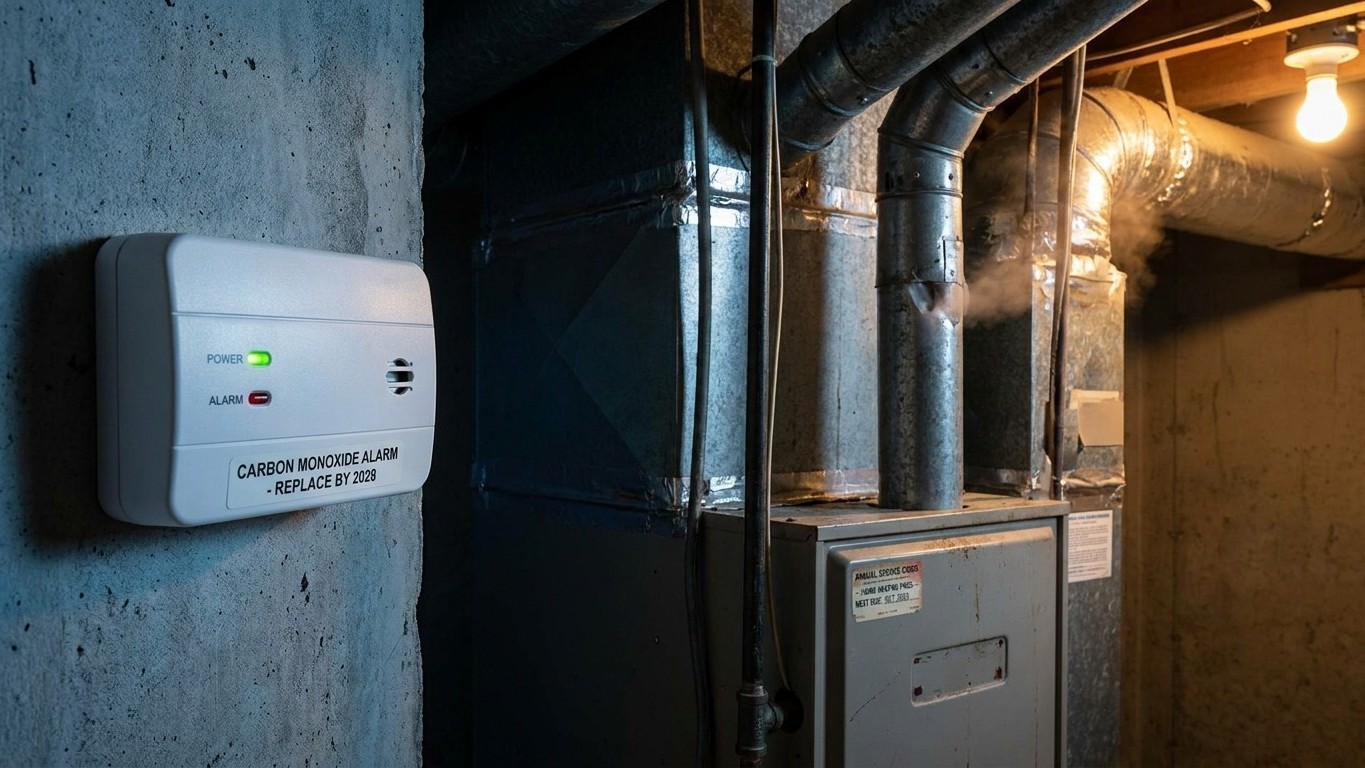

Not every furnace smell means trouble, but one of the smells that can send someone to the hospital doesn’t smell like anything at all. Burning dust after months of idle time is normal and fades on its own. A gas odor means leave the house now. A persistent electrical smell means cut power at the breaker. And carbon monoxide, the one that actually kills, gives off no warning smell whatsoever, which is exactly why it needs its own section before anything else on this page.
Start with the one you cannot smell

Carbon monoxide has no odor, no color, and no taste. A furnace producing it will not announce itself through the air. Nobody has ever caught a CO problem by sniffing near a vent, and nothing described later on this page (burning dust, gas, musty air, hot plastic) tells you anything about whether CO is present. The only tool that detects it is a CO alarm.
The scale of the risk comes from the U.S. Consumer Product Safety Commission, and the wording matters: “Each year, more than 200 people die from unintentional non-fire related carbon monoxide poisoning associated with consumer products. Heating equipment and portable generators are among the top contributors to CO deaths.” That figure counts deaths tied to consumer products broadly, not furnaces specifically, and it groups heating equipment together with portable generators. It is not a furnace death toll on its own, but it explains why heating season is when CO alarms matter most.
The symptoms overlap with a bad flu, which is part of what makes CO dangerous: people sleep through it or blame something else. The CPSC lists them plainly and attaches a single instruction that should not be separated from the list: “Know the symptoms of carbon monoxide poisoning: headache, dizziness, weakness, nausea, vomiting, sleepiness, and confusion. If you suspect CO poisoning, get outside to fresh air immediately, and then call 911.” Outside first. Call second. Not the other way around, and not a call from inside the house while someone tries to air out a room.
Prevention here is a device, not a habit. The CPSC’s guidance is specific about placement: “Install battery-operated CO alarms or CO alarms with battery backup on every level of the home and outside sleeping areas. Interconnected CO alarms are best; when one sounds, they all sound.” Every level, outside sleeping areas, and interconnected if possible so a basement alarm wakes someone upstairs. Note that none of this applies to electric furnaces, electric heat pumps, or electric baseboard heat: CO comes from combustion, and equipment that doesn’t burn fuel doesn’t produce it. With that separated out, the rest of this page deals with smells you actually can detect, starting with the one that requires the least thinking and the fastest exit.
A smell of gas
Natural gas and propane are naturally odorless. Utilities add a chemical, typically one with a rotten-egg or sulfur character, specifically so a leak doesn’t go unnoticed. If a house smells like gas, that additive is doing its job. This is not a moment for troubleshooting, and it is the one section on this entire site where diagnosis of any kind is the wrong move.
The response is short by design:
- Leave the house immediately, and get everyone else out with you.
- Do not operate light switches, appliances, phones, or anything electrical inside the home, since a spark can ignite gas that has accumulated.
- Do not try to find the source of the smell or the leak yourself.
- Once outside, call the gas utility’s emergency line or 911, and let trained personnel handle it from there.
Notice what’s missing from that list. No soapy water on a fitting, no walking the gas line sniffing for the strongest spot, no checking whether the smell is coming from the furnace specifically or somewhere else in the house. Those steps show up in general home-maintenance advice, and they are reasonable for slow, cold checks on equipment that’s shut off. They are not reasonable when the smell is active, because a spark from a light switch or a phone screen is enough to ignite accumulated gas in a way that has nothing to do with how careful someone is being.
Gas leaks and carbon monoxide are frequently discussed together because both come from fuel-burning equipment, but they’re different hazards with different signatures. Gas has a deliberate warning smell. CO has none. That’s also why a gas smell calls for evacuation while a suspected CO exposure calls for fresh air followed by 911, per the CPSC guidance above, rather than a walk through the house looking for the source.
Burning dust, in October
This is the smell that sends most people searching in the first place, and it’s usually the least worrying one. A furnace that hasn’t run since spring collects a fine layer of dust on its heat exchanger and burner assembly over the summer. The first time the system fires up for the season, that dust burns off. The smell is real, sometimes strong enough to notice from another room, and it typically clears within an hour or two of the furnace running.
What separates it from a real problem
Three details distinguish ordinary dust burn-off from something that needs attention. It happens on the first run of the heating season, not on the fiftieth. It fades rather than lingering or coming back every cycle. And it smells like burning dust, a dry, faintly sooty odor, not like hot plastic, melting insulation, or an electrical smell, which reads more like a short circuit than a dusty surface warming up. If the smell matches all three of those and this is genuinely the season’s first heating cycle, there’s little reason for alarm.
If the odor returns on the third or fourth run of the week, or if it smells more chemical than dusty, that’s a different situation and worth having looked at rather than waited out.
A filter change pairs naturally with this moment
The first firing of the season is also a sensible time to deal with the filter, since a dusty startup and a dirty filter tend to arrive together. ENERGY STAR’s guidance is direct: “Inspect, clean, or change air filters once a month in your central air conditioner, furnace, and/or heat pump.” Once a month, across all three types of equipment, not just at the start of the season. A filter that’s been sitting since spring is a reasonable one to swap out the same week the burning-dust smell shows up, since restricted airflow can make a furnace work harder than it needs to.
Musty, electrical, and oily
Past the dust-burn-off smell and past a straightforward gas leak, the remaining odors point in different directions depending on what kind of system is running and what part of it is involved. Some can wait for a scheduled look. One cannot.
| Smell | Likely source | What to do | Can it wait? |
|---|---|---|---|
| Musty, damp | Moisture sitting on the evaporator coil or in a condensate drain pan, often after the cooling side has been running | Check that the drain pan isn’t backed up and that the drain line isn’t clogged | Usually yes, but worth checking soon to avoid mold buildup |
| Hot plastic or electrical | A wire, motor, or component overheating | Shut the system off at the breaker and leave it off | No. This is the exception on this table. |
| Oily | On oil-fired systems, points to the combustion side rather than to dust or the room air | Have the burner and combustion components inspected | Should be looked at promptly, not run through repeatedly |
The musty smell is the least urgent of the three and the most common if a home runs central air conditioning through the same air handler as the furnace. Standing water in a drain pan or a slow drain line gives mold and mildew somewhere to grow, and the smell is usually the first sign before anything else shows up.
The electrical smell is the one that deserves no debate. Hot plastic, a burning-wire odor, or anything that smells like an overheating appliance rather than burning dust means the system goes off at the breaker and stays off until it’s been checked. This applies the same way to gas, oil, and electric furnaces alike, since electrical faults don’t care what fuel a system burns, unlike the CO risk discussed earlier, which is specific to combustion equipment.
An oily smell on an oil-fired furnace is worth separating from the others because it points at the burner and combustion chamber rather than at dust, filters, or drain pans. It’s not automatically an emergency the way a gas smell is, but it’s also not something to let run for a full heating season without a look, since it’s telling you something about how the fuel is burning rather than about dust sitting on a surface.
Common questions
Does a burning smell always mean the furnace is broken?
No. A burning-dust smell on the season’s first run is normal and typically fades within an hour or two. A smell that persists, returns on later cycles, or shifts toward plastic or electrical odor is the one that needs attention.
Can a furnace produce carbon monoxide without any smell warning at all?
Yes. Carbon monoxide is odorless, colorless, and tasteless. A CO alarm is the only way to detect it, which is why the CPSC recommends alarms on every level of the home and outside sleeping areas.
What should I do first if I smell gas near the furnace?
Leave the house immediately, avoid touching light switches or anything electrical, don’t search for the leak yourself, and call the gas utility’s emergency line or 911 once you’re outside.
Is a musty smell from the furnace dangerous?
It’s usually a moisture issue, often standing water in a condensate drain pan or a clogged drain line, rather than a safety hazard. It’s worth checking soon to prevent mold, but it doesn’t call for shutting the system off the way an electrical smell does.