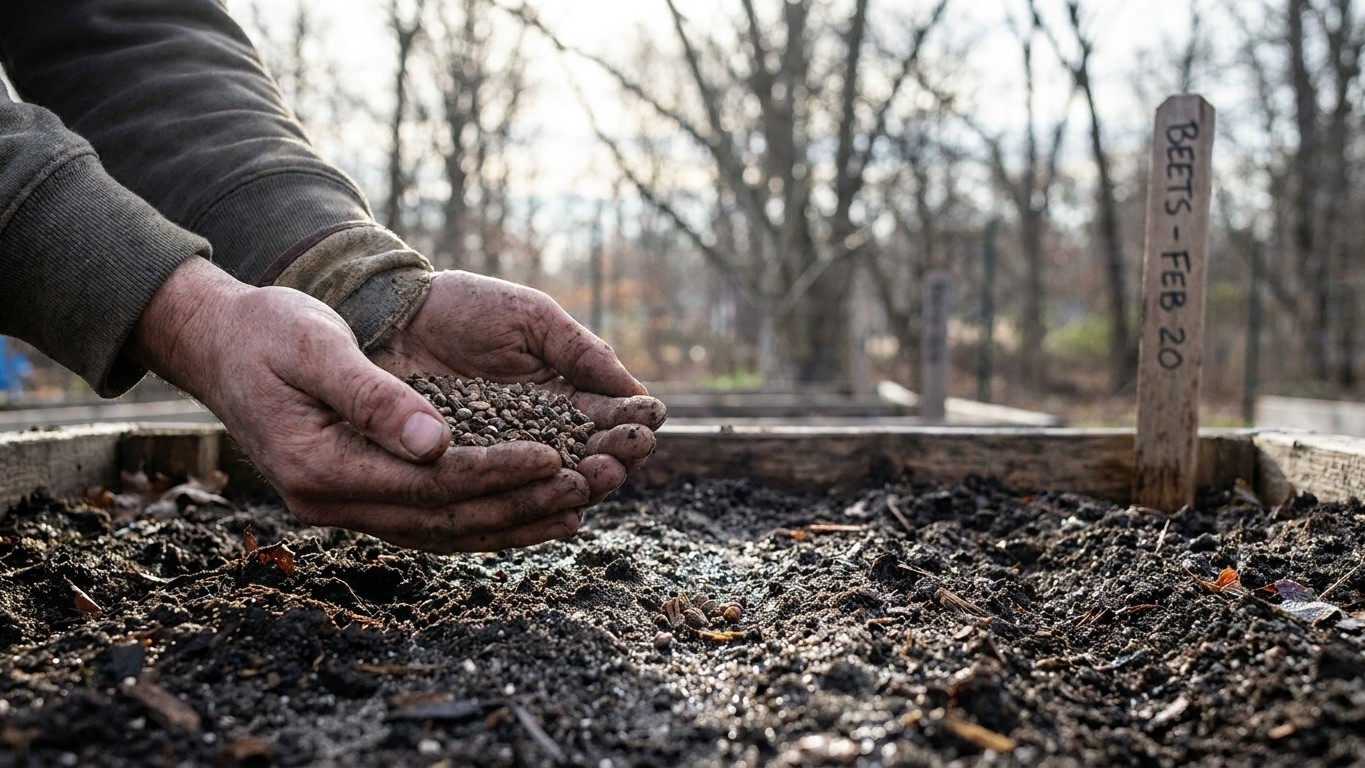

New Brunswick gardeners sow beet seed directly into the ground roughly two to three weeks before the average last spring frost, which lands on May 23 at the Moncton station. That points to a seeding window opening in the first days of May and running through mid-month, though frost risk doesn’t disappear on cue. This piece looks at why that timing fits the province’s ground and climate, and what tends to derail it once seedlings emerge.
The short answer
Start with what’s actually under your boots. New Brunswick’s mapped agricultural ground is most commonly a Podzol, the acid, leached soil that forms under conifer cover once rain has stripped the bases out of the topsoil. Across 418 mapped soil components, the median surface pH sits at 4.7, which counts as strongly acid. Texture runs 47 percent sand, 16 percent clay and 37 percent silt, a loam-to-silt blend, with organic matter around 3.4 percent, and drainage classed as well drained.
That combination is a mixed bag for beets. Utah State University Extension notes that beets want deep, sandy, well-drained soil rich in organic matter, amended with no more than 1 inch of composted organic matter per 100 square feet. The sandy-loam texture and good drainage typical of New Brunswick’s mapped soils line up reasonably well with that description. The acidity is the sticking point: a median pH of 4.7 is well below what most root vegetables prefer, and it’s worth running a soil test before assuming your bed needs lime, since acidity varies from one property to the next even within the same region.
On heat, the picture is harder to pin down with the data at hand. Utah State University Extension warns that heat above 85 F combined with water stress makes beet roots turn woody. New Brunswick’s climate leans cool and maritime, which generally keeps that threshold from being hit as often as it would be further inland or further south, but a specific count of days per year above 90 F for a reference city in the province isn’t published in the sourced data used for this page. Treat the province’s cool reputation as a general tendency, not a number you can plan around.
None of this is a diagnosis for your particular yard. A province the size of New Brunswick spans hundreds of individual soil series, and the median figures above describe the agricultural regions the survey covers, not the far north or any lot a builder has graded, filled or stripped of topsoil. Use the Podzol profile as a starting point for what the region’s ground tends to do, then confirm your own numbers with a test kit before you commit a season’s seed to it.
The six weeks that decide it here
Sowing beets two to three weeks ahead of the May 23 average last frost means the first six weeks of growth, the stretch when water stress does the most damage, land squarely in New Brunswick’s early spring. That’s the window Utah State University Extension flags as decisive: water stress during those first weeks after seeding pushes beets toward premature flowering, a failure known as bolting, and once a beet plant bolts, the root stops bulking up and the crop is effectively lost for the table.
Early spring in this part of the Maritimes is rarely a stable, predictable stretch. Snowmelt can leave soil saturated and cold at the surface even while the top inch dries out fast on a sunny, windy afternoon, a combination that catches new gardeners off guard because the ground looks wet but the seed row is bone dry. Swings between a cold snap that stalls germination and a sudden mild stretch that dries the seedbed are common in this window, and both ends of that swing put young beet seedlings under stress before they’ve built any root reserve to draw on.
The practical takeaway is that bolting risk in New Brunswick sits less with heat, since the province rarely runs hot in May, and more with inconsistency: a seedbed that dries between waterings, or a cold spell that stops growth for a week and is followed by a warm one that restarts it unevenly. Keeping the top inch of soil evenly moist through germination and the following weeks matters more here than watching a thermometer. A seed row mulched lightly, or a bed shaded from midday wind, holds that moisture more evenly than bare, exposed sandy loam, which is exactly the texture this province’s mapped soils tend toward.
Later in the season, once plants are established and summer heat (if it arrives) pushes past 85 F, the risk shifts to woodiness rather than bolting. That’s a separate failure with a separate cause, and conflating the two leads to the wrong fix at the wrong time.
What goes wrong here
- Seed rotting in cold, saturated Podzol soil. Well-drained doesn’t mean instantly warm; a Podzol that’s just shed snowmelt can still sit cold and heavy at seed depth even while it drains fine overall. Wait until the top few inches have visibly warmed and crumble rather than clump before sowing, and consider a raised bed if your particular plot runs on the wetter end of the province’s range.
- Strongly acid ground locking up nutrients. With a median surface pH of 4.7 across the province’s mapped soils, plenty of New Brunswick beds are acid enough to limit nutrient uptake regardless of how much organic matter is present. Test before planting and lime according to what your own soil, not the provincial median, actually needs.
- Uneven moisture in the first six weeks triggering bolting. A seedbed that swings from soggy to dry in the same week is the classic early-season failure here. Mulch the row lightly and check soil moisture by hand rather than by eye, since sandy-loam surfaces can look dry while staying moist an inch down.
- Overloading sandy soil with organic matter. It’s tempting to pile on compost in ground that already reads as fairly lean, but Utah State University Extension caps the amendment at 1 inch per 100 square feet. More than that can throw off the balance beets actually want.
- Woodiness from summer heat stacked on water stress. If a warm stretch does push past 85 F later in the season, missing a watering at the same time is what turns roots fibrous and tough. Keep watering consistent through any hot spell rather than assuming the province’s cool reputation means you can skip a week.
Common questions
Can I sow beets before the average last frost date in New Brunswick?
The two-to-three-week head start recommended ahead of the May 23 average is already a calculated risk, since that date is a mean, not a guarantee. Environment and Climate Change Canada’s normals mean frost arrives later than May 23 in roughly half of all years, so sowing much earlier than the standard window raises the odds of losing a stand to a late freeze, particularly in upland or northern parts of the province that typically run behind the Moncton station.
Does my soil need lime before I plant beets?
Possibly, but only a test of your own bed will tell you for sure. The province’s mapped agricultural soils run strongly acid at a median pH of 4.7, and beets generally don’t thrive in soil that acid, but that figure is a provincial median across hundreds of soil series, not a reading of your specific garden.
How long does it take from sowing to harvest?
Beets are sown directly in place, not transplanted, and the days-to-harvest count runs from that seeding date, typically landing somewhere between 60 and 80 days depending on variety and growing conditions. Because New Brunswick’s window opens in early May, most sowings have room to reach maturity well before the first fall frost.
How much compost should I add to sandy New Brunswick soil before sowing?
Utah State University Extension sets the ceiling at no more than 1 inch of composted organic matter per 100 square feet. Given that the province’s mapped soils already carry moderate organic matter around 3.4 percent, sticking to that rate rather than exceeding it keeps the bed in the range beets actually prefer.