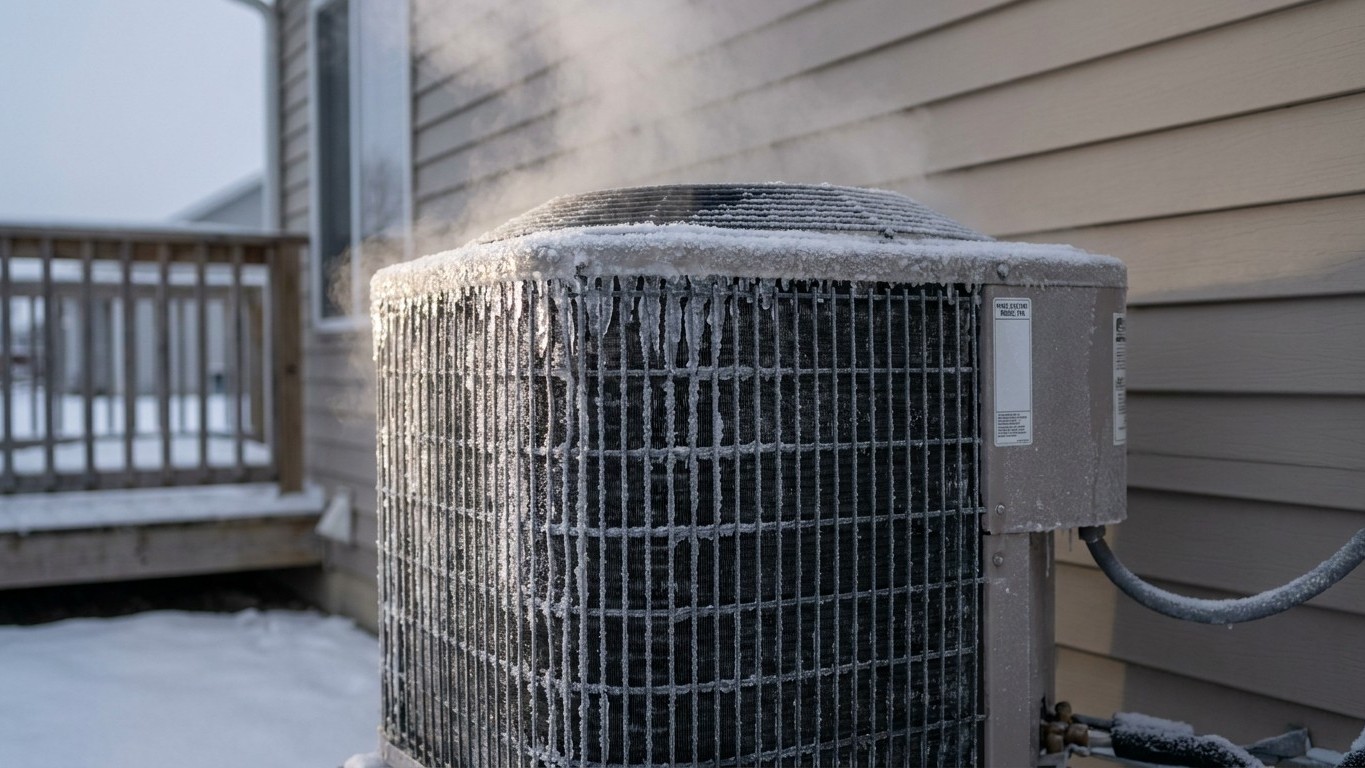

A defrost cycle is the brief pause when a heat pump reverses itself, sends hot refrigerant out to the outdoor coil, and melts off the ice that’s built up on it. It typically lasts anywhere from a few minutes to around ten, and during that window the system is technically cooling your house even in the dead of winter, which is why you might feel a cool draft or see steam rising from the outdoor unit.
The Defrost Cycle, Explained
Frost forms on the outdoor coil because that coil has to run colder than the outside air to pull heat out of it. When the air is humid and near freezing, moisture condenses on the coil and freezes solid, coating the fins the way a windshield frosts over on a damp morning. Left alone, that ice sheet blocks airflow, and airflow is the only thing letting the coil absorb heat from the outside air in the first place.
The system’s controls watch for this buildup, usually through a combination of a temperature sensor on the coil and a timer that tracks how long the unit has been running in heating mode. Once both conditions line up, the reversing valve flips. Refrigerant that would normally flow to the indoor coil gets redirected outside instead, carrying heat with it. That heat melts the frost from the inside of the coil out, the outdoor fan often shuts off so it doesn’t blow cold air across the melting ice, and once a sensor confirms the coil has warmed enough, the valve flips back and normal heating resumes.
During that pause, your indoor comfort takes a small hit. Some systems fire up backup electric resistance heat for those few minutes specifically to offset the fact that the heat pump itself is briefly running in reverse. That’s a deliberate trade: a short dip in efficiency to protect the outdoor coil from an ice buildup that would otherwise choke off performance entirely.
Why the same house sees different defrost patterns in different climates
How often this cycle kicks in depends heavily on outdoor humidity and temperature, which is another way of saying it depends on climate. A location with a long, cold, damp heating season is going to ask a heat pump to defrost far more often than one with a short, mild one. Heating degree days are the number that captures this: they tally, for every day of the year, how far the average temperature sat below 65°F. At the New York Central Park Tower station, the 1991-2020 climate normal runs about 4,553 heating degree days a year, alongside roughly 1,222 cooling degree days. Twice that heating degree day figure means roughly twice the fuel demand for an identical house, and it also means a heat pump there is working through a heating season long and cold enough that frequent defrost cycles are simply part of normal operation, not a warning sign. A milder climate with a fraction of those degree days will see the coil ice up far less, and less often needs cover from that pause.
How to tell, in your own house
Most defrost activity is invisible if you’re not looking for it, which is exactly why homeowners tend to notice it only when something feels off. Here’s how to check, starting with what costs nothing and ending at the point where the job stops being yours.
- Watch the outdoor unit for a few minutes on a cold, damp day. If you see steam or vapor rising off it, or notice the fan has stopped while the unit still hums, that’s very likely a normal defrost cycle in progress. This costs you nothing but a few minutes standing outside.
- Look at the coil itself once the cycle ends. A light, even sheen of moisture or a small amount of quick-melting frost is normal. A thick, solid sheet of ice that doesn’t seem to be clearing after multiple cycles is not, and it points to a fan, sensor, or control problem rather than routine operation.
- Check for anything blocking airflow around the unit. Leaves, mulch, snow drifts, or a fence built too close can all trap moisture near the coil and make icing worse. Clearing a couple feet of open space around the unit is a genuine homeowner fix and often solves a chronic icing complaint on its own.
- Note how long the defrost cycles are running and how often. If they’re happening every twenty or thirty minutes, or lasting well beyond ten minutes, write down the pattern (time of day, outdoor temperature, how long it ran) before calling anyone. That log turns a vague complaint into something a technician can actually diagnose quickly.
- Stop here and call a professional if the ice isn’t clearing, if the outdoor fan never restarts, or if you hear the reversing valve cycling but see no change at the coil. This is the line: diagnosing a stuck reversing valve, a failed defrost sensor, refrigerant charge issues, or a control board fault requires gauges, electrical testing, and manufacturer-specific diagnostics. Opening the refrigerant circuit or probing the control board yourself risks the compressor and, depending on the refrigerant, may be regulated work in the first place.
Everything through step four is fair territory for an attentive homeowner. Step five is where observation has to hand off to a license and a set of gauges.
What it costs you to ignore it
A defrost cycle that isn’t clearing ice properly doesn’t stay a minor issue. Every cycle that fails to fully melt the coil leaves a little more frost behind for the next one to fight through, and the buildup compounds. Thicker ice blocks more airflow, which forces the coil to run even colder to pull the same amount of heat, which in turn encourages faster, thicker icing on the next pass. It’s a feedback loop, not a static problem.
Comfort is the first thing to slip. As the coil struggles, the heat pump has to lean harder on backup heat, or simply run longer to deliver the same warmth, which shows up as rooms that never quite reach the thermostat setting or air handlers that seem to run constantly without catching up. The equipment feels the strain next. A compressor working against a badly iced, airflow-starved coil is working outside its intended range, and prolonged operation in that state is the kind of stress that shortens component life rather than causing a single dramatic failure.
The bill absorbs the rest of it quietly. Every extra minute the system spends fighting ice, or leaning on backup resistance heat instead of efficient heat pump operation, is energy spent overcoming a problem rather than heating the house. None of this shows up as one obvious spike. It shows up as a system that runs longer, more often, and less effectively than it should, season after season, until the pattern becomes the new normal instead of the exception it started as.