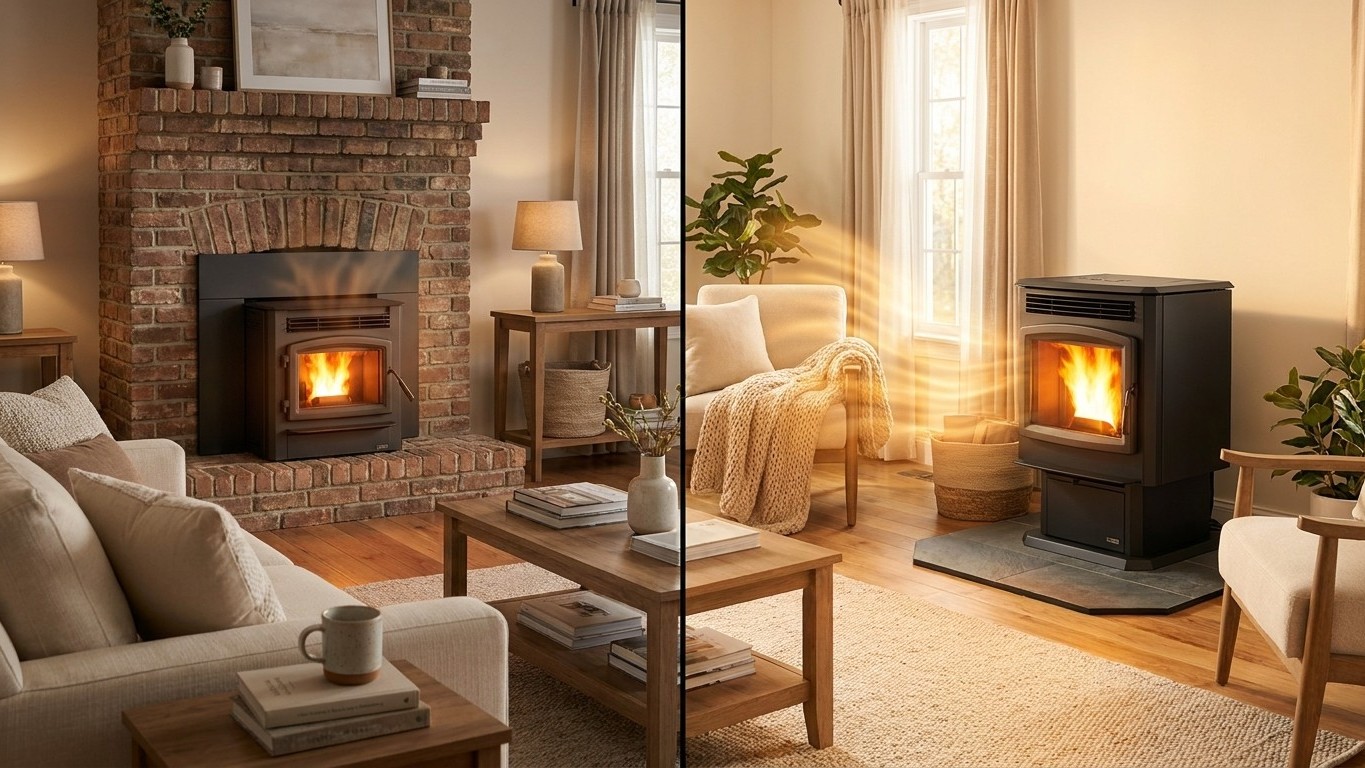

The short answer: pick an insert if you already have a working masonry fireplace and want to reuse that opening and chimney; pick a freestanding stove if you’re heating a room with no existing fireplace, or if you want more of the heat radiating into your living space rather than into a chimney breast. Both burn the same pellets. The difference is where the heat goes and what it costs you to maintain, year after year.
Two answers to two different problems

An insert is built to slide into an existing fireplace opening. It borrows your masonry firebox as a shell, connects to the flue that’s already running up through your chimney, and typically needs a liner run down that flue to vent properly. A freestanding stove doesn’t care what’s already in the room. It sits on a hearth pad, vents through a wall or up through a new chimney chase, and needs nothing more than floor space, a code-compliant clearance zone, and a nearby outlet.
That difference in installation drives almost everything else, including how much of the appliance’s rated output you actually feel. The U.S. EPA notes that “EPA-certified pellet stoves usually fall into the 70-83% efficiency range, while heating capacities range from 8,000-90,000 Btu per hour.” That range applies to both insert and freestanding models. What changes is how much of that output ends up warming you instead of warming brick.
| Insert | Freestanding stove | |
|---|---|---|
| Where it goes | Inside an existing fireplace opening | Anywhere with floor clearance and a vent path |
| What it needs | Existing masonry firebox, flue liner, electrical supply | Hearth pad, wall or roof vent, electrical supply |
| Heat reaching the room | Reduced by masonry absorption around the unit | Radiates from all exposed surfaces into the room |
| Servicing access | Tighter, recessed into the fireplace opening | Open on all sides, easier to reach and inspect |
Both appliance types need power to run. The EPA is direct about this: “Pellet stoves need an electrical supply to work because they use motorized components to feed the fire and blow out hot air.” An insert doesn’t get a pass on that requirement just because it looks like it belongs to the old fireplace it’s sitting in. If your power goes out, neither an insert nor a freestanding stove keeps running without a backup power source, which is worth factoring in if you live somewhere prone to outages.
Where the heat actually goes
This is the trade-off that decides whether you’ll be comfortable, and it has nothing to do with the Btu rating printed on the spec sheet. An insert sits recessed inside a masonry opening. That surrounding brick and mortar is a thermal mass, and thermal mass absorbs heat before it releases it. A meaningful share of an insert’s output goes into warming the chimney breast itself, the masonry wall around the firebox, before any of it reaches the room as radiant warmth you can feel on your skin.
A freestanding stove has no such buffer. Every exposed surface, top, sides, back, radiates directly into open air. Stand near one and you feel the heat immediately, because nothing is standing between the metal and the room. This is why two stoves with identical Btu ratings, one an insert and one freestanding, can feel noticeably different in the same size room. The insert’s number on paper doesn’t fully show up as warmth in your living room; some of it is baked into the wall behind the unit.
Matching the appliance to how you actually use it
That distinction points toward different use cases. An insert suits a home where you already love your fireplace and want an occasional evening fire, something to gather around on a cold weekend without committing to running it as your primary heat source. The masonry mass it warms will radiate some residual heat back out slowly after the fire dies down, which is pleasant for an evening but not efficient as an all-day heating strategy.
A freestanding stove suits the opposite goal: heating a space steadily, for hours at a stretch, as a real supplement to or replacement for a central heating zone. Because none of its output disappears into surrounding brick, it responds faster to the room and delivers a higher share of its rated Btu output as usable warmth. If your plan is to run the stove most of the day during winter and actually lower your thermostat setting elsewhere in the house, a freestanding unit typically gets you there with less waste. If your plan is a cozy fire two or three nights a week in a room that already has a fireplace, an insert does the job without a bigger renovation.
Servicing and access
Here’s the part that doesn’t show up in a showroom but shows up every winter on a to-do list. Pellet stoves of either type need routine attention. The EPA is specific about this: “Pellet stoves need to be regularly cleaned to ensure that the stove runs efficiently and safely. Additionally, you should have your stove professionally cleaned at least once a year.” That’s not a suggestion tied to one brand or one design; it’s a baseline for the appliance category, insert or freestanding.
The mechanism behind that cleaning need is simple. As the EPA describes it, “The pellets are poured into a hopper, which automatically feeds into the stove.” That auger, hopper, and blower assembly moves fuel and combustion air continuously while the stove runs, and ash and fine dust build up around all of it. Fuel quality changes how fast that buildup happens. The EPA notes: “Pellets can differ significantly in how well they’re made and how well they burn. Lower quality pellets may provide less heat and create a fine dust. Higher quality pellets tend to burn cleaner and produce less ash.” A stove burning through inconsistent fuel needs more frequent attention between annual professional visits, regardless of whether it’s recessed into a fireplace or standing free in the room.
This is where the insert’s install location becomes a recurring cost rather than a one-time inconvenience. A technician servicing a freestanding stove can walk around it, pull panels from any side, and reach the flue connection without disassembling anything else. A technician servicing an insert is working inside a recessed fireplace opening, often having to slide the unit forward or remove surround panels just to reach the same components. That extra labor time shows up on the invoice every single year, not just at installation. It’s a running cost baked into owning an insert, not a one-off expense you pay once and forget.
The chimney or vent connected to either appliance carries its own annual obligation, separate from the stove itself. The U.S. Fire Administration puts it plainly: “Maintain heating equipment and chimneys by having them cleaned and inspected each year by a professional.” For an insert, that means accessing a liner run through an existing masonry flue, which can mean more time and more cost than inspecting a straight-shot wall vent on a freestanding model. And regardless of which appliance is in the room, the same clearance rule applies: the U.S. Fire Administration advises to “Keep anything that can burn at least 3 feet from all heat sources including fireplaces, wood stoves, radiators, space heaters or candles.” That’s a rule for the room, not the appliance, and it applies whether the stove is tucked into a fireplace or standing in the middle of the floor.
Buyers sometimes assume the EPA-certified label settles the comfort question on its own. It doesn’t. The EPA notes that it “currently certifies over 90 different pellet stoves,” covering both insert and freestanding configurations across that same 70-83% efficiency band. Certification confirms the appliance burns cleanly and meets emissions standards; it says nothing about how much of that heat reaches your couch versus your brick wall, or how easy the unit will be to reach every fall when the technician shows up.
Common questions
Can I convert a wood-burning fireplace into a pellet insert without other changes?
Most installations need a liner run through the existing flue to vent the pellet insert safely, plus an electrical connection nearby for the hopper and blower motors. A local dealer or chimney professional can confirm what your specific fireplace opening and flue require.
Does a freestanding stove need a masonry hearth?
It needs a code-compliant, non-combustible hearth pad and clearance around it, not a full masonry fireplace. That’s part of why freestanding stoves can go in rooms that never had a fireplace to begin with.
Will an insert heat a whole house the way a freestanding stove can?
Both are rated within the same 8,000 to 90,000 Btu per hour range depending on model size, but because an insert loses some output to the surrounding masonry, a freestanding stove of comparable rating generally delivers more usable heat to open living space. Check your appliance’s specific Btu rating on its label before comparing.
Do both types need the same annual service?
Yes, the professional cleaning recommendation applies to pellet stoves generally, insert or freestanding. What differs is labor time and access difficulty, which an insert’s recessed location tends to increase.