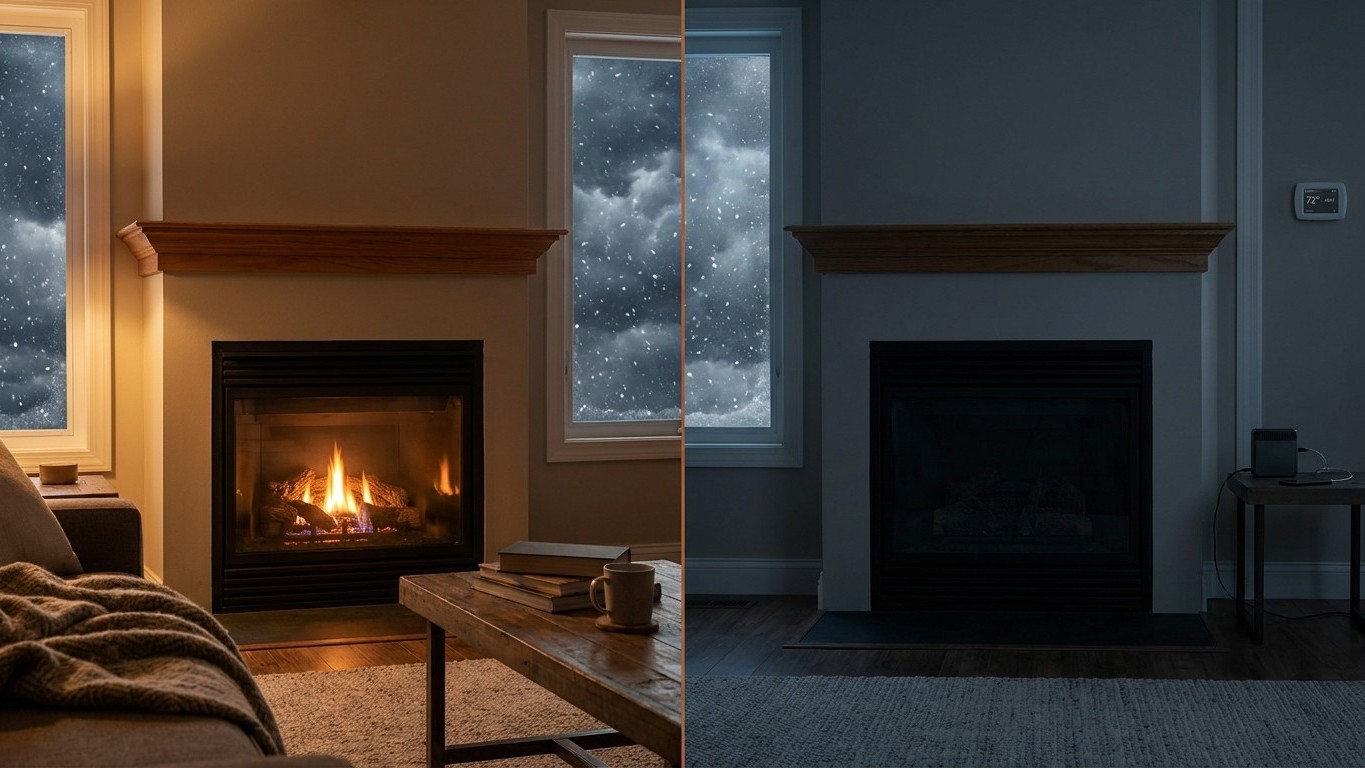

A gas fireplace with a standing pilot keeps burning when the power goes out, because the pilot flame itself powers the valve. A gas fireplace with electronic ignition needs household current or working batteries to strike a flame, and won’t light without it. Which one sits in your living room determines whether you have heat during a storm, or a dark, cold firebox until the lines come back on.
The answer depends on how it lights

Two different ignition systems dominate the gas fireplace market, and they behave in opposite ways once the grid drops. A millivolt system uses the standing pilot flame to generate a tiny electrical current, just enough to hold the gas valve open. No outlet, no batteries, no circuit board required. The pilot burns around the clock, and when you flip the wall switch or turn the knob, gas flows to the main burner and lights off that same pilot flame. Power cut or not, the fireplace doesn’t know the difference.
Electronic ignition works differently. Instead of a constant pilot, a spark module or hot-surface igniter fires the burner on demand, the way a gas furnace or a modern gas range does. That igniter needs a source of current, either from the wall or from a battery pack built into the appliance. Cut the power and the igniter has nothing to work with. Some units include a battery backup that buys a few uses, but once those batteries fatigue or go unreplaced for a year, the fireplace is just as dark as one with no backup at all.
Finding out before the storm hits
The smartest time to answer this question is on a calm Tuesday afternoon, not during a blackout with the temperature dropping. Start with the owner’s manual, which will state the ignition type outright. No manual on hand? Look at the pilot assembly through the glass. A small flame burning continuously behind the logs, even when the fireplace is switched off, points to a millivolt system. If you see no flame at all until you turn it on, and the appliance uses a remote control with a digital display, it’s almost certainly electronic ignition. A local hearth dealer or the technician who last serviced the unit can confirm it in about thirty seconds, and it’s worth asking specifically when scheduling the annual inspection, since that visit is happening anyway.
What you lose either way
A standing-pilot fireplace surviving a power outage doesn’t mean it performs the same as it does on a normal night. Nearly every gas fireplace with a blower fan relies on household current to run that fan, and the fan is what pushes warmed air out into the room rather than letting it simply radiate from the glass front. Kill the power, and the blower stops, even though the burner keeps working fine. What’s left is radiant heat only: the glass and firebox get hot, and warmth moves outward the slow way, the way it would from a wood stove without a fan kit.
That difference matters more than it sounds. A blower doesn’t just make a room feel warmer faster, it distributes heat toward the far corners and hallways instead of concentrating it in front of the fireplace. Without it, the area directly in front of the unit can feel plenty warm while a bedroom down the hall stays cold. In a single evening without power, that’s an inconvenience. Stretch it into a multi-day outage, the kind that follows an ice storm or a hurricane, and it becomes the difference between one warm room the household gathers in and a house that never quite heats up anywhere.
Practically, this reshapes how a family should plan around the appliance. Rather than expecting the fireplace to heat the whole floor plan, it makes more sense to close off unused rooms, keep everyone in the space nearest the fireplace, and treat it the same way people traditionally used a single wood stove: as a heat island, not a whole-house furnace. Blankets, closed doors, and low expectations for the far end of the house go a long way toward making a no-blower evening tolerable instead of miserable.
Running it for hours
Whether it’s smart to let a gas fireplace run for hours during an outage depends on how the appliance is vented, and this is where the three basic types stop being a technical detail and start being a safety question. Vented fireplaces send combustion byproducts outdoors through a flue. Direct-vent models draw combustion air from outside and exhaust through a sealed wall terminal, keeping the whole combustion process separate from the room’s air supply. Both are built for continuous operation, which is exactly the demand a long power outage places on them.
Vent-free appliances are a different animal. They have no outside vent at all, and everything the burner produces, water vapor included, stays in the room. According to the U.S. Consumer Product Safety Commission, currently manufactured unvented gas-fired room heaters include an oxygen depletion sensor under the industry’s voluntary standard, designed to shut off the gas before carbon monoxide reaches a life-threatening level. The CPSC also notes that an unvented appliance depends on ordinary room ventilation, and that inadequate airflow or a maladjusted burner can let dangerous levels build up regardless.
That distinction matters most exactly when it’s least convenient to think about it: during a storm, with windows shut, doors sealed against the wind, and the house buttoned up tighter than usual. A vent-free fireplace running for hours in a closed-up home is putting more moisture and combustion byproducts into a space with less fresh air exchange than on a normal day. Carbon monoxide is colorless and odorless, so a working alarm is the only way a household would know something’s wrong. For a closer look at how vented, direct-vent, and vent-free systems differ day to day, see our guide to vented versus vent-free gas fireplaces, and for what a CO alarm actually catches that your nose can’t, check our page on carbon monoxide and gas fireplaces.
The U.S. Fire Administration’s basic advice doesn’t change just because the power is out. It recommends that households “keep anything that can burn at least 3 feet from all heat sources including fireplaces, wood stoves, radiators, space heaters or candles,” and to “maintain heating equipment and chimneys by having them cleaned and inspected each year by a professional.” An outage is precisely when people pull furniture closer to the one working heat source in the house, so that 3-foot rule deserves a second thought before the first log lights.
Common questions
Will my gas fireplace still work if the whole neighborhood loses power?
Yes, if it has a standing pilot with a millivolt valve system. The pilot itself generates the current needed to open the gas valve, so it doesn’t depend on grid power. If it uses electronic ignition, it won’t light without a functioning battery backup.
Can I run a battery-backup electronic fireplace all night during an outage?
Only as long as the batteries hold a charge, and battery packs on these appliances aren’t designed for continuous multi-hour operation the way a millivolt pilot is. Check the battery condition before storm season rather than discovering it’s dead mid-outage.
Does a gas fireplace need electricity to produce heat at all?
No, the burner itself runs on gas and a standing pilot needs no outside power. What electricity typically drives is the blower fan, so without power the fireplace still heats, just without the fan pushing that heat around the room.
Is it safe to run a vent-free gas fireplace for hours during a power outage?
It depends on ventilation. These units have no outside flue and rely on ordinary room air exchange, and a house sealed up tight against storm winds has less of that exchange than usual. A working carbon monoxide alarm is the only way to know if levels are climbing, since CO has no color and no smell.