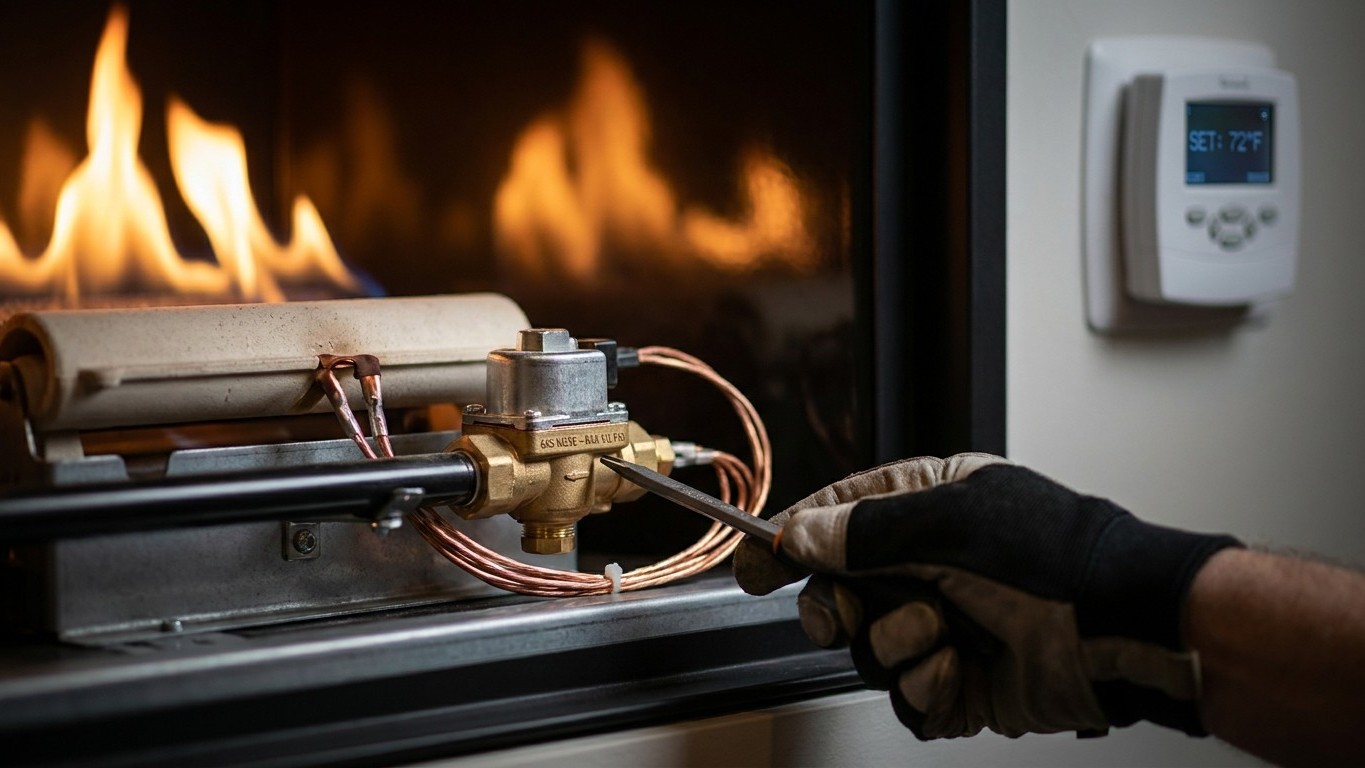

Yes, a gas fireplace can run on a thermostat, but only if the valve behind it is built to accept one. Some units only understand on and off. Others can read a temperature signal and adjust flame height to match it. The difference comes down to the valve type and the low-voltage wiring inside the firebox, not to any thermostat you might buy at a hardware store.
Three ways to control it

Every gas fireplace ships with one of three control setups, and each one has a hard ceiling on what it can do. The first is a manual switch, usually a wall-mounted toggle or a knob at the appliance itself. It does exactly one thing: opens the gas valve fully or shuts it off. There’s no in-between, no temperature reading, nothing.
The second is a handheld remote with a thermostat mode built into its menu. These remotes talk to the valve over a low-voltage signal and can hold a room at a set temperature by cycling the burner on and off, or in some models, by throttling flame height up and down. The remote itself contains the temperature sensor, which matters more than it sounds like it should (more on that below).
The third setup is a wall-mounted thermostat wired directly to a millivolt valve, similar in appearance to a furnace thermostat but electrically nothing alike. This setup lets you mount the sensor away from the fireplace, in a spot that reflects actual room conditions, which the remote-on-the-mantel approach can’t do.
How to check which one you have
The valve body inside the fireplace usually carries a model number and a wiring diagram printed right on it or in the owner’s manual. Look for terms like “millivolt,” “standing pilot,” or “thermostat compatible.” If the manual lists a thermostat wattage rating or shows a two-wire terminal marked TH/TR, the valve is built for one. If the only control path shown is a wall switch with two wires and no valve modulation described, you’re looking at an on/off-only appliance, and no thermostat, wall-mounted or otherwise, will add flame modulation that the valve was never designed to do. When in doubt, the model number on the valve, cross-referenced with the manufacturer’s spec sheet, settles it faster than trial and error with wiring.
Why an ordinary house thermostat may not work
A furnace thermostat and a millivolt gas fireplace thermostat look similar on a wall, but they run on completely different electrical logic, and that mismatch is where a lot of installs go wrong. A standard central-heat thermostat is built around a 24-volt transformer circuit pulled from the furnace or air handler. A millivolt gas valve has no transformer at all. It generates its own tiny current, a fraction of a single volt, from the heat of the standing pilot flame acting on a thermocouple or thermopile. That’s the entire power budget the valve has to work with.
Wire a 24-volt thermostat into a millivolt circuit and the most common result is nothing happening at all. The thermostat’s internal switch is designed to handle a load the millivolt system can’t supply, so the valve simply doesn’t respond to calls for heat. In some cases the mismatch does worse than nothing: components rated for one voltage range can be damaged or behave erratically when exposed to a circuit they weren’t built for, and troubleshooting a fireplace that “sort of” works is harder than fixing one that clearly doesn’t.
The valves also differ in how much resistance or load they tolerate on the thermostat leads, so even two millivolt-labeled thermostats aren’t automatically interchangeable across brands. The manufacturer’s manual for the fireplace itself will specify the exact thermostat type and wiring configuration the valve accepts, sometimes down to the millivoltage output range. That document, not a general assumption about how thermostats work, is the starting point.
This is also where an unvented appliance changes the stakes. Currently manufactured unvented gas room heaters carry an oxygen depletion sensor under the industry’s voluntary standard, a sensor built to shut off the gas before carbon monoxide reaches a dangerous concentration. That safety component is tied into the valve’s existing circuit. Rewiring or bypassing any part of that circuit to force in an incompatible thermostat risks interfering with a safeguard that has nothing to do with comfort control. An unvented appliance has no flue to carry combustion byproducts outside; it depends entirely on the room’s own ventilation, and a maladjusted burner or restricted airflow is how carbon monoxide can build to a fatal level in that setup. Since carbon monoxide is colorless and odorless, a working carbon monoxide alarm is the only way a household would know something had gone wrong. None of this is a reason to avoid thermostats on gas fireplaces; it’s a reason to have a licensed technician confirm compatibility before any wire gets connected, rather than testing it by hand.
Where the sensor should be
A thermostat only manages what its sensor actually measures, and that’s the detail that trips up more installs than the wiring does. A handheld remote sitting on the mantel, directly above an operating firebox, is reading radiant heat from the fire itself, not the air temperature of the living room ten feet away. The result is a fireplace that shuts off long before the room feels warm, because as far as the sensor is concerned, the room already is warm.
The same problem shows up in reverse near a drafty window or an exterior wall. A remote or wall thermostat placed close to a cold surface reads the chill from that surface and keeps calling for more heat, running the appliance longer than the room actually needs. Either way, the fireplace ends up managing the sensor’s immediate surroundings instead of the space the household is trying to heat.
A wall-mounted thermostat wired to the millivolt valve solves this by letting the sensor live somewhere the mantel-top remote can’t: on an interior wall, at a normal thermostat height, away from direct flame radiation and away from window drafts. That’s also the same logic that governs thermostat placement for central heating systems, and the considerations carry over almost exactly. For a fuller rundown of where household thermostats read reliably and where they get fooled by their surroundings, see our companion piece on thermostat placement.
Whatever type of fireplace is involved, vented with a flue to the outside, direct-vent with a sealed wall terminal pulling combustion air from outdoors, or vent-free releasing everything including water vapor into the room, the clearance and maintenance basics from the U.S. Fire Administration don’t change with the control method. The agency advises to “keep anything that can burn at least 3 feet from all heat sources including fireplaces, wood stoves, radiators, space heaters or candles,” and to “maintain heating equipment and chimneys by having them cleaned and inspected each year by a professional.” A thermostat that runs the appliance longer, or more often doesn’t reduce the need for either of those habits. And if a gas smell ever shows up while any of this is being sorted out, the answer isn’t troubleshooting the thermostat. It’s leaving the house and calling from outside.
Common questions
Can I add a thermostat to a fireplace that only has an on/off wall switch?
Only if the valve behind that switch is rated for thermostat wiring in the first place. A switch alone doesn’t tell you the valve’s capability; the valve’s model number and manual do. If the valve was built strictly as on/off, no thermostat will add modulation it was never designed to perform.
Will a smart thermostat work with a millivolt gas fireplace valve?
Most smart thermostats are built around the same 24-volt assumption as standard furnace thermostats, so the same mismatch applies. Some manufacturers offer millivolt-compatible accessories specifically for gas fireplaces; a general-purpose smart thermostat pulled from a big-box shelf usually isn’t one of them without confirming compatibility first.
Why does my fireplace shut off before the room feels warm?
The likely cause is sensor placement, not a broken thermostat. A remote or sensor sitting close to the fireplace itself reads radiant heat rather than room air temperature and cuts the flame early. Moving the sensing point to an interior wall away from the firebox usually corrects it.
Does adding a thermostat affect how safe an unvented gas fireplace is?
The thermostat itself doesn’t change the appliance’s built-in safety components, but any wiring work near the valve should be done by someone who understands that unvented units rely on room ventilation and an oxygen depletion sensor circuit. Confirming compatibility with the manufacturer’s manual, and having an installer handle the wiring, keeps that safeguard intact.