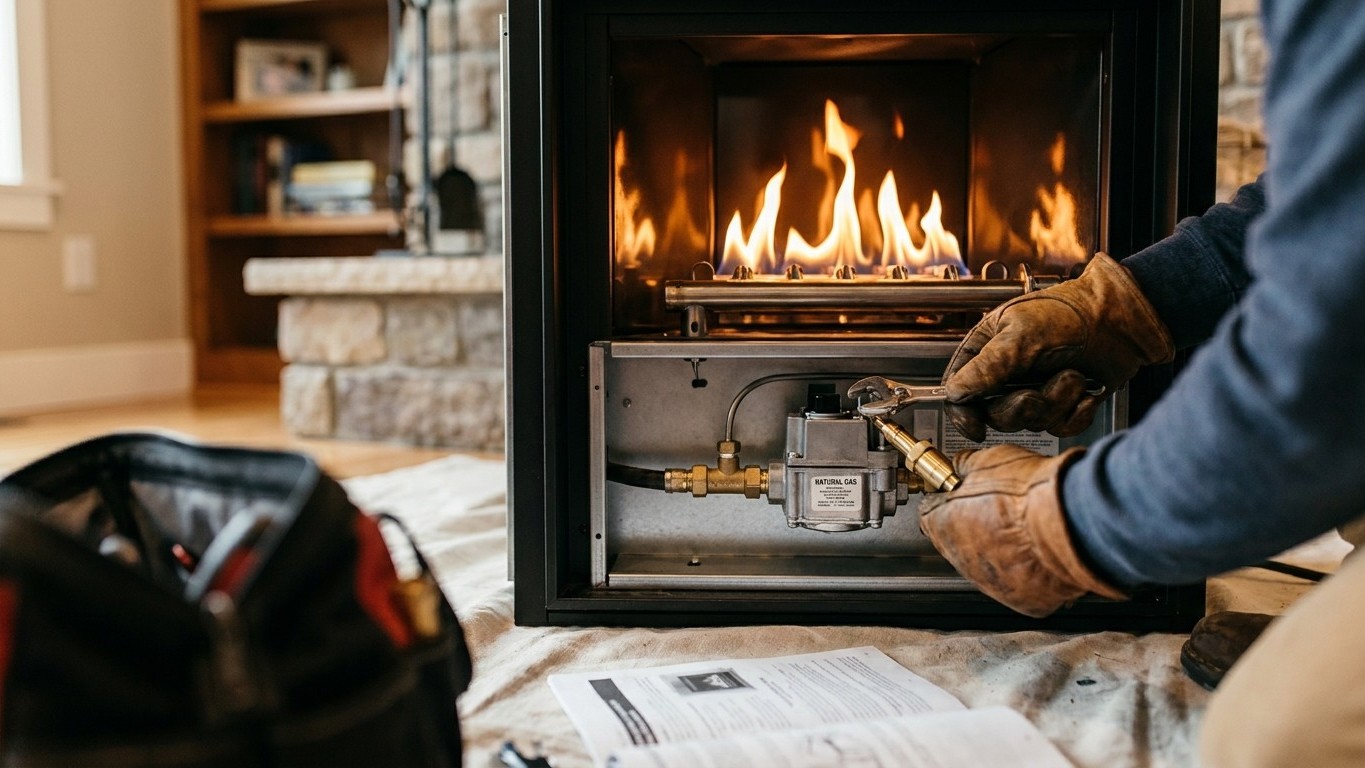

The direct answer: a propane or natural gas fireplace performs the same job, but the fuels are not interchangeable inside the same box. Natural gas is piped in continuously and burns at a lower pressure; propane arrives by tank and burns hotter per cubic foot, so it needs a smaller orifice. The real Differences show up in three places: what the appliance itself is built to burn, how the fuel actually reaches your house, and what you pay to keep the flame going.
The appliance is built for one of them

Here’s what catches a lot of buyers off guard: a gas fireplace isn’t a universal box that happens to run on whatever fuel line is nearby. It’s manufactured with orifices, valves, and a regulator sized for one specific gas pressure. Natural gas burns at roughly half the pressure of propane, so a burner built for natural gas simply can’t be fed propane through the same openings, and vice versa. Too much fuel through an orifice sized for the wrong gas means incomplete combustion. Too little means a weak, sputtering flame that won’t heat the room it’s supposed to.
That’s why manufacturers sell conversion kits, and why those kits are meant to be installed by a qualified technician, not swapped in over a weekend. A conversion isn’t a matter of screwing on a different fitting. It changes the orifice size, sometimes the regulator, and occasionally the control valve, and it has to match that specific model’s specifications exactly. Running an appliance on the wrong gas without that conversion isn’t a performance compromise you can just live with. It’s a real hazard, full stop.
Why the wrong fuel is dangerous, not just inefficient
Incomplete combustion produces carbon monoxide, and carbon monoxide is colorless and odorless. An alarm is the only way a household actually detects it, because your nose and eyes won’t. This matters more with vent-free appliances, which release all their combustion byproducts, including water vapor, directly into the room, than with vented units that send everything outdoors through a flue, or direct-vent models that draw combustion air from outside and exhaust through a sealed wall terminal. A vent-free unit depends entirely on ordinary room ventilation and correct burner adjustment, according to the U.S. Consumer Product Safety Commission, and inadequate airflow or a maladjusted burner (say, from a mismatched orifice) can let fatal levels of CO accumulate.
Currently manufactured unvented gas-fired room heaters carry an oxygen depletion sensor under the industry’s voluntary standard, which the CPSC says shuts off gas flow before carbon monoxide reaches a life-threatening level. That standard is voluntary; CPSC actually revoked a mandatory version of it back in 1984, by which point 95 to 100 percent of manufacturers had already fallen in line anyway. None of that replaces a proper conversion, or the U.S. Fire Administration’s basic advice to have heating equipment and chimneys cleaned and inspected each year by a professional.
Where each one comes from
The mechanical difference between the two fuels translates into a very practical one once the appliance is installed. Natural gas comes through a buried pipe connected to a utility main, and it’s billed continuously, the same way water or electricity is. You turn the valve, gas flows, and it keeps flowing as long as the utility’s infrastructure reaches your street and your account is in good standing. There’s no tank to watch, no delivery truck to schedule, no gauge to check before a cold snap.
Propane works on a completely different supply model. It arrives by truck and gets pumped into a tank that you either own outright or rent from a supplier, usually sitting in the yard or buried alongside the house. That tank has a finite volume, and unlike a gas line, it can run empty. A fireplace, furnace, or water heater running on propane is only as reliable as the level in that tank and the timing of the next delivery.
What that means when it’s cold
This distinction stops being theoretical the first time a January cold snap hits and a propane tank runs low. Natural gas users don’t think about supply during a cold stretch, because the pipeline doesn’t care how many degrees below freezing it is outside. Propane households do have to think about it: heavy heating demand during a stretch of extreme cold can draw a tank down faster than expected, and delivery trucks get backed up exactly when everyone else’s tank is also running low. Rural properties without access to a natural gas main don’t get a choice in the matter, propane is often the only piped or tank-delivered gas option available, which is a big part of why it remains common in areas a utility line has never reached.
None of this changes the day-to-day safety basics either fuel demands. The U.S. Fire Administration’s standing advice applies regardless of what’s in the line or the tank: keep anything that can burn at least 3 feet from all heat sources including fireplaces, wood stoves, radiators, space heaters, or candles. A propane tank running low is an inconvenience. A space heater or fireplace sitting too close to curtains or furniture is a fire waiting to happen, and that risk doesn’t discriminate between fuels.
Which costs more to run
Cost is where the honest answer gets less satisfying than most people want. Propane usually costs more per unit of heat delivered than natural gas, largely because it has to be extracted, transported by truck, and stored in a tank rather than flowing continuously through shared utility infrastructure. That extra handling shows up on the bill. But “usually” is doing real work in that sentence, because local pricing swings hard from one region to another, one supplier to another, and one season to another.
A household with a natural gas main already running to the street has an easy comparison to make: check the local utility rate against a propane supplier’s delivered price and decide from there. A household without access to that main doesn’t really have a comparison to make at all. If there’s no gas line reaching the property, propane isn’t the more expensive option, it’s the only option, short of switching to electric heat entirely. That’s the detail that gets lost when people ask which fuel is “cheaper” as if it were a simple number to look up.
What actually moves the number
A few practical factors tend to shift the real-world cost comparison more than people expect:
- Distance from the nearest natural gas main, since running new pipe to a rural property can be its own significant expense before the first flame is ever lit
- Whether the propane tank is owned or leased, since leased tanks often come with supplier restrictions on who can deliver fuel
- Regional propane pricing, which fluctuates with weather-driven demand and delivery logistics in a way piped natural gas typically doesn’t
- How the appliance is actually used, since a fireplace run occasionally for ambiance draws far less fuel than one used as a primary heat source through a full winter
Anyone comparing the two fuels for a specific property is better off pulling actual local rates, from the utility and from a propane supplier, rather than relying on a national average that may not reflect what’s happening on their own street this particular winter.
Common questions
Can I just swap a natural gas fireplace to run on propane myself?
No. The orifice sizes, and sometimes the regulator, are different for each fuel. A manufacturer-specific conversion kit installed by a qualified technician is the only safe way to switch an appliance from one gas to the other.
Is a vent-free fireplace safe to run on either fuel?
Vent-free units release combustion byproducts directly into the room and depend on adequate room ventilation and a correctly adjusted burner, according to the CPSC. That makes precise fuel-matched orifice sizing more critical for vent-free models than for vented or direct-vent units that exhaust outdoors.
How would I know if my gas fireplace is producing carbon monoxide?
Carbon monoxide is colorless and odorless, so a working CO alarm is the only reliable way a household can detect it. Sight or smell alone won’t tell you.
What should I do if my propane tank runs low in the middle of winter?
Contact your supplier as soon as you notice the level dropping rather than waiting for the tank to empty, since cold-weather demand can slow delivery schedules across an entire region at once. And if you ever smell gas from any appliance, leave the house and call from outside before doing anything else.