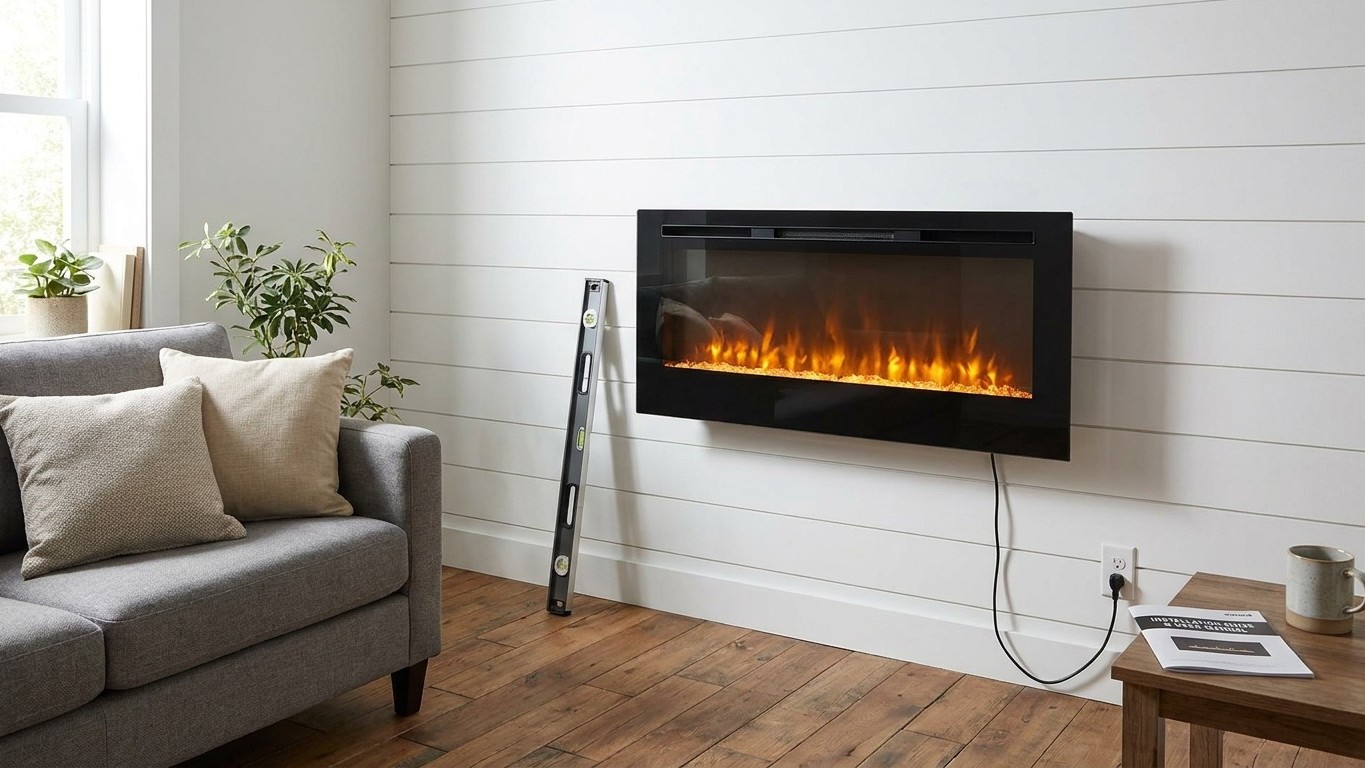

An electric fireplace installs the same way no matter the format: find a spot near an outlet, mount or set it in place, check the clearances printed in the manual, and plug it into power. Wall-mounted units need studs and a level. Inserts slide into an existing firebox or a built cabinet. Freestanding units just need floor space and a nearby socket. None of the three touch a chimney, a gas line, or a permit office.
What it does not need

Here is the part that changes everything about where this appliance can go: there is nothing to vent. No flue pipe running up through the roof. No gas line snaking behind the wall. No combustion air intake cut into an exterior wall. No inspector signing off on a venting permit before you can strike a match. An electric fireplace does not need any of that because it does not burn anything to make heat.
No combustion, no flue, no carbon monoxide, no water vapor. That is the honest advantage, and it is worth stating plainly rather than burying it in marketing language. A wood or gas fireplace produces byproducts that have to go somewhere, which is why building codes are so specific about clearances to combustibles, makeup air, and chimney height. An electric unit produces none of that, so the entire venting chapter of the code simply does not apply.
Where that opens the door
Take away the flue requirement and the list of eligible rooms gets a lot longer. A bedroom on the second floor of a colonial, nowhere near an existing chimney, becomes a candidate. So does an interior wall in the middle of a ranch-style house, a wall that a wood-burning insert could never back onto because there is no path to the outside. Apartments and rental units, where landlords will not allow any structural venting work, are often the best fit of all: an electric fireplace can go in and come out again without a contractor, a permit, or a hole in the wall that has to be patched before the security deposit is returned.
The tradeoff is scale. A plug-in electric fireplace running on a standard 120-volt household circuit is built at or below about 1,500 watts, which works out to roughly 5,000 Btu per hour. That is enough to warm one room, not a house. Homeowners who want whole-home heat still need a furnace, a heat pump, or a wood-burning system sized for the job. What the electric fireplace does is bring supplemental warmth and the look of a fire into a specific room, with none of the structural work that a real hearth demands.
Fixing it safely
Once the room is chosen, the mounting work is mostly carpentry. Wall-mounted units are heavier than they look once the housing, the heater, and the glass are all accounted for, so hanging one on drywall anchors alone is asking for trouble. Run a stud finder across the intended spot, mark the stud centers, and use the mounting bracket’s own hole pattern to line up with wood rather than plaster or drywall compound. Most brackets are designed to catch at least two studs, spread the load, and keep the unit level over years of use.
Every model ships with a set of clearance numbers, and those numbers are not suggestions. The distance required above the unit, below it, and out to each side is specific to that appliance’s heat output and housing design, and it is printed in the installation manual that comes in the box, not on a general spec sheet online. Skipping that step and eyeballing the gap is the single most common mistake in a DIY install, because a unit that looks fine sitting on a mantel can be too close to trim, cabinetry, or a TV mounted above it.
Airflow matters even without a flame
It is easy to assume that a device with no flame and no exhaust does not need airflow at all. That is not true. An electric fireplace still moves air: cool air is drawn in through an intake, passed over a resistive heating element, pushed out through a fan, and released into the room as warm air. Block that intake with a rug, a decorative screen, or furniture pushed too close and the unit either underperforms or shuts itself down on a safety cutoff. Keep the intake and outlet vents clear the same way you would with a portable space heater, because mechanically, that is essentially what is inside the cabinet.
The flame effect itself is worth understanding for exactly this reason. What flickers behind the glass is LEDs and a moving reflector or gauze panel, a lighting trick, nothing more. The heat comes from a separate resistive element and a fan, running independently of the visual effect. You can run the flame with the heater off, which is common in warmer months, and the room temperature will not move. Nobody should assume the pretty light show is doing any of the warming.
The socket, and what not to do
The electrical side of the install is where good intentions go wrong fastest. A 1,500-watt draw is a real, continuous load, and it needs a dedicated outlet positioned close enough to the fireplace that the factory cord reaches without strain. Dedicated means that outlet is not also feeding a window air conditioner, a space heater in the next room, or a string of holiday lights, because shared circuits trip breakers and, worse, overheat wiring that was never sized for two heavy loads at once.
What a 1,500-watt electric fireplace should never sit on is an extension cord or a power strip. Both are built for light, intermittent loads like lamps and phone chargers, not for hours of continuous current at a wattage that runs hot even through properly rated wire. A closer look at why an extension cord is the wrong choice for high-wattage appliances lays out exactly how that kind of overload starts a fire, and the mechanism is the same whether the appliance at the other end is a fireplace or a heater.
The U.S. Fire Administration’s guidance on heat-producing appliances applies here without any asterisks for the word “electric.” As the agency puts it: “Keep anything that can burn at least 3 feet from all heat sources including fireplaces, wood stoves, radiators, space heaters or candles.” That 3-foot rule covers curtains, bedding, stacked firewood used only for looks, and the couch pushed a little too close for a better view of the flame. The agency also advises: “Turn space heaters off when leaving the room or going to bed.” An electric fireplace with its heater engaged is functionally a space heater with a nicer face, and it deserves the same habit: off when the room empties out, off before the lights go off for the night.
Common questions
Can an electric fireplace be installed on any interior wall?
Yes, as long as the wall can support the mounting bracket on studs and there is a dedicated outlet nearby. Because there is no venting requirement, interior walls with no connection to the outside are fair game in a way they never would be for a gas or wood unit.
Does an electric fireplace need a special outlet?
It needs a standard, code-compliant 120-volt outlet that is not shared with other heavy appliances. It does not need a special voltage or a dedicated circuit breaker beyond what any single high-wattage appliance in a home would require, but that outlet should not be an extension cord or power strip.
How much of a room can an electric fireplace actually heat?
A unit at or below about 1,500 watts, roughly 5,000 Btu per hour, is built to supplement heat in a single room. It is not designed or sized to replace a home’s primary heating system.
Is there carbon monoxide risk with an electric fireplace?
No. An electric fireplace burns nothing, so there is no flue gas, no carbon monoxide, and no combustion air requirement. That is the core difference between an electric unit and a gas or wood-burning one, and it is why installation is so much less restrictive.