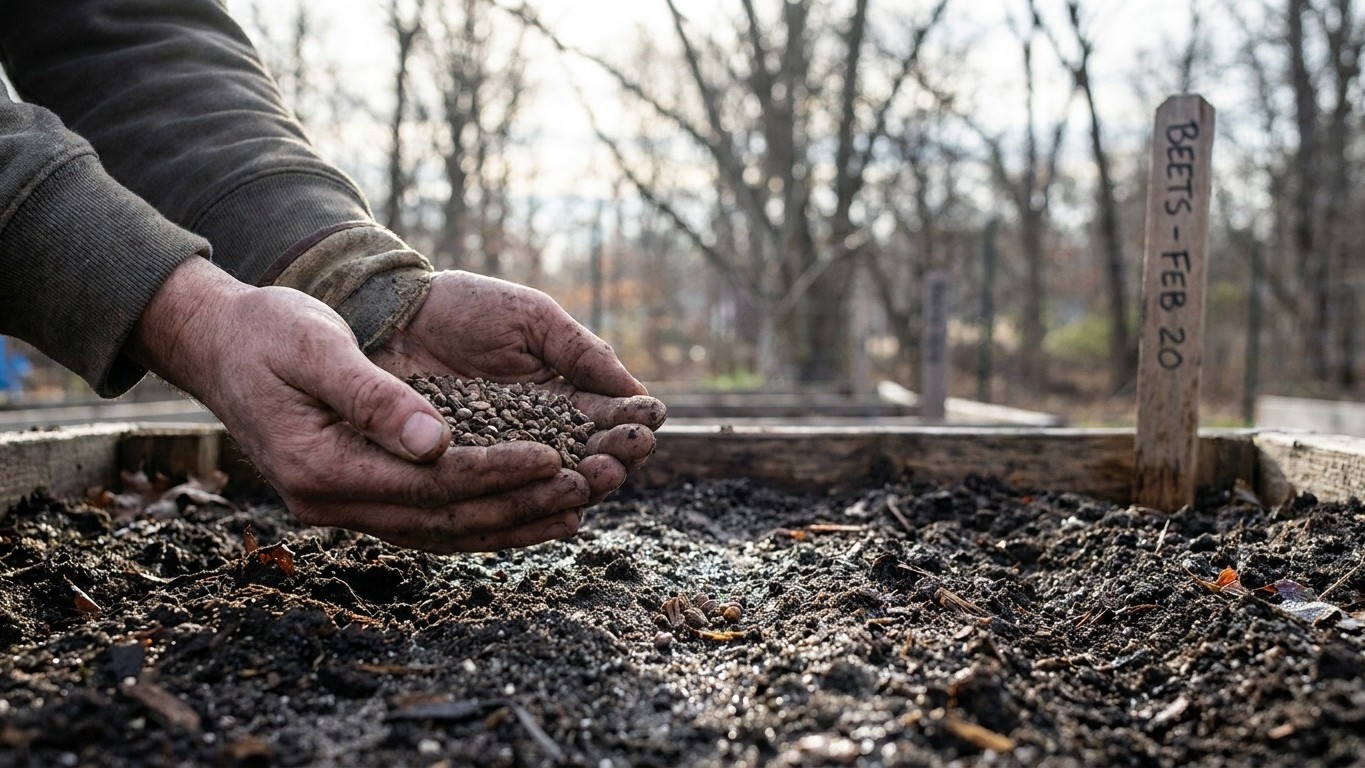

In the Piedmont, where NOAA’s 1991-2020 climate normals put the last spring frost between March 23 and April 5, beets go into the ground about two to three weeks before that window closes, meaning early-to-mid March for most Piedmont gardens. Coastal plain soil warms sooner, so sowing can start a bit earlier there; the Blue Ridge mountains lag by several weeks. Beets are direct-seeded, never transplanted, and take 60 to 80 days from that sowing date to reach harvest size.
The short answer
Start with the ground itself. North Carolina’s benchmark soil, the Cecil series, is an Ultisol, an old, heavily weathered and leached soil type that formed under long stretches of humid heat and lost much of its native fertility along the way. USDA’s Soil Survey Geographic Database lists the surface horizon of a representative Cecil profile, drawn from 636 mapped components, at 68 percent sand, 13 percent clay and 20 percent silt, with organic matter running about 0.8 percent and a surface pH near 5.5, slightly acid. Drainage class: well drained.
For a beet, that mix cuts both ways. The sand fraction means water moves through fast, so a bed rarely sits soggy, which beets tolerate poorly anyway. But the same sand drains away moisture just as quickly during a dry stretch, and with organic matter sitting at only 0.8 percent there is little in the soil to hold that water once rain stops. Utah State University Extension’s guidance for the crop calls for soil that is deep, sandy and well drained, rich in organic matter, amended with no more than 1 inch of composted material per 100 square feet. Cecil-type ground checks the sand and drainage boxes and falls short on the organic-matter one, by a wide margin.
Then there’s heat. Utah State’s research notes that once temperatures climb above 85 F while the plant is also short on water, the root turns woody, an outcome no amount of prep salvages once it happens. North Carolina’s Piedmont, where the reference frost dates on this page were recorded, runs hot summers, and stretches above 85 F show up well before the calendar reaches midsummer in most years. The climate-normals dataset used here does not publish a count of days above any particular temperature threshold for the region, so no specific number appears on this page, but the practical point stands regardless: the window that works for beets closes well before the deepest heat of the season arrives.
One caution belongs at the top of any soil discussion built around a single series. Cecil is the profile USDA lists as representative of North Carolina under its State Soils program, not a survey of every backyard in the state. North Carolina spans hundreds of mapped soil series, and a garden on river bottomland, in hill country, or on ground a builder graded and refilled can look nothing like this figure. Treat it as a starting point that shows what Piedmont ground tends to do, then confirm the actual number for a specific yard with a soil test.
The six weeks that decide it here
NOAA’s 1991-2020 climate normals put the Piedmont’s last spring freeze, the 32 F threshold, somewhere between March 23 and April 5. Sowing beets two to three weeks ahead of that date lands most Piedmont gardeners in early-to-mid March, with the coastal plain warming sooner and the Blue Ridge running several weeks behind. Wherever the exact date falls locally, the seed goes into ground that is still cool, and the six weeks that follow set up almost everything that happens for the rest of the season.
That stretch, roughly mid-March through the end of April in the Piedmont, is the same window when the region swings between cold fronts dropping rain and runs of dry, sunny days as the jet stream shifts north for spring. It is not a steady, predictable soak the way a coastal winter can be, nor a reliable dry spell either. A bed can go from saturated to crusty within a week, and Cecil-type sandy ground, draining fast and holding little organic matter to buffer that swing, tends to track the sky closely rather than smoothing it out.
Utah State’s research is specific about what that instability costs a beet: water stress in the first six weeks after sowing causes premature flowering, or bolting, and once a beet bolts, root development effectively stops. That is a separate failure from the woody-root problem tied to later summer heat, and it happens earlier in the season, while the plant is still small and easy to overlook on a quick walk through the garden. A single dry week in late March or early April, on a sandy Piedmont bed with no mulch, is enough to tip a stand toward bolting before a gardener notices anything is wrong above ground.
The practical answer isn’t complicated, even if the weather driving it is. Keep the bed evenly moist through those first six weeks rather than waiting for the soil surface to look dry, since sandy ground can look fine on top while the root zone underneath has already lost its water. A layer of mulch buys a few extra days between waterings and evens out the gap between a wet front rolling through and the dry, sunny run that typically follows behind it in a Piedmont spring.
What goes wrong here
- Bolting during the first six weeks. Cecil-type sandy ground, 68 percent sand, drains fast, and with organic matter around just 0.8 percent there is little to hold moisture between the Piedmont’s swinging spring fronts and dry stretches. A week of thirst while the beet is small pushes it toward flowering early, per Utah State University Extension, and once that happens root growth is effectively finished. Water on a set schedule through the first six weeks rather than waiting for visibly dry soil, and mulch to smooth out the gaps between rain events.
- Woody roots once summer heat arrives. Utah State’s research ties woody texture to temperatures above 85 F combined with water stress, a combination the Piedmont reaches well before the peak of summer. Sowing on schedule, two to three weeks before the local last frost, gives a beet its full 60 to 80 days from seeding to reach harvest size before that heat sets in. Pushing the sowing date back even a couple of weeks narrows that margin considerably.
- Thin, starved roots from low native fertility. Organic matter near 0.8 percent in representative Cecil soil falls well short of what Utah State’s guidance calls for in a beet bed. Work compost into the bed ahead of sowing, capped at 1 inch per 100 square feet per that guidance, rather than assuming a sandy, well-drained bed is automatically fertile just because water moves through it easily.
- Guessing instead of testing. The Cecil profile is a statewide representative figure built from hundreds of sampled components, not a reading of any one garden. A yard sitting on old fill, river bottomland, or a different mapped series entirely can carry a very different pH, texture and organic-matter level. A soil test from the local extension office replaces that guesswork with the actual number for a specific bed before a season gets spent amending for the wrong problem.
Common questions
How many days do beets take to mature after sowing in North Carolina?
Utah State University Extension lists 60 to 80 days from seeding to harvest for beets, counted from the date the seed goes into the ground. Beets are direct-sown, so this timeline never starts from a transplant date.
Does the sowing date change between the coastal plain, the Piedmont and the mountains?
Yes. The March 23 to April 5 last-frost window from NOAA’s climate normals applies to the Piedmont reference station used on this page. The coastal plain typically warms earlier in spring, while the Blue Ridge mountains to the west run several weeks later, shifting the two-to-three-week-before-last-frost sowing target in each direction.
Is my garden soil the same as the Cecil series described here?
Not necessarily. Cecil is the series USDA lists as representative of North Carolina under its State Soils program, drawn from measurements across 636 mapped components. The state contains hundreds of other soil series, and any one yard, especially bottomland, hill country, or graded fill, can differ completely. A local soil test gives the actual figures for a specific garden rather than a statewide average.
How much compost should go into a beet bed before sowing?
Utah State University Extension recommends no more than 1 inch of composted organic matter per 100 square feet worked into the bed, since beet roots respond poorly to soil that runs too rich, too loose or too dense for their needs.