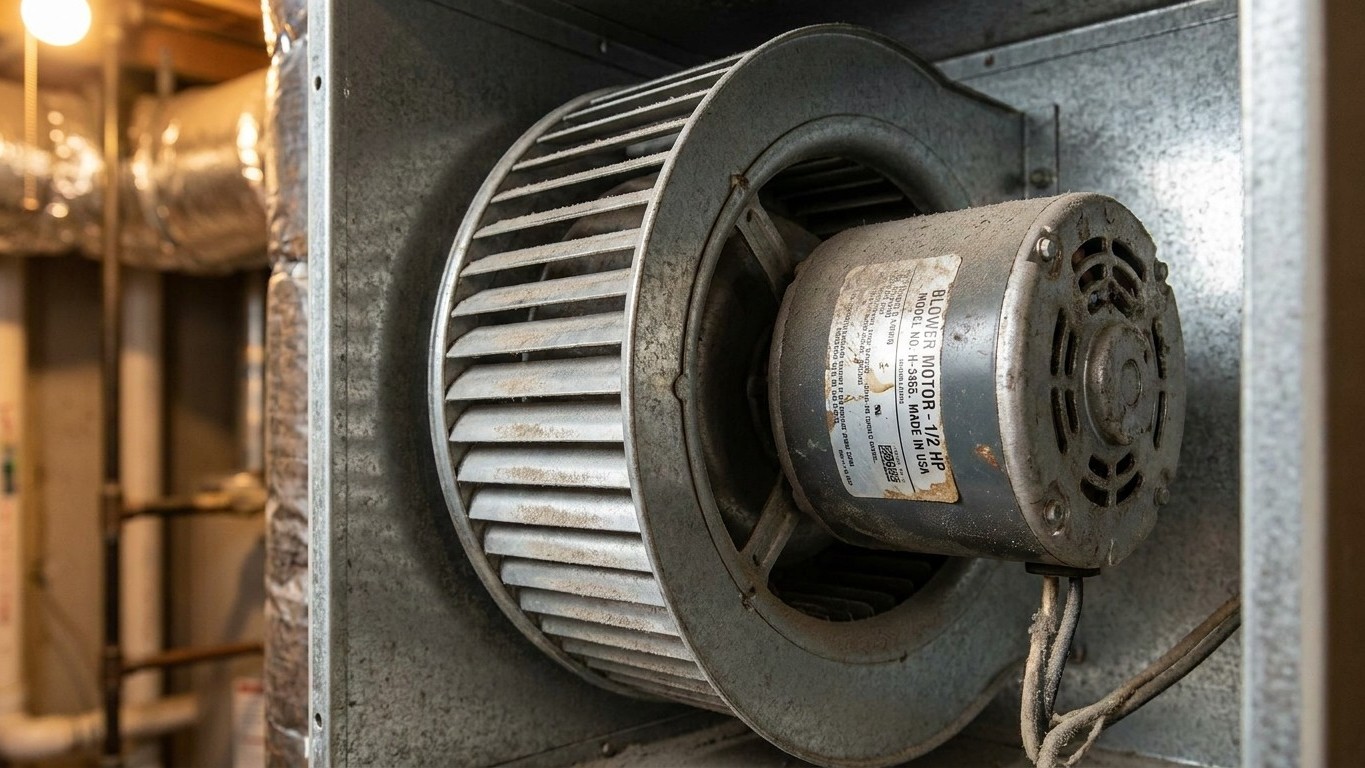

The blower motor is the fan that pushes heated (or cooled) air through the ductwork and into every room. Nothing else in the system does that job. A furnace can produce plenty of heat at the burner, but if the blower motor is weak, dirty, or dying, the warm air never makes it past the cabinet. Homeowners usually meet this part only when something’s wrong with it: a new noise, weak airflow, or a system that won’t start.
Everything you feel comes from here

Split a furnace into two jobs and the picture gets simple fast. The burner makes heat. The blower motor moves it. Those are separate tasks handled by separate parts, and only one of them ever reaches your living room. A furnace can have a burner running exactly as designed, full flame, correct combustion, everything by the book, and still leave the house cold if the blower can’t push that heated air through the ducts. The heat just sits in the cabinet.
The same fan does double duty if the house has central air conditioning tied to the same ductwork. In summer, the blower motor moves the cooled air from the evaporator coil out to the registers. So this single part works essentially year-round in a lot of homes, heating season and cooling season both, with maybe a few shoulder-season weeks where it barely runs at all.
That workload is exactly why it fails before other parts. A gas valve or an igniter might cycle a handful of times a day. The blower motor, on the other hand, can run for hours at a stretch, especially on cold snaps or hot spells when the system barely shuts off. More run-hours means more wear on bearings, more heat cycling through motor windings, more dust pulled through the housing. None of that is a design flaw. It’s just physics catching up with a part that works harder than almost anything else in the system.
That’s worth sitting with for a second, because it changes how you should think about blower problems. This isn’t a part that breaks because something went wrong. It’s a part that wears out because it’s been working the whole time everything else looked fine. A blower motor failure at year twelve or fifteen isn’t bad luck. It’s closer to a worn brake pad: an expected wear item finally reaching the end of its service life. That framing matters when a technician mentions replacing it. It’s not a sign the furnace was poorly made. It’s a sign the furnace was being used.
Two kinds, and why the newer one behaves differently
Furnaces built years ago mostly used single-speed blower motors. Simple concept: the motor is either off or running at one fixed speed. When the thermostat calls for heat, the blower kicks on at full output and stays there until the call ends. No ramping, no adjustment, no in-between state. It’s a light switch, not a dimmer.
Newer furnaces increasingly use variable-speed blower motors instead. These ramp up gradually at the start of a cycle, hold a target airflow rate rather than a fixed speed, and adjust that output in response to conditions inside the ductwork. The motor’s internal control constantly reads how much resistance it’s working against and adjusts power to keep delivering roughly the same volume of air, even as conditions change.
That difference shows up in daily life in ways an occupant actually notices, not just in a spec sheet.
| What you notice | Single-speed motor | Variable-speed motor |
|---|---|---|
| Start-up | Full blast immediately | Gradual ramp-up, softer start |
| Noise | One consistent sound level | Quieter at start and low demand, louder as it ramps |
| Run length | Shorter, full-power bursts | Longer, lower-power stretches |
| As the filter loads up | Simply moves less air, no compensation | Works harder to hold the same airflow, hiding the problem |
That last row is the part most people never get told, and it’s genuinely useful to understand. On an old single-speed motor, a dirty filter shows up fast: airflow drops, rooms get noticeably weaker heat, and the decline is obvious enough that most people notice within a few weeks. On a variable-speed motor, the control board compensates. It ramps the motor harder to push the same volume of air through a filter that’s getting harder to breathe through. From the register, everything feels normal. The airflow doesn’t seem to change.
What’s actually happening is the motor working progressively harder against progressively more restriction, quietly, for weeks or months, until either the filter gets changed or the motor reaches a load it can’t sustain. Variable-speed technology is genuinely an upgrade in comfort and efficiency, but it comes with this tradeoff: it masks the exact warning sign that used to tell people it was time to change the filter. The compensation is invisible right up until it isn’t.
What a failing blower looks like
Blower motor failure isn’t usually sudden. It tends to move through a fairly predictable sequence of symptoms, and catching it early in that sequence is what keeps a filter problem from turning into a motor replacement.
- A squeal at start-up. Often the first sign, most noticeable in the seconds right after the blower kicks on, then fading or disappearing once the motor’s up to speed. This points toward bearing wear or a belt issue on older blower assemblies.
- A rumble or vibration that wasn’t there before. A steady, low-frequency noise or a felt vibration through the cabinet or ductwork, present through the whole run rather than just at start-up.
- Air that’s become weak at every register. Not one room, all of them, evenly. Airflow that used to feel strong now feels thin, house-wide, even though the thermostat says the system is running.
- The motor running hot and cutting out on its own. Modern blower motors have thermal protection built in. If the motor overheats, this safety shuts it down rather than letting it cook itself. The system stops mid-cycle, then may restart once things cool, then stop again.
- Not starting at all. The final stage. The furnace may still ignite, or attempt to, but no air moves through the ducts.
The single most common driver behind that entire sequence is a filter nobody’s kept up with. The U.S. Department of Energy’s ENERGY STAR program puts it plainly: “Airflow problems can reduce your system’s efficiency by up to 15 percent.” A blower fighting a clogged filter isn’t just running inefficiently, it’s running under more mechanical strain than it was built for, which is exactly what accelerates bearing wear and pushes a motor toward that thermal shutdown stage.
ENERGY STAR’s guidance on preventing that is specific: “Inspect, clean, or change air filters once a month in your central air conditioner, furnace, and/or heat pump.” Once a month, not once a season, and it applies across all three pieces of equipment, not just the furnace.
One more mechanical detail worth knowing: a blower wheel caked in dust is a genuine, physical cause of vibration, separate from bearing wear. The wheel is a set of curved blades spinning at speed, and when dust builds unevenly across those blades, the wheel goes out of balance the same way an unbalanced tire shakes a car at highway speed. That vibration isn’t cosmetic. It puts uneven stress on the motor shaft and bearings, and it’s a mechanical problem a filter change alone won’t fix once the wheel itself is fouled.
What is yours and what is not
The line here is short and it’s worth knowing before a technician ever shows up. Changing the filter and keeping the return air grilles clear of furniture, rugs, or boxes stacked in front of them: that’s the homeowner’s job, and it’s the single biggest thing that keeps a blower motor from an early death. It costs nothing but attention, and it’s the one maintenance task that directly affects how hard this part has to work every single day it runs.
Everything past the filter and the return grille belongs to a technician. A run capacitor, the motor itself, the control board that governs a variable-speed unit, and any wiring inside the furnace cabinet are not owner-serviceable, full stop. The same caution that applies to the capacitor on an outdoor air conditioning unit applies here too: a run capacitor holds an electrical charge even after the power to the unit has been shut off. That stored charge doesn’t discharge itself just because a breaker’s been flipped. This is exactly why blower motor diagnosis and replacement is technician work, not a weekend project, regardless of how straightforward the part looks once the cabinet’s open.
What actually speeds up a service call, and often saves a return trip, is showing up with three pieces of information already sorted out. What does the noise actually sound like: a squeal, a rumble, a grinding, a hum that wasn’t there before? When does it happen: right at start-up, partway through a cycle, or constantly the whole time the blower runs? And does it happen in heating, cooling, or both? That last question matters more than it seems, because a noise that only shows up in cooling but never in heating points toward something different than a noise present in both modes, even though the same blower motor and the same fan wheel handle both jobs. A technician walking in with those three answers already in hand can usually narrow the diagnosis before the panel’s even off the furnace.
Common questions
Can a furnace run with the burner working but the blower motor dead?
Yes, and it’s one of the more confusing failures for homeowners to spot, because the furnace may still ignite normally. Without the blower moving air, that heat stays trapped in the cabinet and never reaches the ducts, so the house stays cold even though the furnace is technically running.
Is a loud blower always a sign it’s failing?
Not always, but a change in sound is the signal to pay attention to. A blower that’s always been quiet and suddenly starts squealing at start-up, or develops a steady rumble it didn’t have before, is worth having checked before it progresses further down that symptom sequence.
Does the blower motor affect air conditioning too, or just the furnace?
If central air conditioning shares the same ductwork as the furnace, it’s the same blower motor doing both jobs. A blower problem that shows up in winter heating will very likely show up in summer cooling as well, since it’s one fan moving air for both systems.
Will changing the filter fix a blower that’s already making noise?
Sometimes it helps, especially if the noise is airflow-related strain from a badly clogged filter, but it won’t fix mechanical wear that’s already set in, like worn bearings or a blower wheel that’s gone out of balance from built-up dust. At that stage, a technician needs to look at the part itself.