
There’s no single number that answers “what size furnace do I need,” and that’s the honest starting point. The right size depends on your specific house: its square footage, sure, but also its insulation, its windows, its air leaks, and the coldest temperatures your region typically sees. A furnace sized correctly heats evenly and runs efficiently. One sized by guesswork, including the guess of “match what’s already there,” often doesn’t.
« The same as the old one » is not a calculation

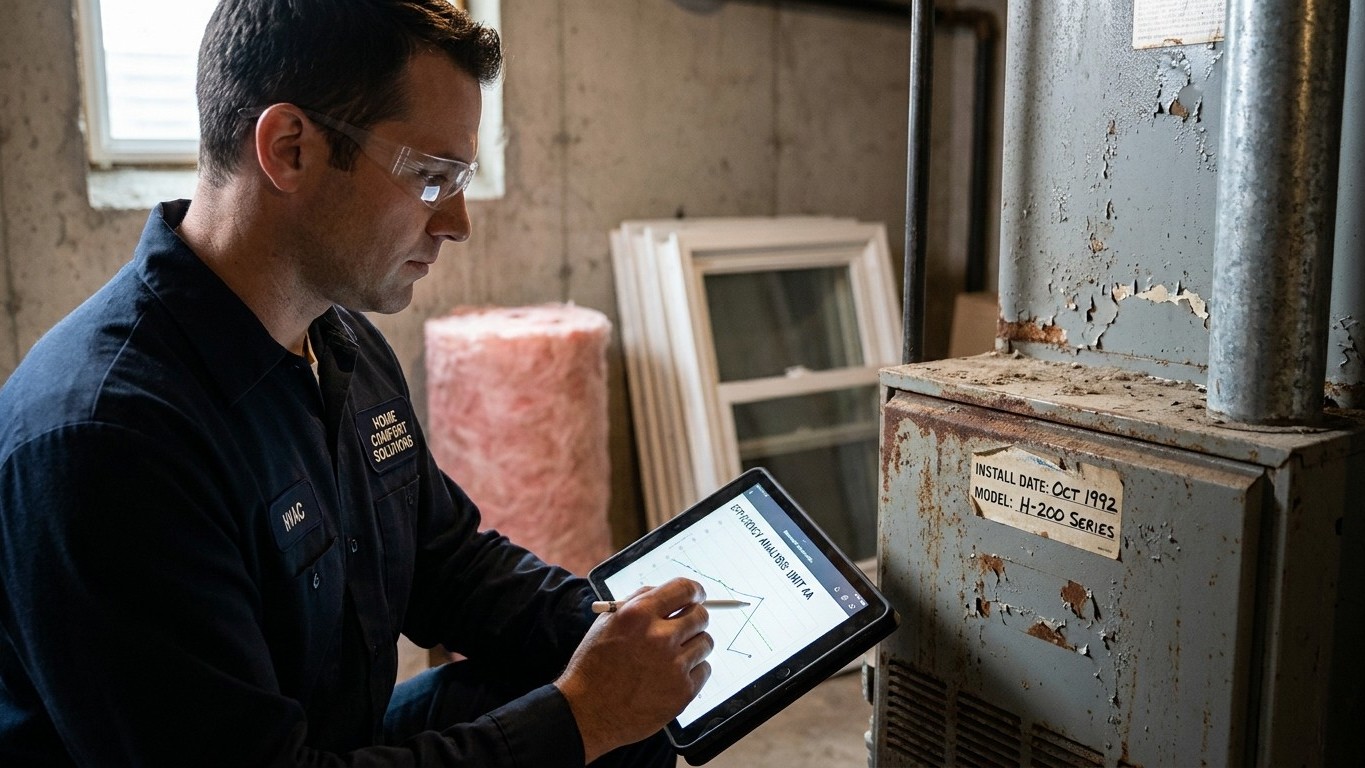
When a furnace fails, the fastest path to a quote is also the least reliable one: replace it with a unit rated for the same output as the old one. It feels safe. The old furnace kept the house warm for years, so why not just match it? The problem is that this logic assumes the old furnace was sized correctly in the first place, and there’s no guarantee of that at all.
Furnaces get oversized for reasons that have nothing to do with your house. A contractor working fast, a distributor with one size in stock, a previous owner who wanted margin for error, a builder who installed the same unit in every house on the block regardless of layout. Oversizing has been common enough for long enough that “the old one” is at best a weak clue about what your home actually needs, not a benchmark to replicate.
Even if that furnace was sized correctly the day it was installed, your house probably isn’t the same house anymore. Windows get replaced with better-sealed, better-insulated units. Attics get insulated or, alternatively, converted into living space that adds square footage without anyone updating the heating math. Additions get built. Weatherstripping gets added, or removed and never replaced. Every one of these changes shifts how much heat the house loses on a cold night, which shifts how much heating capacity it actually needs.
The alternative to matching the old unit is a load calculation. This is not a shorthand, not a rule of thumb, not a chart you can eyeball based on square footage alone. It’s a calculation, using your house’s actual measurements and materials, that determines how much heat escapes on the coldest expected day in your area and therefore how much heating capacity is needed to replace it. Contractors who install furnaces for a living should be running this calculation as a matter of course, not treating it as optional paperwork.
Skipping it doesn’t just risk getting the number slightly wrong. It risks buying a furnace that actively works against the comfort and efficiency you’re paying for, which is the subject of the next section.
What an oversized furnace does
An oversized furnace produces heat faster than the house can absorb and distribute it. That mismatch shows up as short cycling: the furnace fires, reaches the thermostat’s setpoint within a few minutes, and shuts off, only to fire again shortly after because the house has already started cooling. Instead of long, steady runs that spread warm air evenly through every room, you get frequent, brief bursts that heat the rooms closest to the vents while rooms farther down the ductwork barely feel it.
That unevenness isn’t a coincidence of layout. Air distribution takes time. A furnace cycle that ends after a few minutes hasn’t given the blower enough time to push warm air through the full duct run and into every register. The room with the thermostat reads comfortable. The bedroom at the far end of the house does not, and no amount of adjusting the thermostat fixes a problem that’s actually about cycle length, not temperature setting.
There’s a real efficiency cost buried in this pattern too. The U.S. Department of Energy’s ENERGY STAR program notes that “airflow problems can reduce your system’s efficiency by up to 15 percent.” Short cycling is exactly the kind of airflow problem that triggers this: air doesn’t move through the system long enough or consistently enough to do its job, and the equipment works harder for a smaller return.
Frequent starts also wear equipment faster than steady operation does. Every start is a small mechanical stress: motors spinning up, igniters firing, components heating and cooling in quick succession instead of settling into a stable run. A furnace that short-cycles all winter accumulates far more start-stop cycles over its life than one sized to run in longer, steadier stretches, and that extra wear falls on the parts most likely to need service or replacement first.
On systems that share ductwork and a blower with central air conditioning, an oversized furnace creates a second problem downstream. The blower and duct sizing often get set around the furnace’s airflow needs, which means a furnace picked without a proper calculation can leave the cooling side working with equipment that was never actually sized around the house’s cooling load either. One bad number early in the process has a way of propagating through the whole system.
What a load calculation actually looks at
A load calculation isn’t a black box, and it isn’t complicated in concept, even though the arithmetic is best left to someone trained to run it. It works through a defined set of inputs about your specific house:
- Floor area and volume, room by room, not just the total square footage of the house
- Insulation levels in the walls, attic, and floor, since insulation is what slows heat loss in the first place
- Window area and orientation, because a wall of west-facing glass loses and gains heat very differently than a small north-facing window
- Air leakage, meaning how much outside air infiltrates through gaps, cracks, and poorly sealed penetrations
- The local design temperature, which is the typical coldest outdoor temperature your specific region needs to plan around, not the record low
- How the house is actually used, including things like how many people occupy it and how the thermostat is typically managed
Feed those inputs into the calculation and what comes out is a heating load figure, expressed as the amount of heat the house loses on a design-cold day and therefore the amount of heating capacity needed to replace it. That figure, not the old furnace’s rating and not a square-footage guess, is what a correctly sized furnace should be matched to.
Here’s the leverage point worth understanding before you ever get a quote: sealing air leaks and adding insulation before the load calculation is run can lower the number the calculation produces. A tighter, better-insulated house loses less heat, which means it needs less capacity to replace what’s lost, which means a smaller furnace does the job. Smaller furnaces tend to run in longer, steadier cycles and put less strain on components over time. If your home hasn’t had an insulation or air-sealing upgrade in a while, that’s worth addressing before replacement, and this site’s insulation guides walk through where those upgrades tend to pay off most.
It’s also worth pausing on what a furnace even burns, because that varies enormously by where you live. Data from the U.S. Energy Information Administration’s 2020 Residential Energy Consumption Survey shows how differently states heat their homes. In Maine, 46% of homes heat with a furnace and 31% with a steam or hot-water boiler, and the dominant fuel is fuel oil or kerosene at 49% of homes, with propane at 16%. In Maryland, 64% of homes use a furnace, and natural gas leads as fuel at 49%, with electricity at 41%. In Washington state, 47% of homes use a furnace, and electricity is the leading fuel at 55%, with natural gas at 37%. A replacement is a natural moment to ask not just what size furnace you need, but whether the same fuel and the same type of equipment still make sense for your house and your region.
What to ask for in a quote
A furnace quote is only as good as the calculation behind it, and you’re entitled to see that work before you commit to anything. A few direct questions separate a quote based on your house from one based on habit.
- Ask whether a load calculation was performed, and ask to see it. A contractor who ran one should have no hesitation showing you the inputs and the resulting number.
- Ask what output capacity the quote is based on, and ask them to explain how that number was reached rather than just stated.
- Ask whether the existing ductwork was assessed as part of the process. Ducts sized for one furnace’s airflow don’t automatically work well with a different one, and a proper quote should account for that.
- Ask what happens to the cooling side of the system if the new furnace changes the blower’s airflow. A shared system means a change on the heating side can affect how well the air conditioning performs too.
If the answer to any of these is some version of “we always put in the same size,” that’s not an answer, it’s a shortcut. A quote handed to you without a calculation behind it isn’t really a sizing decision, it’s a guess with a number attached and a price tag on the number.
On the subject of that price tag: what a furnace costs is driven by output capacity, efficiency rating, the complexity of the installation, and whatever ductwork or venting changes the job requires, not by a flat rate per size. Those variables differ from one house and one contractor to the next, which is exactly why a written, itemized quote, backed by an actual load calculation, is the only reliable way to know what you’re paying for and why.
Common questions
Can I size a furnace myself using square footage alone?
Square footage is one input among several, and using it alone tends to produce a poor estimate. Insulation levels, window area, air leakage, and your region’s design temperature all shift the number significantly, which is why a proper load calculation weighs all of them together rather than relying on floor area by itself.
Does a bigger furnace at least heat the house faster in an emergency?
A larger furnace can raise indoor temperature quickly after it’s been set low, but day-to-day, that same oversizing produces short cycling, uneven room temperatures, and added wear, so the tradeoff generally isn’t a good one for ongoing comfort or equipment life.
Should I upgrade insulation before or after replacing the furnace?
Addressing insulation and air sealing before the load calculation is run gives the calculation a lower number to work from, which can mean a smaller, better-matched furnace. Doing insulation work after a furnace is already sized and installed means the equipment may end up oversized for the improved house.
Does the type of fuel a furnace burns affect how it’s sized?
Sizing itself is driven by the house’s heating load, not the fuel type. But fuel and equipment are separate questions worth asking together at replacement time, since RECS 2020 data shows fuel choice varies widely by state, and a replacement is a reasonable moment to confirm the current fuel and equipment type still fit your situation.