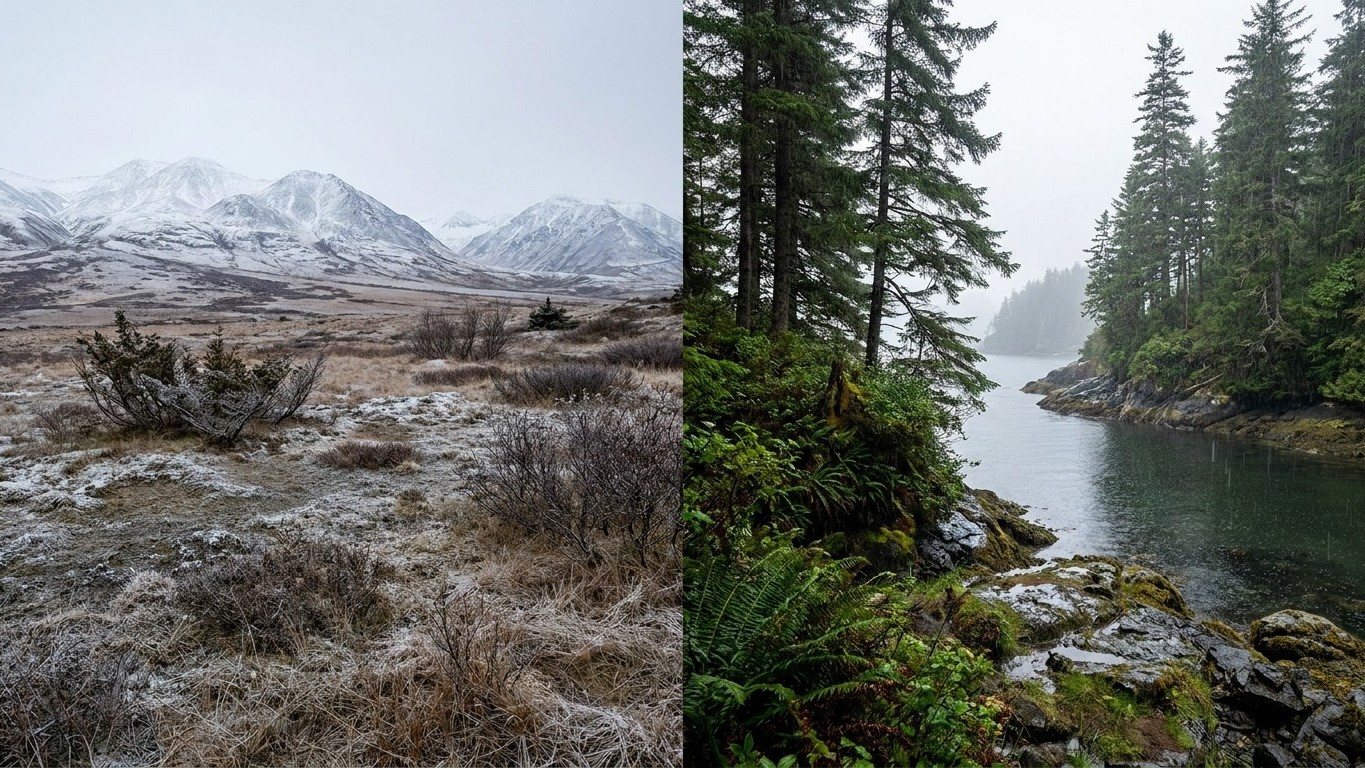

Texas runs a full USDA hardiness spread, from 6a up near the Panhandle to 10a down along the Rio Grande Valley and the southern coast. That four-zone stretch is why a plant list for this state can’t collapse into a single yes-or-no answer: something planted in Amarillo and something planted in Brownsville are living in two different climates wearing the same state name.
What will not survive a winter in Texas

Start with the number that matters most here: of the 65 landscape trees, shrubs and perennials this site tracks, zero are hardy across the whole 6a-10a range, and zero fail across all of it either. Every single one of them survives in at least part of Texas. None of them is a flat no.
That’s a different outcome than you’d get running this same crossing for a state with a narrower or more extreme range. Texas is wide enough, and its warm end mild enough, that outright failure everywhere just doesn’t happen among the species documented here. If you were hoping for a short list of plants to cross off entirely, statewide, there isn’t one to give you.
What that number does not mean is that every plant on the list will thrive wherever you happen to garden. Hardiness, as USDA defines it through the Plant Hardiness Zone Map, measures one thing: the average annual extreme minimum temperature a plant can survive without dying outright. It says nothing about whether that plant is comfortable, vigorous or good-looking in the conditions it’s asked to survive. A shrub rated hardy down to zone 10a can still limp through a Houston or Brownsville summer, because the top end of a hardiness range is frequently a heat ceiling dressed up as a cold rating. Nurseries and extension databases report the number that matters for winter survival; they don’t always flag that the same plant may sulk, drop leaves early or stop blooming once summer heat and humidity take over.
So the honest framing for Texas isn’t “what will die here” but “where in this range does a given plant stop being hardy” and this is where the state’s size actually bites. A gardener in the Panhandle, working in zone 6a or 6b, is choosing from a pool shaped by hard freezes. A gardener on South Padre Island, in 10a, almost never sees a hard freeze at all and is instead fighting subtropical heat, humid nights and soil that barely cools down between one summer and the next. Both readers are technically “in Texas.” Neither is gardening in the same Texas as the other, and a plant that suits one can be the wrong pick for the other. That’s the gap the next section fills.
The plants that work in part of the state and not the rest
All 65 plants documented for this territory fall into that middle bucket: hardy across part of the 6a-10a range, not the whole thing. The zones each one drops out of aren’t random, though, and grouping them by where they fail is more useful than listing 65 names in one long column.
Grouped by where the range runs out
| Where it fails | Zones affected | Examples from this site’s list |
|---|---|---|
| Warm tip only | 10a | Cercis canadensis, Cornus florida, Magnolia grandiflora, Ilex glabra, Kalmia latifolia, Achillea millefolium, Lavandula angustifolia, Betula nigra, Ginkgo biloba, and more than a dozen others on this site’s list |
| Warm third | 9a, 9b, 10a | Echinacea purpurea, Buxus sempervirens, Physocarpus opulifolius, Pinus strobus, Quercus rubra, Acer saccharum, Amsonia hubrichtii, Salvia nemorosa |
| Warmer half | 8a through 10a | Picea abies, Thuja occidentalis |
| Most of the state, sparing only the coldest strip | 7b through 10a | Syringa vulgaris |
| A mid-band gap plus the warm end | 7a, 7b, and 9a through 10a | Weigela florida |
| Both extremes at once | 6a, 6b, and 10a | Ficus carica |
Read that table by zone, not by name. A reader gardening in 6a or 6b, up toward the Panhandle, only needs to worry about the last row: Ficus carica is the one plant on this list that struggles at that cold end. Everything else in the table is perfectly fine that far north. A reader in 9a, 9b or 10a, closer to the Gulf or the Valley, is the one who needs to scan almost every row, because that’s where most of the drop-outs cluster.
Finding out which of those zones you’re actually in is the step that makes this table usable, since “Texas” alone doesn’t tell you. The insulation page for this state carries the county-level zone picture, and it’s the fastest way to see whether your address sits in the cold end, the warm end, or somewhere in the wide middle this state spans.
The soil and the summer they will be planted into
Hardiness zone gets a plant through winter. What kills a lot of woody plants and perennials in Texas has nothing to do with cold at all, and everything to do with what’s under their roots the rest of the year.
The soil series USDA lists as representative of Texas is Houston Black, a Vertisol: heavy clay, 54 percent clay against just 20 percent sand and 26 percent silt, with a surface pH around 7.9. Vertisols are the shrink-swell clays that crack open into wide fissures when they dry out and turn to a sticky glue when they’re wet. That’s a drainage problem before it’s anything else. A plant that wants its roots to dry between waterings can sit in standing moisture for days in this kind of ground, and winter wet does more damage to woody roots and perennial crowns than winter cold does on a normal Texas year. Raised beds, amended planting holes and a plant list that tolerates heavy clay all matter more here than the last frost date does. Organic matter in this series runs around 3.0 percent at the surface, which is a workable but unremarkable starting point, and the soil is described as moderately well drained rather than well drained, which lines up with everything else in that profile. None of this is a stand-in for testing your own yard: this is the series USDA treats as representative of the state, not a reading from any one garden, and river-bottom ground, Hill Country limestone soils and anything a builder has graded will differ from it completely.
Layer summer rainfall on top of that soil and the picture sharpens. The reference station used here averages about 14.6 inches of rain across June, July and August, out of 51.8 inches for the year, with July running driest at 3.77 inches against June’s 6.0 and August’s 4.84. That’s real rainfall, not a dry-summer state on paper. But rain totals don’t translate the same way on every soil. On a sandy soil, 6 inches in June drains through within a day and the ground is dry again by the weekend. On the Houston Black clay described above, that same 6 inches can sit at or near the surface for the better part of a week, especially if it arrives as a single thunderstorm rather than spread evenly across the month. A plant sensitive to wet feet is at more risk on this soil in a wet June than the rainfall number alone would suggest, and that’s the cross to make rather than converting inches of rain into a watering routine.
When to plant, here
The reference station used for these frost dates sits at Houston’s Bush Intercontinental Airport, which puts it firmly at the mild end of the state’s range. It’s a reasonable anchor for the Gulf Coast and a poor one for the Panhandle or the Hill Country, where both frost dates fall on a different calendar entirely.
At that Houston station, the last spring frost typically falls between February 4 and March 1, and the first fall frost arrives between December 1 and December 19. Those are 30-to-70 percent freeze-probability windows from 1991-2020 climate normals, not guarantees, and they describe one station, not the state.
| Window | What it suits | Main risk |
|---|---|---|
| Spring, after the last frost window closes | Plants that need a full growing season to establish before their first winter, and anything better suited to going in while temperatures are still climbing rather than falling | A late cold snap can still catch new growth even after the average window has passed; the reading is a probability band, not a fixed date |
| Autumn, ahead of the first frost window | Most trees, shrubs and perennials, since cooling soil and lower heat stress let roots establish without the plant also having to push top growth | In the coldest part of Texas’s range, that autumn window is far shorter than it is near the Gulf, leaving less time for roots to settle before the ground turns cold |
The reasoning behind favoring the cooler windows is about roots, not the calendar itself. A woody plant put in the ground needs time to grow new roots into the surrounding soil before it’s also expected to leaf out into summer heat or stand up to a hard freeze. Fall planting lets that root work happen while the top of the plant is dormant or slowing down, which is why it’s generally the better bet where the season allows for it. Spring planting works too, but the plant is racing summer heat almost as soon as it goes in, and in the deep-clay soil described above, a spring-planted root ball can also be sitting in wetter ground than an autumn-planted one going into cooler months.
Whichever window you use, and whatever a plant’s published drought tolerance says, water it through its first season regardless. Every drought rating on a plant tag or in an extension database describes an established plant with a root system already in the ground, not one still growing into new soil.
Where to read about each one
Every hardiness figure used on this page comes from the North Carolina Extension Gardener Plant Toolbox, a university extension plant database, crossed here against Texas’s own 6a-10a zone range. Those are hardiness ranges, built to answer one question: will the plant survive winter where you live. They’re a separate thing from the adaptation zones this site uses elsewhere for apple varieties, which come from a fruit-variety table and describe a different kind of fit; the two shouldn’t be read as the same number.
Among the trees on this site’s list that suit at least part of Texas, the names include Acer rubrum, Cercis canadensis, Cornus florida, Ginkgo biloba, Juniperus virginiana, Lagerstroemia indica, Liquidambar styraciflua, Magnolia grandiflora, Nyssa sylvatica, Quercus alba and Quercus rubra, along with Betula nigra, Carpinus caroliniana, Platanus occidentalis and Tilia americana.
On the shrub side, Aronia arbutifolia, Buxus sempervirens, Clethra alnifolia, Fothergilla gardenii, Hydrangea macrophylla, Hydrangea paniculata, Ilex glabra, Ilex verticillata, Itea virginica, Kalmia latifolia, Physocarpus opulifolius, Spiraea japonica, Syringa vulgaris, Viburnum dentatum and Weigela florida all appear in part of the state’s range.
For perennials, the list includes Achillea millefolium, Amsonia hubrichtii, Asclepias tuberosa, Baptisia australis, Echinacea purpurea, Heuchera americana, Iris sibirica, Lavandula angustifolia, Monarda didyma, Phlox paniculata, Rudbeckia fulgida, Salvia nemorosa and Hylotelephium spectabile, plus fruiting species such as Ficus carica, Vaccinium corymbosum and Prunus persica that carry their own zone limits within the state.
Each of those names carries its own specific zone cutoffs, laid out earlier in this page. The next useful step isn’t a general Texas plant list, it’s checking your own county against the zone map on the insulation page for this state, then matching that single zone number against the tables above.