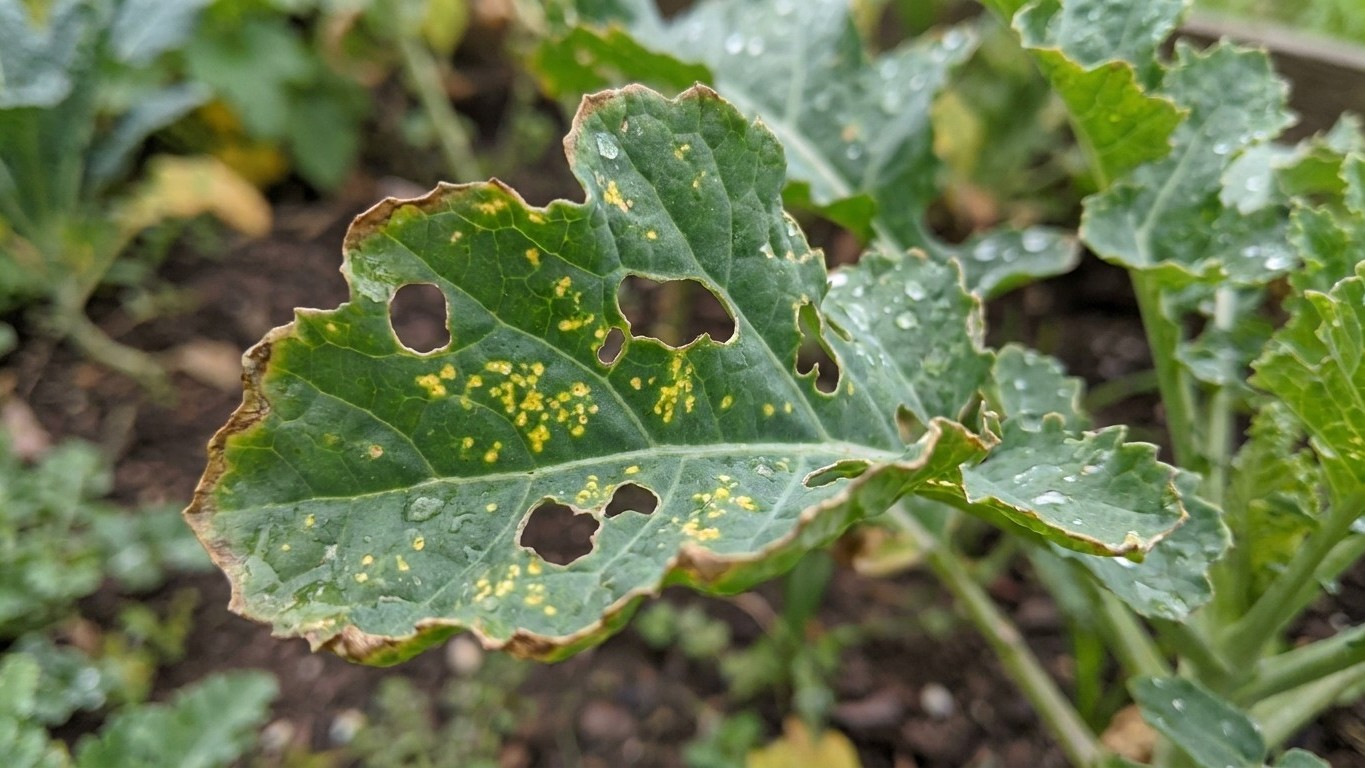

Four insects do the real damage to summer squash in Missouri gardens: squash bugs, squash vine borers, cucumber beetles, and spider mites. University of Missouri Extension / MU IPM documents all four for this territory, and each one works on its own schedule and leaves its own signature. Squash vine borer is the one that can take down a thriving plant in under a week once it gets inside the stem.
Which pests attack summer squash in Missouri

University of Missouri Extension / MU IPM documents ten pests active in Missouri landscapes and gardens: bagworms, brown marmorated stink bug, cucumber beetles, hunting billbug, Japanese beetle (Popillia japonica), spider mites, squash bug (Anasa tristis), squash vine borer (Melittia cucurbitae), tobacco hornworm, and tomato hornworm. That’s a long list, but most of it has nothing to do with a squash bed.
Six of the ten don’t belong on this page. Bagworms build their bags on junipers, arborvitae, and other needled trees, not on broad-leaved vegetable foliage. Hunting billbug lives and tunnels in turfgrass crowns and roots, a lawn problem, not a garden one. Japanese beetle mostly skeletonizes roses, grapevines, and linden leaves, and rarely bothers squash. Tobacco hornworm and tomato hornworm are nightshade specialists, feeding on tomato, pepper, eggplant, and tobacco, and cucurbit leaves simply aren’t their food. Brown marmorated stink bug does feed across a wide range of fruits and vegetables, but it’s not the insect that has built its life cycle around cucurbits the way the squash bug has.
That leaves four pests actually documented as threats to summer squash here. Cucumber beetles arrive early, feed on seedling leaves and blossoms, and can carry bacterial wilt from plant to plant. Squash bugs pierce leaves and stems to feed, causing wilting patches that spread across the plant. Squash vine borer larvae tunnel inside the main stem, cutting off water to everything past the entry point. Spider mites feed on the underside of leaves and multiply fastest in the hottest, driest stretch of the season, when the region logs a mean of 32.7 days a year at or above 90°F. None of the other six species in the MU list have a documented reason to show up on this crop.
When each one shows up, and what it does first
Missouri’s frost-free stretch runs from a last spring frost of April 6 to April 20 to a first fall frost of October 18 to October 29 at the reference station, giving squash roughly six months of open season, longer in southern parts of the state and slightly shorter near Kansas City. Pest pressure tracks that window, not a fixed date on the calendar.
Cucumber beetles are usually the first visitors, showing up as soon as seedlings or transplants are in the ground after the spring frost risk clears. The first sign is small, ragged holes in cotyledons and young leaves, sometimes with the beetle itself still sitting on the damage.
Squash bugs follow within a few weeks, once plants are established and vining. The earliest sign isn’t the adult insect at all, it’s clusters of bronze, football-shaped eggs glued to the underside of leaves, usually along a vein. Left alone, those eggs hatch into nymphs that feed in groups, and leaves start to show yellow speckling that turns brown and papery.
Squash vine borer activity builds through the warmest stretch of summer, the same period driving the region’s 32.7 days at or above 90°F. The first visible sign is deceptively simple: one vine wilts in the middle of the day while the rest of the plant looks fine and the soil is clearly moist. That’s the tell, because ordinary drought wilts the whole plant, not one runner.
Spider mites build up during the driest weeks, typically the tail end of summer when rainfall drops to its low point. The first sign is fine yellow stippling on leaves, followed by a bronzed, dusty look as populations grow, worse on plants already stressed by heat or uneven watering.
Telling the damage apart from everything else
Squash growers lose time treating the wrong problem more often than they lose the plant to the actual pest. A few symptoms look alike but point to different causes, and the fix only works if the cause is right.
| Symptom | Likely cause | What tells them apart |
|---|---|---|
| One vine wilts while soil is moist | Squash vine borer larva inside the stem | Look near the base for a small hole with sawdust-like frass; whole-plant wilting instead points to drought or root damage |
| Whole plant wilts despite regular watering | Bacterial wilt spread by cucumber beetles, or root stress | Cut the stem and press the cut ends together: a milky, sticky ooze that strings between them is bacterial wilt, not drought |
| Yellow stippled or bronzed leaves in the hottest weeks | Spider mites | Tap a leaf over white paper; moving specks are mites, while a uniform yellow with no specks points to a nutrient deficiency |
| Ragged holes in leaves or chewed blossoms | Cucumber beetles | Find the actual beetle on the plant; hail or foot traffic leaves torn edges, not chewed ones |
| Clusters of bronze eggs under leaves | Squash bug eggs | This is the earliest sign, visible before any feeding damage shows up at all |
None of this replaces a second opinion. A leaf that looks off in a photo can mean three different things depending on soil, watering habits, and what’s growing nearby, and a local extension agent who can look at the actual plant, or a soil test, settles what a symptom list can only narrow down.
What actually works here, and what is a waste of time
Missouri’s long frost-free window, six months or more between the spring and fall frost dates, actually works in a grower’s favor: there’s room for a second planting if the first one gets hit hard by vine borer, since a fresh round of squash put in during early summer can outrun that generation and still finish well before the October frost.
Physical barriers do more here than most gardeners expect. Row covers over young transplants keep cucumber beetles and egg-laying squash bugs off the plant during its most vulnerable weeks. The timing matters more than the material: covers need to come off once flowers open, because squash needs pollinators to set fruit, and a cover left on past bloom just trades one problem for another.
Scouting for and scraping off squash bug egg clusters before they hatch is tedious, but it’s one of the few hand actions that actually changes the outcome, since a cluster removed never becomes a feeding generation. Consistent watering through the driest stretch of summer also keeps spider mite populations lower, since mites thrive on plants already stressed by drought.
What doesn’t help: waiting until a vine is already wilting to act. By the time that symptom shows up, the borer is inside the stem and out of reach of anything applied to the leaf surface. Reflective mulch and other passive tricks get talked about often but aren’t a substitute for covers or timing. This site doesn’t recommend specific products, rates, or active ingredients, because what’s labeled and legal changes by state and by year, and that call belongs to University of Missouri Extension / MU IPM, not a general gardening article.
Where to check this for your own county
Everything above describes what’s documented across Missouri as a whole, and the state runs from a hardiness zone of 5b to 7b, a range wide enough that pest timing in the southern Bootheel and pest timing near the Iowa line won’t match. The frost dates cited here come from a reference station well north of Kansas City itself; the downtown station runs about five days earlier in spring, and southern Missouri is milder still.
That spread is exactly why a county-level check matters more than a statewide list. University of Missouri Extension maintains county offices that track what’s actually showing up on local plants in a given year, not just what’s possible across the state. A pest documented for Missouri as a whole may be light in one county and heavy in the next, depending on the previous winter, local soil, and what got planted nearby.
The next useful step isn’t another article, it’s a call or a visit to the county extension office with a description, or better, a photo, of the actual damage. That’s where a general list turns into an answer specific to one garden.