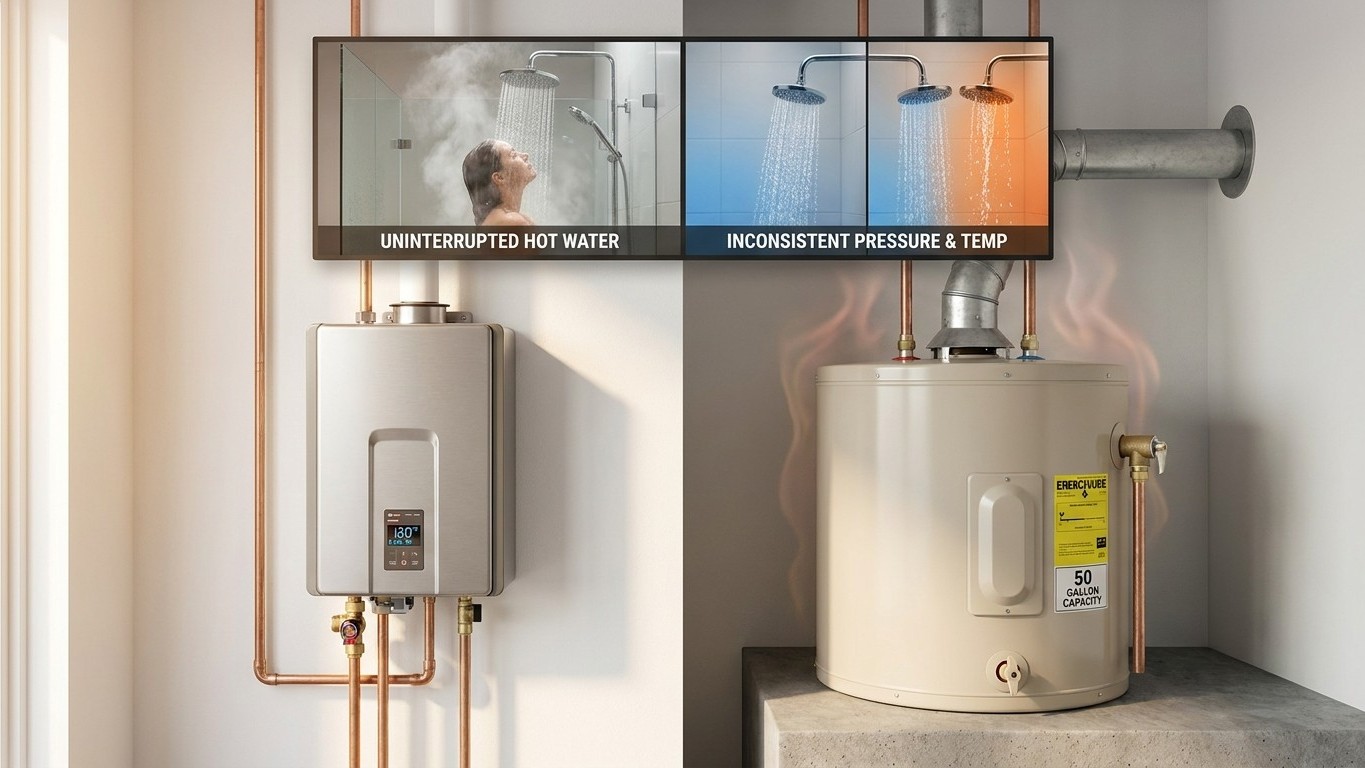

A tankless water heater trades a 40- or 50-gallon reservoir for a compact heat exchanger that fires up the instant a tap opens. That swap solves the classic problem of running out of hot water mid-shower, but it introduces new limits: how much hot water you can draw at once, how the unit reacts when you turn a faucet on and off, and what your home needs before installation can even happen. None of that shows up in a showroom brochure.
It makes hot water, it does not keep any
Storage water heaters spend energy around the clock keeping 40 or 50 gallons hot, whether anyone uses it or not. That’s standby loss, and it’s a real cost: the U.S. Department of Energy attributes roughly 14% to 25% of a home’s total energy use to water heating, and standby loss is a chunk of that figure for tank-style units. A tankless heater skips this entirely. No stored water, no idle heating, no standby loss. The unit sits cold until a valve opens somewhere in the house, then it ignites or energizes and starts raising the Temperature of water as it flows through.
That’s the upside. The flip side is just as real: there’s no reserve to draw on. A storage tank can supply a burst of demand that exceeds its heating capacity for a while, because it’s been quietly stockpiling hot water for hours. A tankless unit can’t do that. Its output is capped by its flow rate, and once you hit that ceiling, something has to give.
What happens when two showers run at once
This is where sizing decisions matter more than most homeowners expect. Every tankless model has a maximum flow rate it can heat to a given temperature rise, and that number doesn’t stretch. Run a shower and start the dishwasher at the same time, and the unit either splits its output across both draws (making both a little cooler) or, if it’s undersized for the household, one fixture ends up with lukewarm water while the other performs fine. Larger homes with multiple bathrooms sometimes solve this with two smaller units instead of one large one, splitting the load across different zones of the house rather than asking a single heat exchanger to cover everything. It’s a design conversation worth having with an installer before the unit goes in, not after the second shower turns tepid.
The cold-water sandwich
Owners describe it without knowing there’s a name for it: hot water, then a burst of cold, then hot water again, all within the same shower. It happens when a tap is shut off briefly and turned back on, and it catches people off guard because it feels like a malfunction rather than a known quirk of how these units work.
The mechanism is mechanical, not electrical. When you close a faucet, the tankless unit stops heating and the water already sitting in the pipe between the heater and the fixture starts cooling. If you reopen the tap quickly, that cooled slug of water reaches you before the unit has fully re-ignited and ramped its heat exchanger back up to temperature. So you get a beat of cold sandwiched between two stretches of hot, right at the moment you least expect it, like adjusting the water pressure or stepping back under the showerhead after shampooing.
Some designs reduce how often this happens. Units with a small internal buffer or a recirculation feature keep a little pre-heated water on standby near the point of use, closing the gap between “faucet reopens” and “heater responds.” Recirculation pumps, whether built into the unit or added separately, push hot water through the line continuously or on a timer, so the pipe run between heater and fixture stays warmer even during pauses. Neither approach eliminates the sandwich completely, but both shorten it, and it’s a reasonable question to raise with an installer if quick on-off use (rinsing dishes, washing hands intermittently) is part of your household’s routine.
What retrofitting really involves
The part that surprises most homeowners isn’t the unit itself, it’s everything around it. Swapping a tank heater for a tankless model rarely means unplugging one box and plugging in another. A gas-fired tankless unit typically demands more instantaneous heat output than a storage tank ever needed, which often means the existing gas line feeding it isn’t adequate and needs to be upsized, along with dedicated venting suited to the new unit’s exhaust requirements. That’s plumbing and venting work, not just an appliance swap, and it’s the reason two contractors can quote wildly different numbers for what sounds like the same job.
Electric tankless units carry their own version of this surprise. They draw a lot of power in a short burst to heat water on demand, and many homes’ existing electrical service isn’t sized to handle that draw alongside everything else already on the panel. That can mean an electrical service upgrade before the water heater itself ever gets installed, a step that adds both cost and time to a project that looked simple on paper.
What to ask before you get a quote
Because the supporting work varies so much from house to house, it’s worth asking a contractor a few direct questions rather than comparing bottom-line prices alone:
- Does the existing gas line or electrical circuit support this specific unit, or does something need to be upgraded first?
- Is new venting required, and where will it run?
- Will the local code office need to inspect or permit the gas, electrical, or venting work separately from the water heater installation?
- Does the quote include that supporting work, or only the appliance and its direct connection?
The appliance’s own installation manual spells out its specific gas and electrical requirements, and the local code office is the authority on what your jurisdiction requires for permits and inspections. Skipping that homework is how “quick tankless upgrade” projects turn into multi-week jobs.
Scale is the enemy
A tankless heat exchanger is small, dense, and runs hot, which is exactly the environment where mineral scale builds up fastest. In hard water areas, dissolved calcium and magnesium precipitate out as the water heats, coating the interior of that compact exchanger the same way they’d coat a kettle, just faster because the surfaces run hotter and the water moves through in a thinner channel.
The consequences show up gradually rather than all at once. Scale narrows the passages inside the heat exchanger, which reduces flow rate and forces the unit to work harder to hit its target temperature. Efficiency drops, energy use per gallon creeps up, and in hard water regions the unit can start falling short of the output it delivered when new, well before anything visibly “breaks.”
Periodic descaling isn’t optional maintenance for households on hard water, it’s a real requirement for keeping the unit performing as designed. That typically means flushing the heat exchanger with a descaling solution on a schedule tied to local water hardness, something a plumber can advise on based on your specific water supply. For the full flushing procedure, the water quality factors that make it more or less urgent, and how often it should happen, see our water heater maintenance guide.
Common questions
Can a tankless water heater run out of hot water?
Not in the way a tank can. It has no reserve to deplete, so it never “runs dry” the way a tank empties after a long shower. Its limit is different: it can only heat a certain flow rate at a time, so demand beyond that capacity means water arrives cooler, not that it stops arriving.
What temperature should I set my water heater to?
The Department of Energy recommends 120°F, describing it as comfortable for most household uses. It’s a compromise: lower settings save energy and reduce scald risk, while higher settings raise both. Stored water held too cool is also a recognized concern for bacterial growth, so households with infants, elderly residents, or anyone immunocompromised should check with their doctor or their local water utility before adjusting the setting either direction.
Do tankless water heaters need carbon monoxide protection?
Gas and propane tankless units are fuel-burning appliances, so the same carbon monoxide precautions that apply to any combustion appliance apply here in full: CO is colorless and odorless, and a CO alarm near the unit and in sleeping areas is required. Electric and heat pump tankless units burn no fuel and don’t carry this risk.
Are new efficiency rules changing how tankless heaters compare to tank models?
Amended federal efficiency standards bring common electric storage water heaters up to the efficiency level of an entry-level heat pump water heater, narrowing the gap that once favored tankless models on efficiency alone for electric households. This applies to storage-tank electric units of common household sizes; check the nameplate and manual on any unit you’re considering to see which standard it was built to meet.