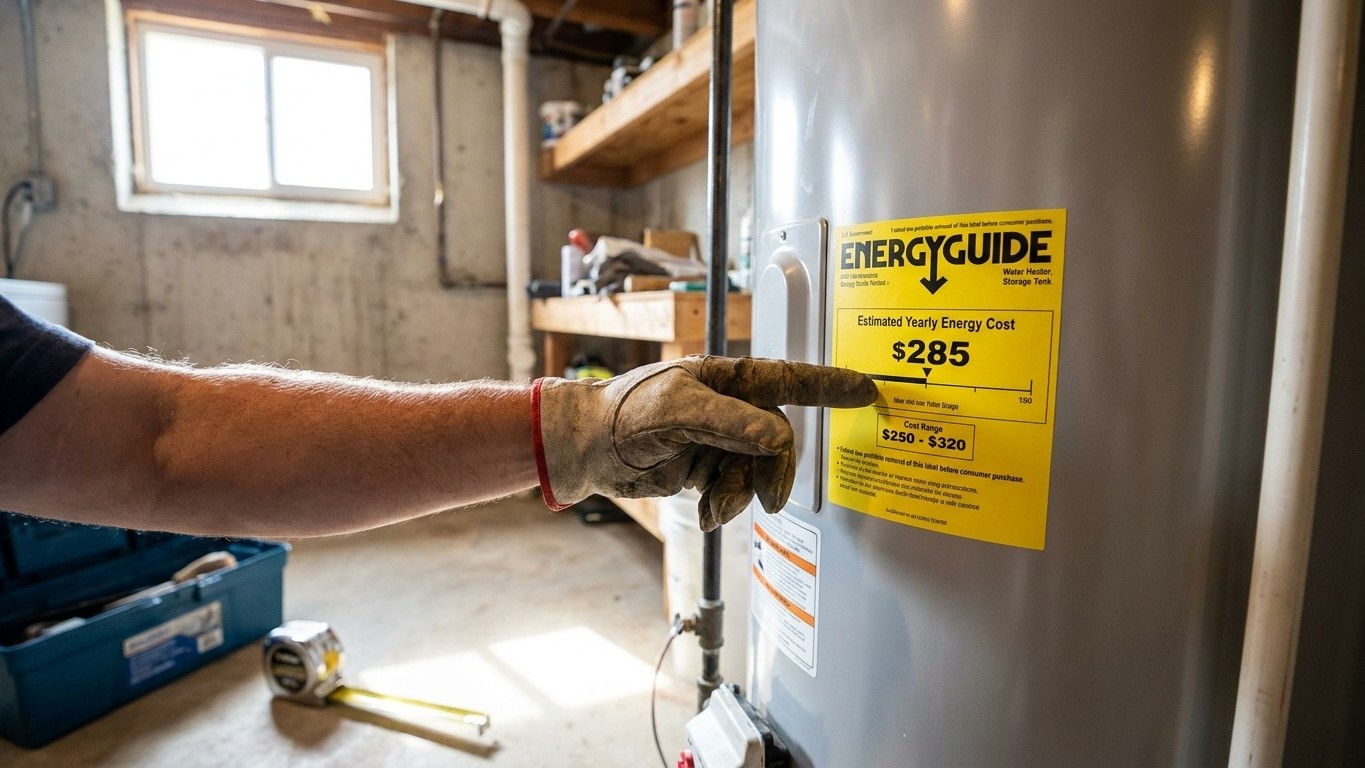

The right water heater size has nothing to do with tank gallons or how many people live in the house. It comes down to First Hour Rating for tank models, or flow rate at a stated Temperature rise for tankless units. Both figures sit on the yellow EnergyGuide label, and both answer the same question: how much hot water can this unit actually deliver during the busiest hour of the day, not on paper, but at the tap.
Gallons is the wrong number
Ask someone how big a water heater they need and they’ll usually answer in gallons: 40, 50, 80. That number describes tank capacity, not performance. A 50-gallon tank paired with a slow-recovery electric element can run short of hot water faster than a 40-gallon tank with a fast gas burner. What matters is First Hour Rating, a single figure that combines stored capacity with how quickly the unit reheats during that first hour of heavy demand.
Manufacturers print First Hour Rating on the yellow EnergyGuide label attached to every new storage water heater. Look for a line naming that rating, followed by a gallon figure that’s usually higher than the tank’s raw capacity, since it accounts for reheat happening while water is being drawn. That’s the number to weigh against your household’s peak hour demand, not the volume stamped on the side of the tank.
Tankless units skip storage entirely, so they’re rated differently: flow rate at a specific temperature rise. The label states how much output the unit sustains when raising incoming water by that many degrees. Because output shrinks as the required rise grows, one unit can look generous on one label line and modest on another, depending entirely on the temperature assumption behind the number.
How the label ties to efficiency rules
Water heating already accounts for roughly 14% to 25% of the energy used in a typical home, according to the Department of Energy, so a unit sized too large adds standby losses on top of that share, while one sized too small tempts people to compensate by cranking the thermostat. Amended federal efficiency standards now bring common electric storage water heaters, the kind found in most homes built before the update, up to roughly the efficiency level of an entry-level heat pump water heater. Anyone replacing an older electric tank today is likely buying into that higher standard, whether they shopped for it or not.
| Type | Rating to check | Where it’s printed | What limits it |
|---|---|---|---|
| Storage tank | First Hour Rating | Yellow EnergyGuide label | Reheat speed of the burner or element |
| Tankless | Flow rate at stated temperature rise | Manufacturer’s label or spec sheet | How cold the incoming water runs |
Measuring your own peak hour
Household size is a lazy stand-in for what actually drives sizing: how many hot water draws overlap in a single hour, and how big a temperature rise each draw needs. A four-person household where everyone showers between 7 and 8 a.m. needs a much bigger unit than a four-person household spreading showers, laundry, and dishes across the whole day. The clock matters more than the headcount.
The method is simple counting, not a formula. Walk through the household’s busiest hour on a typical morning or evening and list what’s actually running: a shower or two, a dishwasher cycle, a load of laundry, maybe a bathtub fill for a toddler. Each draw pulls a share of hot water and keeps the burner or element working the whole time. Add them together, and that total, not the number of bedrooms in the house, is the demand the water heater has to cover.
Where thermostat setting fits into the math
Thermostat setting changes the calculation too. The Department of Energy recommends setting a water heater’s thermostat to 120°F, a point it describes as comfortable for most household uses. That figure is a compromise, not a fixed rule: lower settings save energy and reduce scald risk, especially for households with small children or older adults, while higher settings stretch each gallon further but burn more energy and raise the risk of a scald at the tap.
There’s a second side to that compromise worth stating plainly. Water stored too cool is a recognized concern for bacterial growth, while water held hotter reduces that risk but increases both energy use and scald danger. Neither extreme is free. Households with infants, older residents, or anyone with a weakened immune system should raise the question with their doctor or their local water utility rather than guess, since local water chemistry and plumbing layout both affect the actual risk.
Once the peak hour draws are counted and a thermostat setting is chosen, compare the total against the First Hour Rating or flow rate figure from the label. A unit that only matches an average day will come up short on the one day a week when three showers, a dishwasher, and a laundry load overlap, which for most households is the day sizing actually gets tested.
Why a tankless unit is smaller in winter
Tankless water heaters don’t fail because of tank size. They never had one. They fail because of temperature rise, the gap between incoming groundwater temperature and the temperature the household wants at the tap. That gap isn’t fixed. It changes with the seasons and by region, which is exactly the variable that trips up sizing done from a summer showroom visit or a spec sheet read without checking local climate.
Groundwater arriving into a home in July runs far warmer than groundwater arriving in January. A tankless unit works harder, meaning it raises the temperature further, when incoming water is cold. Since a tankless unit’s maximum flow rate is stated at a specific temperature rise, a bigger rise requirement in winter shrinks the effective output of the exact same unit compared to what it delivered in summer. Nothing about the appliance changed. The input did.
This is why a tankless unit that felt generous running two showers at once in August can leave someone standing in a lukewarm trickle in February, in the same house, with the same fixtures. It’s not a malfunction and it’s not undersizing in the way a storage tank runs empty. It’s the unit doing exactly what its label promised, just at a different point on the flow-versus-rise curve than the one used when it was purchased.
Sizing for the coldest day, not the mildest
The practical fix is sizing against the coldest expected incoming water temperature for the region, not the mildest, and checking that a spec sheet lists output across a range of temperature rises rather than a single flattering figure. Local plumbing supply houses and installers who work in that specific climate typically know the seasonal swing better than a national spec sheet does, and that local knowledge is worth more than any average.
Fuel type matters here too. A gas or propane tankless water heater is a fuel-burning appliance, producing carbon monoxide as a byproduct of combustion, a colorless and odorless gas that requires a working CO alarm nearby, the same rule that applies to any fuel-burning appliance in the home. An electric or heat pump tankless unit burns nothing and carries no such requirement.
Common questions
What’s the difference between tank capacity and First Hour Rating?
Tank capacity is how much water the unit stores. First Hour Rating adds in how much more the unit can reheat while that stored water is being drawn down, giving a more realistic picture of what’s available during a busy hour.
Is 120°F safe for a household with young children or elderly residents?
The Department of Energy describes 120°F as comfortable for most household uses and notes it lowers scald risk compared to higher settings. Households with vulnerable occupants should still confirm the right setting with their doctor or local water utility, since stored water held too cool carries its own bacterial growth concerns.
Why do federal efficiency standards affect which storage water heater I can buy?
Amended federal standards now require common electric storage water heaters to meet roughly the efficiency level of an entry-level heat pump water heater. That changes the models available on shelves for anyone replacing an older unit, though it doesn’t affect units already installed.
Does a tankless water heater need a carbon monoxide alarm?
Only if it burns fuel. Gas and propane tankless units produce carbon monoxide and require a working alarm nearby, the same as any fuel-burning appliance. Electric and heat pump tankless units burn nothing and don’t carry that requirement.