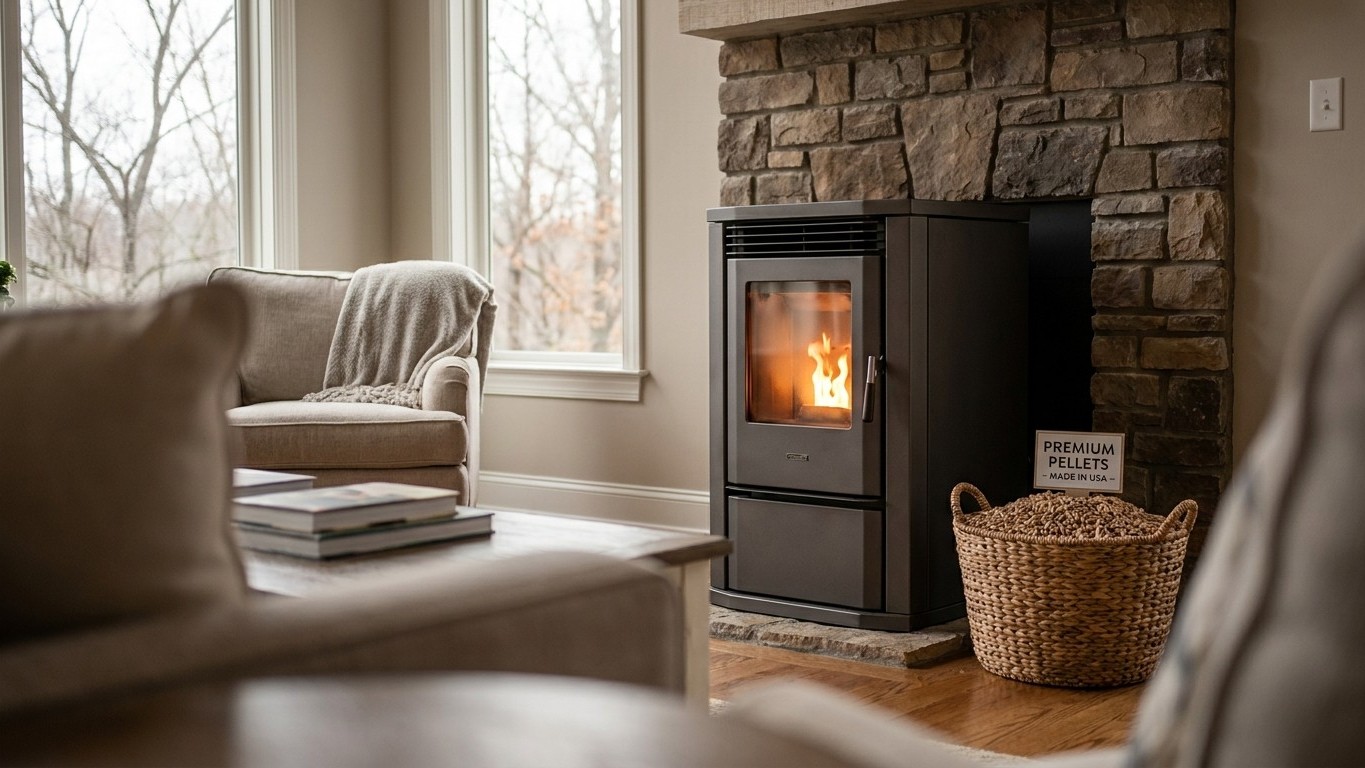

In the Toronto area, winters run cold enough that a pellet stove earns its keep as real heat, not just ambiance. The region logs about 4,004 heating degree days a year, the heating season stretches roughly nine months, and most homes still lean on a forced-air furnace as their primary system. That combination means: expect a real fuel bill, buy your pellets before the shelves empty in fall, and plan for what happens when the power goes out, because a pellet stove without electricity is just a metal box.
How hard the winter works here

The number that actually runs this whole page is 4,004. That is the annual total of heating degree days below 18 degrees Celsius recorded at Toronto Buttonville A, the reference station for the Greater Toronto Area under Environment and Climate Change Canada’s 1981-2010 Climate Normals. Every degree-day is a measure of how much heating demand accumulates on a given day, so a bigger number simply means a colder, longer-fought winter. Double the degree-days, roughly double the fuel burned to hold the same indoor temperature. That’s the mechanism, and it’s why a household in Thunder Bay or Ottawa, sitting on very different totals, should never assume Toronto’s number describes their own furnace room.
One caution matters before comparing this figure to anything American: it isn’t comparable, for three separate reasons. The base temperature differs (18°C here versus 65°F, or about 18.3°C, on U.S. pages). The unit differs, since these are Celsius degree-days and converting by 1.8 only gives a rough order of magnitude. And the measurement period differs too, 1981-2010 for this Canadian normal versus 1991-2020 for U.S. figures elsewhere on this site. Treat the 4,004 as a Canadian number that only compares cleanly to other Canadian stations.
The length of the season tells a separate story from its depth. Heating demand at this station begins in September, the first month whose average daily temperature (15.7°C) drops below the 18°C threshold used to count degree-days. It builds through fall, peaks hard in January at 738 degree-days for that month alone, and only falls back below the threshold in June. That’s roughly nine months of the year where a house in this region needs some form of supplemental heat, even if the coldest stretch, January and February combined, accounts for nearly 1,400 of the annual total by itself. A mild but long season and a short but brutal one look identical on a yearly total; this region has neither. It’s long and it’s hard, which is a rarer combination and a tougher one on a hopper.
Ontario is a big province, and Buttonville is one station near Toronto. A reader out toward Windsor, up near North Bay, or further north toward James Bay is looking at a meaningfully different degree-day total and a different season length. Check your own regional normal before assuming this page’s numbers apply directly to your address.
How many tons a winter takes here
Nobody can hand you a tons-per-winter number that fits your specific house, and any territorial page claiming otherwise is guessing. What you can do is work the math yourself, because the chain is simple and open. A standard bag of wood pellets weighs 40 pounds. Fifty of those bags make a ton. From there, consumption tracks the heat your house actually needs to replace, which is exactly what the 4,004 annual degree-days above is measuring for this region. More degree-days accumulated during a cold snap means more pellets burned that week, full stop.
Three things move that total more than anything else, and they can shift the outcome for two houses on the same street by a factor of two or more:
- How well the house holds heat — insulation, air sealing, window quality, and even how exposed the house is to wind all change how much fuel is needed to offset the same outdoor cold.
- Whether the stove is the only heat or a supplement — in this province, 66 percent of homes run a forced-air furnace as the primary system, so many pellet stoves here are heating one zone or taking the edge off a furnace bill rather than carrying the whole house alone.
- The setting the stove runs at — a stove left on a low or medium setting through most of the season burns dramatically less than one run wide open to heat a large or poorly sealed space.
Given all that, the most honest approach isn’t a published estimate at all. It’s counting your own bags. Track how many you buy and burn through your first full winter, from the September start of the heating season through the June tail-off, and that number becomes your baseline. It accounts for your house, your habits, and your stove’s actual output in a way no territorial average ever could. One measured season, in your own basement or living room, beats every estimate anyone can offer you in an article. For the general math behind bag counts and burn rates, the national page on how many pellets a winter takes walks through the calculation in more depth.
Buying and storing them in this climate
Timing the purchase matters more than most people expect. Heating demand in this region starts climbing in September, which means the smart window to buy is before that month, not during it. Once a cold snap hits in November or December, regional demand spikes and shelves at hardware stores and fuel dealers empty fast. Pellets bought in late spring or summer, when demand is lowest, also tend to be priced lower per ton, since dealers aren’t scrambling to restock during a cold week. Buying ahead isn’t just about avoiding a shortage. It’s about not paying the seasonal premium that shows up every year around the same time.
Storage is where this climate creates its own problem. Wood pellets are compressed sawdust, held together purely by the natural lignin in the wood, with no glue or binder. That means moisture is the enemy in a very literal, physical sense: pellets that absorb damp swell, lose their shape, and crumble into sawdust and dust well before they ever reach the stove’s hopper. Southern Ontario’s summers bring real humidity off the Great Lakes, and a garage or shed that isn’t climate-controlled can hold enough ambient moisture in July and August to degrade a bag stacked against a concrete floor, especially if that floor sweats on humid days. A pallet raised off the ground, in a dry interior space, survives the season far better than one stacked directly on cold concrete.
Skip comparing sticker prices per bag between suppliers. The only number that compares cleanly is price per ton, since bag sizes and per-bag pricing can make one deal look cheaper than it actually is. For a deeper look at keeping pellets dry through a full season and telling good fuel from bad, the national pellet storage guide and pellet quality guide cover both in detail.
What a winter outage means here
A pellet stove isn’t a wood stove with a hopper attached. It needs an electrical supply to run the auger that feeds pellets into the firepot and to run the fan that moves heated air into the room. Cut the power, and the stove goes cold within minutes, no matter how full the hopper is. That single fact separates pellet heating from a traditional wood stove, which keeps burning through a blackout without any electrical input at all.
Cross that dependency with the region’s degree-day profile and the stakes become clear. In January, when the station averages 738 degree-days for the month alone, an outage isn’t an inconvenience, it’s a heating emergency, especially for a household leaning on the stove as a meaningful part of its heat. In the shoulder months of September or May, the same outage just means an evening without the stove running, no real consequence attached.
What most households fall back on during an outage depends on what they’re already heating with. In this province, 66 percent of homes run a forced-air furnace as the primary system, but it’s worth remembering that a typical gas or oil furnace also needs electricity to run its blower motor, so a furnace alone doesn’t guarantee heat in a blackout either. Seven percent run boilers with hot-water or steam radiators, another 7 percent use electric baseboard heaters, and 4 percent rely on heat pumps, all of which share the same vulnerability to a power cut. Only about 1 percent list a heating stove as their main system province-wide, underscoring that a pellet stove here is almost always a supplement to a grid-dependent system rather than an independent backup to it.
None of this means guessing at a generator size or a battery capacity from an article. Check the wattage draw printed on your stove’s data label, since that number, not a rule of thumb, is what any backup power plan needs to be built around. The national power-cut page walks through backup options for pellet stoves specifically, including what actually keeps an auger and fan running when the grid doesn’t.