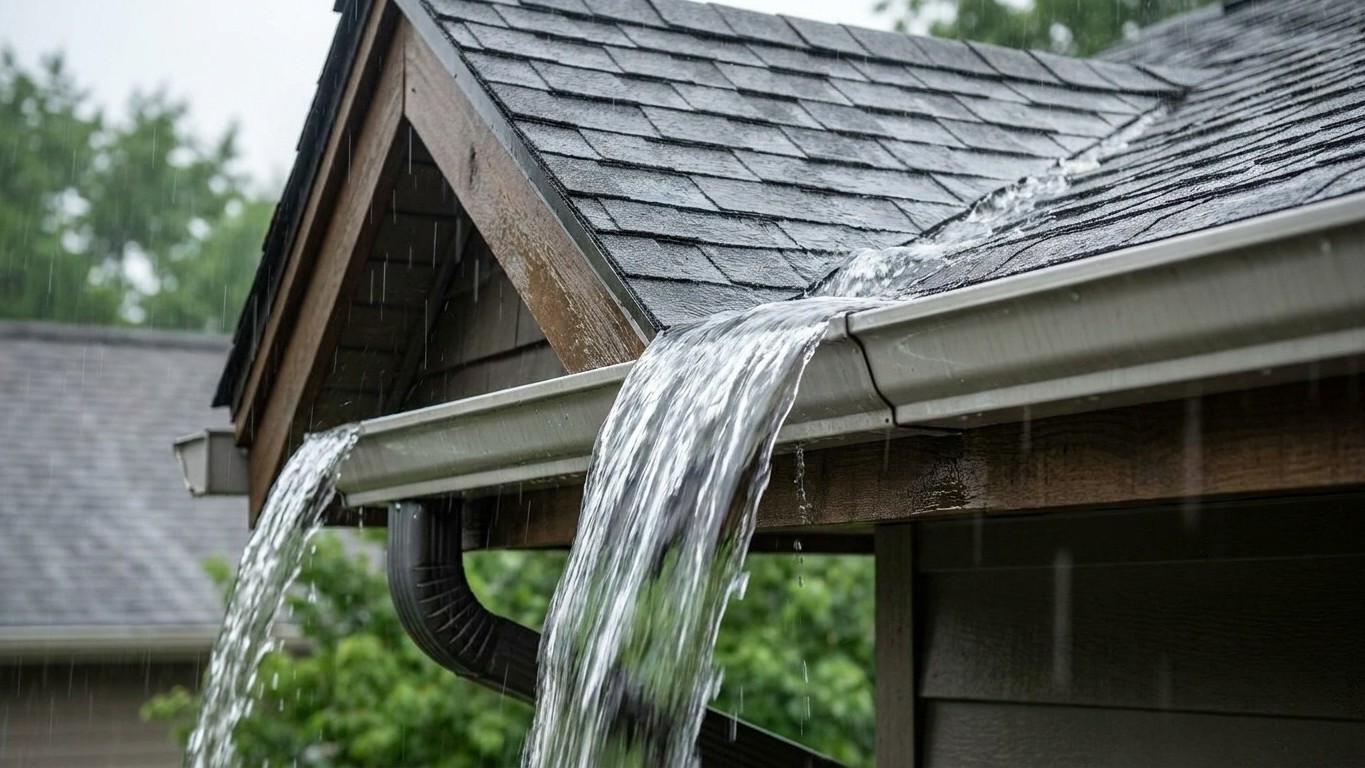

Gutters overflow even when spotless because the problem usually isn’t inside the gutter at all. It’s the volume of water hitting one section, the slope carrying it away, or a roof valley funneling several hundred square feet of runoff into a three-foot stretch of trough. Cleaning removes debris, but debris was never the bottleneck. Until the slope, capacity, or valley concentration gets addressed, the overflow comes back after the next storm, clean gutters or not.
What is actually happening
Every gutter system is built around three variables: how much water arrives, how fast it moves, and how much the trough can hold at any given second. Cleaning affects none of these. A gutter can be completely free of leaves and still fail if the water arriving exceeds what the channel and downspouts can carry away in real time.
The valley problem
Roof valleys are where two roof planes meet at an angle, and they act like funnels. Rain that falls across an entire slope gets redirected into that narrow seam, then dumped into whatever gutter section sits below it. A gutter that handles the rest of the roofline without issue can be overwhelmed at that one spot because it’s receiving runoff from a much larger area than its length suggests. Standing water or a small waterfall spilling over the front lip during heavy rain, but nowhere else along the run, is the signature of this exact issue.
Slope and capacity
Gutters need a slight pitch toward the downspout, usually a fraction of an inch per running foot, so water keeps moving instead of pooling. Over the years, fasteners loosen, sections sag, or a previous repair reset the pitch incorrectly. Water then sits in the low spot until it’s deep enough to spill over the outer edge, rather than draining. A capacity mismatch does something similar: if the downspouts were sized for the original section but a roof addition or valley was added later, the gutter simply can’t move water fast enough regardless of how clean it is.
Both problems share a symptom that misleads homeowners: the gutter looks empty and clear right up until the moment it doesn’t drain. That gap between “looks fine” and “fails under load” is why repeated cleaning brings no lasting improvement.
What you can see without climbing
A ladder isn’t the first step here, and for most of this checklist it isn’t a step at all. Overflow patterns and the damage they cause are visible from solid ground or from inside the attic, both safer vantage points that still tell you what’s wrong.
- Watch during or right after rain, from the ground. Binoculars or a phone camera zoomed in let you see exactly where water is spilling over the front edge versus draining normally through the downspout. Note whether the overflow happens at one specific point (often below a valley) or along the entire length (often a slope or capacity issue).
- Check the downspout discharge. A trickle or dry outlet while the gutter above is visibly overflowing means water isn’t reaching the downspout at all, pointing to a low spot holding water back rather than a blockage.
- Look at the fascia and siding below the gutter run. Streaking, dark stains, or peeling paint concentrated under one section confirms a chronic overflow point rather than a one-time heavy storm.
- Move to the attic with a flashlight, on a dry day. Scan the underside of the roof deck for any point of daylight showing through, which signals a gap or deterioration letting water in directly.
- Check the rafters and sheathing for staining. Dark, tide-line marks along wood grain usually track exactly to the exterior overflow point identified from the ground.
- Press gently on insulation near the eaves. Damp, matted, or discolored insulation confirms water has been getting in for more than one storm cycle.
Done together, ground observation and an attic check usually pinpoint the exact section responsible, which is the information a roofer needs before any repair conversation starts.
What it costs to leave it
Overflow that keeps happening at the same spot isn’t just cosmetic. Water finds the path of least resistance, and that path runs downward into parts of the house that are far more expensive to fix than the gutter itself.
Where the water actually goes
The first material to suffer is usually the fascia board, the trim piece the gutter is mounted to. Constant saturation softens wood fibers, and paint or sealant that once shed water starts holding it instead. From there, water tracks behind the fascia into the roof edge and soffit, the horizontal panel under the eave, where trapped moisture creates ideal conditions for rot and, in humid climates, mold growth. If the overflow point sits above a window or door, siding and trim nearby take the same soaking, often showing streaking or bubbled paint well before anyone climbs up to inspect the source.
Why it’s gradual, not sudden
None of this happens in one storm. It’s cumulative: dozens of small overflow events, each pushing a bit more moisture into wood that dries out between rains but never fully recovers. That slow cycle is exactly why the damage tends to go unnoticed until it’s visible from inside, as a stain on a ceiling or a soft spot in a wall, at which point the repair involves carpentry and possibly drywall rather than just the gutter. Insurance may cover some of that repair if it stems from a specific storm event, but coverage depends entirely on the policy and how the damage is documented, so photographing the overflow pattern and any interior staining as soon as it’s noticed matters more than trying to guess what a claim might pay out.
The practical takeaway isn’t a deadline, it’s a pattern: the same overflow point, storm after storm, is the signal that the damage clock has already started, whether or not it’s visible yet.
What is not a householder job
Diagnosing overflow from the ground and the attic is safe and genuinely useful. Fixing what causes it, in most cases, is not something to do solo, and drawing that line clearly matters more than any repair tip.
Where the line sits
Anything above a single story puts a fall at a height that turns a minor slip into a serious injury, and that risk doesn’t scale down just because the fix looks simple. A wet, mossy, steep, or frosted roof surface removes footing that a ladder or harness can’t fully compensate for. Any task requiring both hands, adjusting a gutter hanger, resealing a valley, repitching a section, while standing on a sloped surface leaves no hand free to catch a slip. These aren’t reasons to be cautious about DIY roofing work. They’re reasons not to attempt it.
The overflow diagnosis described above (ground observation, attic check, noting exactly where and when water spills) gives a roofer everything needed to start work without a separate inspection visit just to locate the problem. That diagnostic groundwork is worth doing regardless of who ends up on the ladder.
For a fuller walkthrough of what a professional inspection covers and how to prepare for one, see the roof inspection guide. When the fix involves repitching a section, correcting a valley, or anything beyond a downspout adjustment, the page on hiring a licensed roofer covers what to ask before agreeing to any work.
Common questions
Why does my gutter overflow only during heavy rain and not light rain?
Light rain rarely exceeds what a slightly undersized or slightly misaligned section can handle. Heavy rain, or rain concentrated by a roof valley, pushes past that threshold quickly, which is why overflow often looks like an all-or-nothing event rather than a gradual leak.
Could a bigger gutter or downspout fix this permanently?
Sometimes, particularly when the cause is genuinely a capacity mismatch from a roof addition or valley added after the original gutters were installed. A roofer can confirm whether resizing solves it or whether slope and hanger spacing need correcting first.
Is it normal for one section of gutter to overflow while the rest works fine?
Yes, and it’s actually the most common pattern. It almost always points to a specific local cause, usually a valley above that section or a low spot in the pitch, rather than a system-wide problem.
Does overflow always mean the gutters need replacing?
No. Many overflow problems trace back to hanger spacing, pitch, or a single misaligned section rather than the material itself failing. A roofer’s inspection distinguishes a repair situation from one that genuinely calls for replacement.