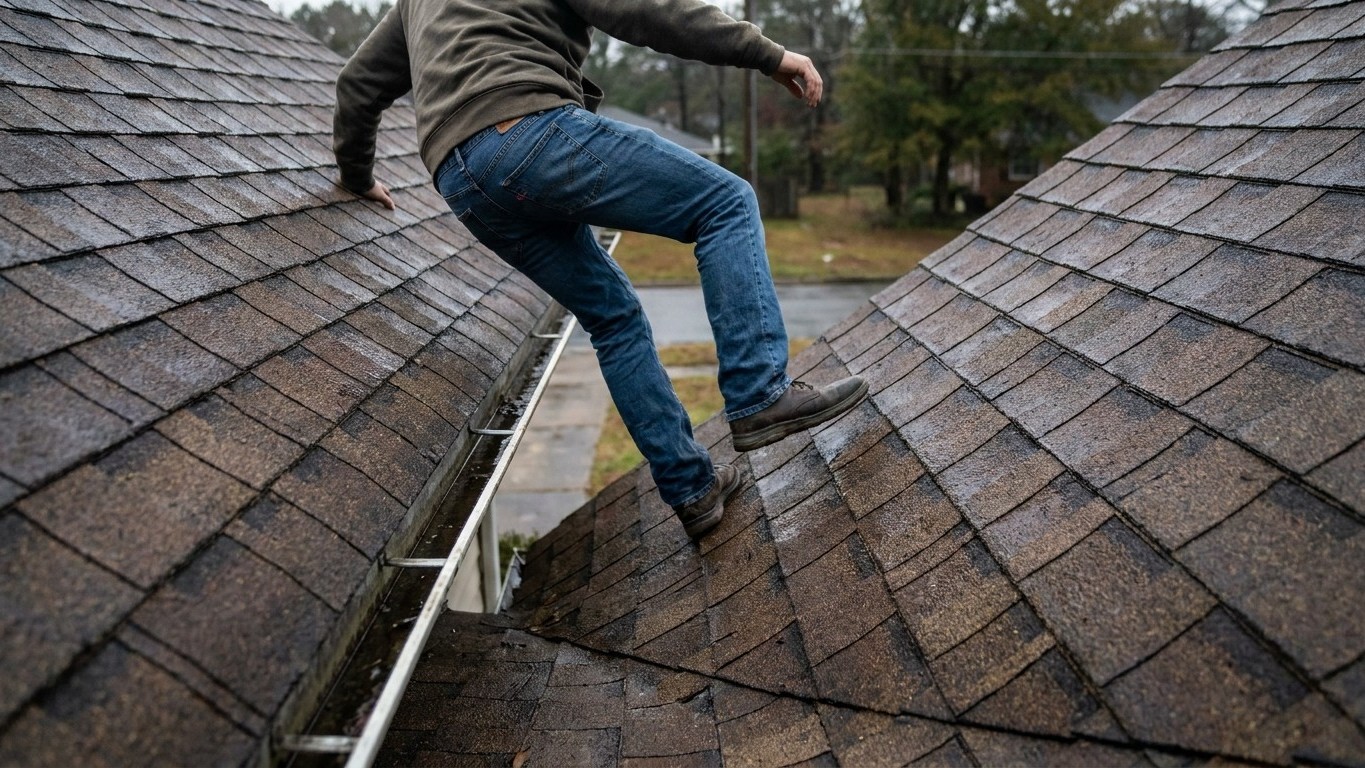

Walking on a roof is risky for two reasons that rarely get explained together: you can fall, and your weight can damage the very surface you’re trying to check. For almost every routine concern (a missing shingle, a stain on the ceiling, storm damage after high winds) you can get a clear answer from the ground or the attic. Climbing up should be the last option, not the first, and usually it’s a job for someone trained to do it safely.
What is actually happening
Two separate problems combine the moment a foot lands on a roof deck. The first is obvious: a sloped, often slick surface sitting well above ground level is an unforgiving place to lose your balance. Falls from roofs are a leading cause of serious home-related injury, and they don’t require a steep pitch or bad weather to happen. A single loose granule, a patch of morning dew, or a moment of distraction is enough.
The second problem gets far less attention: the roof itself doesn’t tolerate foot traffic well, no matter how careful you are. Roofing materials are engineered to shed water and resist wind uplift, not to bear concentrated point loads from a 180-pound adult standing on one heel. Each step presses body weight into a small contact area, and on asphalt shingles that pressure can dislodge the protective granules embedded in the surface. Those granules aren’t decorative. They shield the material underneath from ultraviolet light, and once an area is stripped bare, that spot ages faster than the rest of the roof.
On tile or slate, the mechanism is different but the outcome is similar. These materials are rigid and brittle under lateral stress, meaning a foot planted at the wrong angle, or shifted weight while catching your balance, can crack a tile that was otherwise sound. A cracked tile doesn’t always show a visible gap right away. It can sit in place, structurally compromised, until wind or freeze-thaw movement works it loose.
Walking also compresses and bruises the mat layer beneath shingles in ways that aren’t visible immediately but shorten the material’s effective performance in that exact spot. Repeated foot traffic in the same path (the route someone takes to check a vent or a chimney flashing) creates a wear line that ages faster than the surrounding roof, even though nothing looks obviously broken to the eye standing at the base of a ladder.
What you can see without climbing
Most of what homeowners want to know about roof condition is visible without ever setting foot on the surface. A methodical look from two vantage points covers nearly everything that matters.
- From the ground, using binoculars or a phone camera zoomed in. Walk the perimeter of the house and scan each slope from a distance. Look for shingles that are curling, cupping, or missing outright; for tile that looks cracked, slipped, or discolored compared to its neighbors. For dark streaking that suggests algae or moss buildup. And for anything reflective or shiny that might be exposed metal flashing where it shouldn’t be. A zoomed phone photo lets you review the image afterward, which is often easier than trying to judge detail in real time.
- From the attic, using a flashlight. Climb into the attic on a bright day and turn off any interior lights. Daylight visible through the roof deck is one of the clearest signs of a gap or a failed seam, and it’s something you simply cannot see from outside. While you’re up there, run the light slowly along the rafters and the underside of the decking, looking for water stains, dark streaks, or a rusty tint on nail points. Damp or matted Insulation, especially near a valley, chimney, or vent pipe, is another strong signal that water is getting in somewhere upstream.
This two-step routine, ground first, attic second, is genuinely sufficient for spotting the vast majority of problems that would otherwise prompt someone to grab a ladder. It won’t catch every hairline issue a trained inspector would find, but it answers the question most people actually have: is something wrong right now, and does it need attention. If either check turns up something concerning, that’s the point to call in a professional rather than go up and confirm it yourself.
What it costs to leave it
Ignoring a small roof problem doesn’t make it stay small. Water finds the path of least resistance, and once it gets past the outer layer of shingles or tile, it moves through underlayment, into the decking, and eventually into the framing and insulation below. None of this happens instantly, but it also doesn’t reverse itself. Every rain event after the first breach adds a little more moisture to material that’s already compromised.
The decking, typically plywood or oriented strand board, is the first structural layer at risk. Wood exposed to repeated moisture starts to soften, delaminate, and eventually rot, losing its ability to hold fasteners securely. Once that happens, the roof covering above it has nothing solid to grip, which accelerates further damage in a feedback loop that gets harder to fix the longer it runs.
Insulation soaks up water and compresses, losing its ability to keep the living space comfortable and creating a damp, dark environment that’s exactly what mold needs to establish itself. Once mold takes hold in an attic, it tends to spread along framing members and insulation batting, and dealing with it becomes a separate project from the roof repair itself.
Rafters and trusses, the framing that holds the whole roof shape, are usually the last thing affected, but also the most expensive to address. Persistent moisture weakens wood fiber over time, and in severe cases it can compromise the structural integrity of the framing, not just its appearance. Stains you notice on a rafter during an attic check are rarely the first sign of a leak. They’re evidence that water has already been finding its way to that spot for a while, which is exactly why catching daylight or staining early, before it reaches the framing stage, matters more than any specific repair timeline.
What is not a householder job
Some situations look manageable but aren’t, and it’s worth being direct about where that line sits. Anything above a single storey puts you at a fall height where an accident is far more likely to cause serious injury, and rescue or emergency access becomes much harder. A wet, mossy, steep, or frosted surface removes the traction you’d normally count on, and all four of those conditions can appear without warning, especially early in the morning or after a light rain that hasn’t fully dried. Any task that requires both hands while you’re standing on a slope, holding a tool, a hose, or a piece of flashing, removes your ability to catch yourself if you slip.
These are exactly the moments that tempt people onto a roof: a single loose shingle you can almost reach from the ladder, a gutter clog that seems quick to clear, a patch job that “just needs five minutes.” It’s not worth it. The injury risk doesn’t scale down just because the task looks small, and a roofer with the right harness, footwear, and experience can do the same job in less time and with far less risk than an untrained homeowner improvising on a slope.
If your ground and attic checks turn up something concerning, or if you’re not sure what you’re looking at, the next step is a proper look rather than a personal climb. A structured walkthrough of what to check and how to document it is covered in our roof inspection checklist, and if the issue needs hands-on repair, our guide on hiring a roofer covers what to ask before anyone gets on your roof, including how licensed contractors are equipped and insured for exactly this kind of work.
One more thing worth knowing before any storm-related repair: if damage came from hail or wind, your homeowner’s insurance policy governs how a claim is filed and what’s covered, and those terms vary by policy and by state. Photograph what you can see from the ground or attic, keep dated notes, and let the claims process follow your specific policy rather than a general rule someone else’s roof used.
Common questions
Is it ever fine to walk on a roof briefly to check something?
Even brief foot traffic can dislodge granules, crack tile, or put you at fall risk, and most of what a quick check would reveal is already visible from the ground with binoculars or a zoomed phone camera, or from the attic with a flashlight. There’s rarely a situation where climbing up “just to look” is actually necessary.
What’s the first sign I should look for in the attic?
Daylight showing through the roof deck is the clearest sign of a gap, followed by water stains or dark streaking on the rafters and damp or matted insulation, especially near valleys, chimneys, or vent penetrations.
Does walking on a roof void any warranty on the materials?
Warranty terms differ by manufacturer and by product line, so this is a question for the specification sheet that came with your roofing material or for the contractor who installed it, not a general rule that applies across all roofs.
How do I know if roof damage is serious enough to call someone now versus later?
Visible daylight through the deck, active dripping, sagging in the roofline, or staining that’s spreading between inspections are all signs that warrant a prompt call. Cosmetic granule loss or a single displaced tile spotted early is worth documenting and monitoring, but still best assessed by a roofer rather than climbed to confirm.