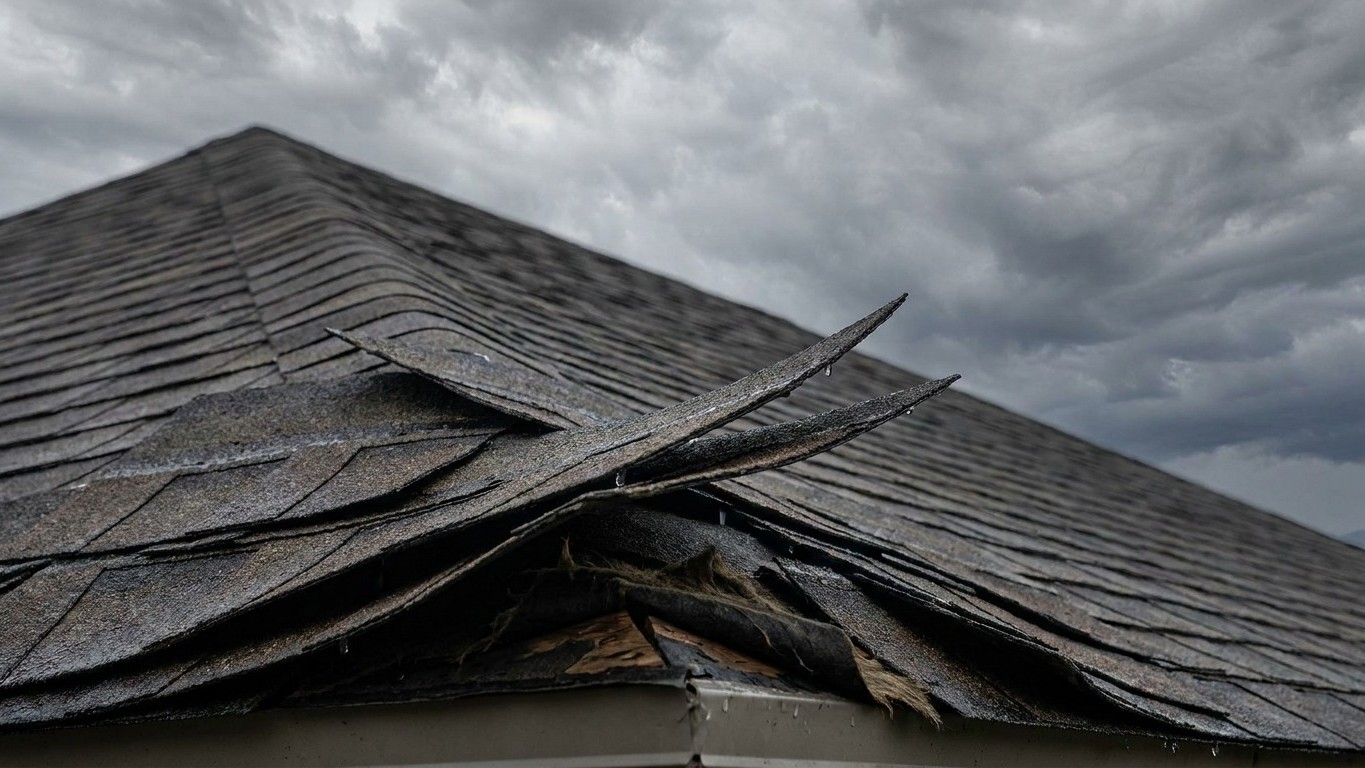

Wind doesn’t push down on a roof, it pulls up on it. Air moving fast across a roofline creates lower pressure right above the surface, and that difference is strongest at the edges, corners, and ridges. The field of a roof, the flat middle expanse, barely feels it. The perimeter takes the load first, every time, which is why damage almost always starts at the edge and works inward.
What is actually happening
Roofing material is fastened down to resist weight pressing on it: rain, snow, foot traffic. Wind doesn’t work that way. As air accelerates over a roof edge, it separates from the surface and creates a pocket of suction right where the material meets open air. That suction pulls upward on shingles, tiles, or panels from underneath their exposed edge, working against fasteners that were never designed to resist an upward force in that spot.
This is why corners fail before edges, and edges fail before the field. A corner sees wind coming from two directions at once, so the low-pressure pocket there is more intense than anywhere else on the structure. Engineers who study building aerodynamics divide a roof into zones for exactly this reason: corner zones, edge zones, and field zones, each rated for different wind loads. A homeowner doesn’t need the technical breakdown, just the practical version: the perimeter is always the weak point, and that’s where to look first after any windstorm.
The part that surprises most people is that a shingle or tile can be broken loose without actually moving. Wind can snap or lift a sealant bond, crack an adhesive strip, or bend a fastener just enough to break its grip, and then the material settles right back into place because there’s nothing pushing it sideways anymore. From the ground, it can look untouched. The failure is structural, not visual. That single unsealed edge is now a hinge, and the next windstorm, even a weaker one, has an easier time finishing the job because there’s no bond left to resist it.
Repeated wind events compound this. A roof that survives one storm with minor, invisible seal breaks is often weaker going into the second storm, even if nothing ever visibly tears loose. Damage accumulates in the fasteners and the seals, not necessarily in the material itself. That’s the mechanism worth remembering: wind damage is frequently a story of loosening, not breaking, and loosening doesn’t announce itself the way a missing shingle does.
Flashing around chimneys, vents, and skylights behaves the same way. These are edge conditions too, just interior ones, and wind treats the transition between roofing material and a protruding fixture the same way it treats the roofline itself: as a place to grab and pull. That’s why inspection after a wind event has to include every edge on the roof, not just the perimeter.
What you can see without climbing
A wind check does not require getting on the roof, and it shouldn’t. Almost everything useful can be seen from the ground or from inside the attic, in that order.
- Walk the perimeter of the house at ground level. Use binoculars or the zoomed-in camera on a phone rather than trying to get closer. Look specifically at the edges, corners, and ridge line rather than scanning the whole roof at once.
- Look for lifted or displaced material along those edges. A shingle or tile that’s tilted up at one corner, a ridge cap that looks slightly offset, or a line of roofing that doesn’t sit flush with its neighbors is exactly the kind of edge failure wind produces.
- Check flashing around chimneys, vents, and any roof penetration the same way, since these interior edges fail by the same mechanism as the perimeter.
- Scan the ground and gutters for granules, small fragments, or pieces of roofing material that have come loose. Their presence reliably signals that something up top has already failed, even if the roof still looks intact from a distance.
- Move to the attic with a flashlight, preferably in daylight hours. This is the most informative step and it involves no climbing at all.
- Look for daylight coming through the roof deck. Any visible pinpoint of light where there shouldn’t be one means a gap has opened above.
- Check rafters and the underside of the deck for staining. Water that has been getting in leaves a mark long before it soaks through to a ceiling below, and that mark is often the earliest real evidence of a wind-loosened seal.
- Feel the insulation near the perimeter of the attic space. Damp or matted insulation, especially near the eaves where edge failures concentrate, confirms that water has already found a way through.
Doing this walk-through after any storm with strong sustained wind, not just after obvious hail or visible debris, catches the damage type that hides best: the loosened edge that hasn’t torn away yet. A phone photo of anything questionable, taken from the ground, is also useful documentation to have on hand later, particularly if an insurance conversation becomes necessary.
What it costs to leave it
An unsealed edge does not repair itself, and it does not stay the same size. Wind that loosened one shingle or one section of flashing has already shown that spot is vulnerable, and the next weather event, rain as much as wind, tends to widen the opening rather than reset it. What starts as a hairline gap at a single edge becomes a channel that water follows every time it rains from that direction.
Water that gets past the roofing material lands first on the deck below it. Wood roof decking absorbs moisture and holds it, which is a different problem from a leak that simply drips through. A deck that stays damp between rain events doesn’t dry out on its own, especially in an attic space with limited airflow, and sustained dampness is exactly the condition that allows rot and mold to take hold in wood framing. Neither problem announces itself loudly. Rot works from the inside of a rafter or a section of decking outward, so the surface can look sound while the structural strength underneath has already declined.
Insulation sitting under a slow leak absorbs water and loses much of its effectiveness once wet, and it stays wet far longer than exposed wood does because it holds moisture against the surfaces around it. That’s part of why the attic check matters as much as the ground check: staining and dampness are the visible evidence of a process that is otherwise happening out of sight.
None of this moves on a fixed schedule. How fast a small edge failure turns into a real problem depends on how much rain follows the wind event, how well the attic ventilates, and how exposed that section of roof is to prevailing weather. What’s consistent is the direction of travel: an edge that has already failed once is a weak point going forward, and every additional wind or rain event finds that weak point before it finds anywhere else. The practical takeaway is that the timing of the inspection matters more than trying to estimate how long a hidden leak has been active. Catching a lifted edge before the next storm is worth more than diagnosing rot after it’s already established.
Insurance coverage for wind-related roof damage depends entirely on the specific policy in place and the state it was written in, and both the coverage terms and any filing deadlines vary. What matters practically is documentation: photos from the ground and the attic, dated and taken as soon as damage is suspected, give a policyholder something concrete to work with regardless of what the policy itself specifies.
What is not a householder job
The urge to get up there and fix a lifted shingle by hand is understandable, and it’s also the wrong move in almost every situation a homeowner will actually face. Roof edges, the exact zones this article has been describing, are also the zones where a fall is most likely, because they’re where the surface ends and the pitch is often most exposed to whatever wind caused the damage in the first place.
A few conditions rule out doing it yourself, without exception. Anything above a single story is out of reach for a reasonable homeowner ladder setup and out of the question for anyone without fall protection. Anything wet, mossy, steep, or frosted changes the footing enough that a surface a person could walk confidently in dry summer conditions becomes unsafe after rain or in early morning dew. And any repair that needs both hands, holding a shingle in place while nailing it, means no hand left to hold onto anything if the footing shifts. All three describe exactly the situations wind damage tends to create: a slick, edge-adjacent, awkward repair right after a storm has already made everything wetter and more exposed than usual.
Falls from roofs cause real injuries every year, and the risk doesn’t scale down just because the repair looks small. A ten-minute fix on a two-story roof carries the same fall risk as a much bigger job. There’s no version of “just this once” that changes the physics of a slope.
The useful next step after spotting a problem using the ground and attic checks above is a professional look, not a personal one. A detailed roof inspection can confirm exactly which edges or fasteners failed and how far water has already traveled, using tools and access a homeowner isn’t set up to use safely. From there, the question of who does the repair is worth its own research; see the guide on hiring a roofer for what to check before anyone gets on the roof on your behalf.
Common questions
Does wind damage always look like missing shingles?
No. The more common early sign is a shingle or tile that’s still in place but no longer sealed, which can look completely normal from the ground. That’s why the attic check for daylight and staining matters as much as the exterior scan.
Can I tell wind damage apart from hail damage from the ground?
Wind damage tends to concentrate at edges, corners, and ridges, with material lifted or displaced rather than pitted. Hail tends to leave scattered impact marks across the whole field of the roof, not just the perimeter. Both are worth photographing for a professional inspection either way.
Is a roof with no visible damage safe to leave unchecked after a windstorm?
Not automatically. A seal can be broken without any visible displacement, so the ground and attic checks described above are worth doing after any storm with strong sustained wind, even if nothing looks wrong at first glance.
Who decides if wind damage is covered by insurance?
The specific policy and the state it was issued in govern that, and terms vary. What a homeowner controls is documentation: dated photos from the ground and attic taken as soon as damage is suspected give any claim a stronger factual basis, regardless of what the policy ultimately says.