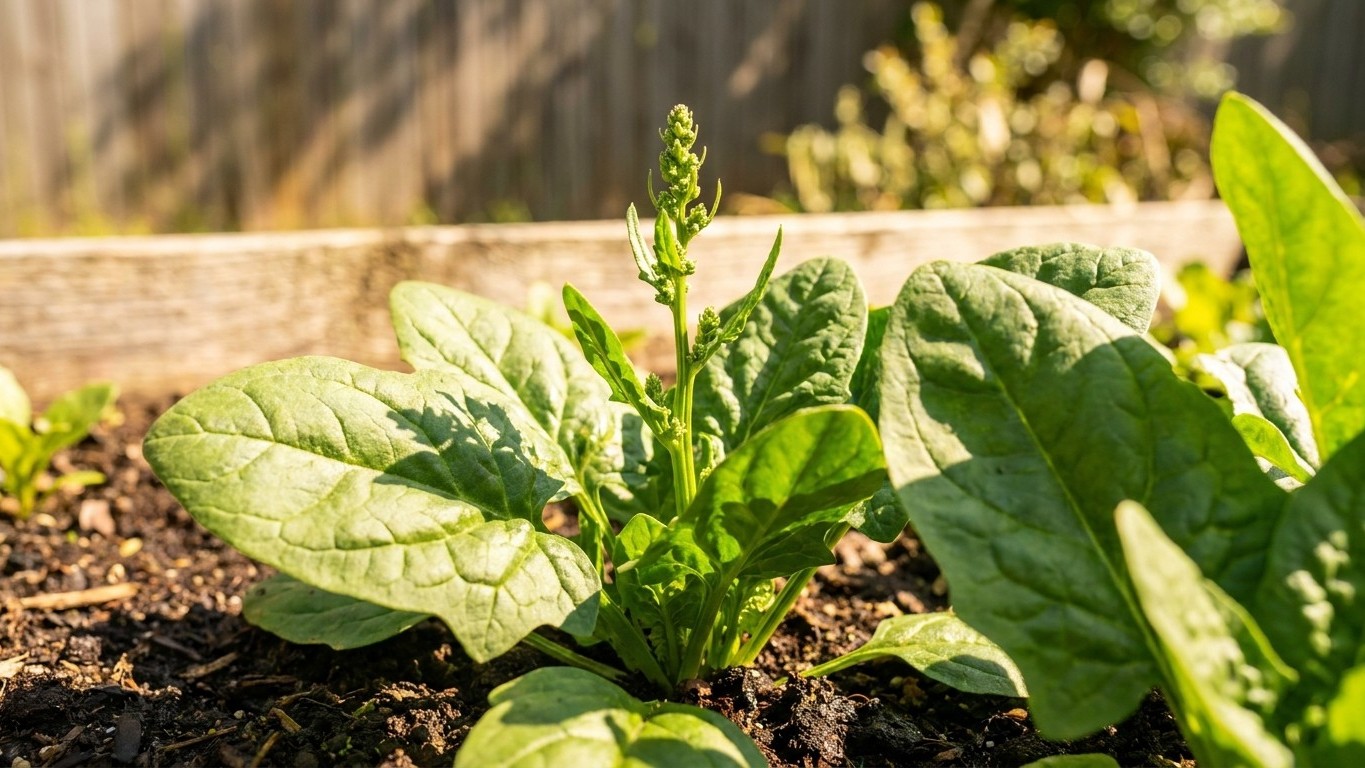

In Arkansas, the two insects that actually feed on spinach are aphids and whiteflies. Both are sap feeders drawn to young, tender leaves, and both build up fastest as the plant’s brief cool window closes and warmth pushes it toward bolting. Other insects the state’s extension service tracks belong to squash vines, roses, and fruiting crops. They show up in garden reports, but not on a spinach leaf.
Which pests attack spinach in Arkansas

The University of Arkansas Division of Agriculture Cooperative Extension documents seven pests for this territory: Aphids, Japanese beetles, Scale insects, Squash bugs (Anasa tristis), Squash vine borer, Stink bugs, and Whiteflies. That is the full list this service publishes here. It is not a list of what eats spinach specifically, and sorting it is the first job.
Squash bugs and squash vine borer are cucurbit specialists. They target squash, pumpkin, and cucumber vines, and a spinach bed offers them nothing to lay eggs on or tunnel into. Japanese beetles skeletonize leaves on roses, grapes, and a wide range of ornamentals and fruit trees, but they are not drawn to low, ground-level greens the way they are to a rose cane at eye level. Scale insects attach to bark and woody stems on shrubs and perennials, and a spinach plant, which lives its whole life as soft annual tissue, never grows the kind of surface they colonize. Stink bugs feed by piercing developing fruit and seed pods, which means their damage shows up on tomatoes, beans, and peppers, not on a leaf crop with no fruit to puncture.
That leaves aphids and whiteflies, and the extension service documents these ones for the state, without a longer list to pad it out. Both are sap feeders, which matters because their damage looks nothing like chewing damage. Aphids cluster on the undersides of young leaves and along the crown, sucking plant fluid and often leaving a sticky residue behind. Whiteflies do something similar but disperse when disturbed, rising off the plant in a small cloud before settling back down. Neither insect chews holes; both drain the plant from within, which is the detail that separates them from every other pest on that seven-name list.
A gardener who spots a beetle on a spinach leaf in Arkansas is very likely looking at something passing through, not something that intends to stay and feed. The two insects worth tracking are smaller, less dramatic, and easy to miss until the plant already shows stress.
When each one shows up, and what it does first
Spinach in this part of the state has to fit inside a narrow window. The frost-free stretch for planting cool-season greens typically opens somewhere between March 12 and March 28, and the crop’s tolerance ends once the plant hits a 75 F growth ceiling, the same temperature that also turns the leaves bitter. Aphids tend to appear early in that spring window, while nights are still cool and the plant is putting out its first true leaves. They favor the tenderest new growth, which is exactly what a young spinach plant is made of.
Whiteflies arrive later in the same window, as daytime temperatures climb and the plant’s tissue thins from the heat. A gardener who sees small pale insects lifting off the leaves in a cloud, rather than clustering and staying put, is more likely seeing whiteflies than aphids. Both problems intensify at the same moment the plant itself is under stress from approaching heat, which is not a coincidence. Sap feeders concentrate where the plant’s defenses are already weakest.
The autumn planting works on a different clock entirely. Spinach seed germinates poorly once soil temperature climbs above 80 F, so the fall sowing window opens only after the soil has cooled, not on a fixed date on the calendar. Once that sowing happens, count on 50 to 75 days before the harvest date the gardener has in mind, working backward from the first fall frost, which falls between November 7 and November 20. Aphid pressure in the fall crop tends to be lighter, because the soil has already cooled and the plant is not putting out the same flush of tender new growth under stress. Whiteflies, by contrast, can still be active into early autumn if the season stays warm, since they build populations through the hot months and don’t disappear the moment the calendar turns.
What a gardener notices first, in either season, is rarely the insect itself. It is a leaf that looks slightly off, pale, curled at the edge, or dulled, before anything crawling is visible on close inspection.
Telling the damage apart from everything else
Spinach fails for reasons that have nothing to do with insects far more often than gardeners assume. Heat is the biggest one. The same 75 F threshold that limits growth also triggers bitterness, and a plant sitting near that ceiling can look stressed, yellowed, or slow, long before an aphid ever lands on it. Long days add to that stress independently, since spinach bolts under long daylight and warmth together, and a bolting plant often shows pale, elongated new growth that has nothing to do with pest feeding.
Water stress produces a similar picture: leaves that wilt in the afternoon heat and recover overnight are usually thirsty, not infested. Nutrient deficiency shows up differently again, typically as a uniform yellowing that starts at the older, lower leaves and moves upward, rather than the localized curling or stippling that sap feeders leave behind. Mechanical damage, from hail, foot traffic, or a garden tool, tends to leave a torn or bruised edge rather than the fine speckling aphids and whiteflies cause.
| Symptom | Likely cause | What tells them apart |
|---|---|---|
| Curled, sticky young leaves | Aphids | Clusters visible on leaf undersides; residue feels tacky |
| Small pale insects rising in a cloud when touched | Whiteflies | Insects disperse and resettle, unlike stationary aphids |
| Pale, stretched new growth, plant turning upward | Bolting from long days and heat | No insects present; growth pattern, not leaf texture, is off |
| Afternoon wilting that recovers by morning | Water stress | Leaf tissue itself is undamaged |
| Uniform yellowing from the bottom of the plant up | Nutrient deficiency | Even color change, no clustering or feeding marks |
None of this replaces a direct look at the plant. A gardener unsure which column applies is better served bringing a sample, or a clear photograph, to the local extension office than guessing from a symptom chart.
What actually works here, and what is a waste of time
Timing does more work than any treatment on a crop with a growing season this short. A floating row cover set over spinach at planting, before aphids or whiteflies have found the bed, keeps both insects off the plant without a single spray. Once the cover comes off for harvest access, that protection ends, so the trick is leaving it on as long as the plant’s light and temperature needs allow.
The source names four spinach varieties for this kind of planting, Bloomsdale, Melody, Teton, and Olympia, but publishes no comparative data on how any of them performs against insects or heat. Choosing among them on pest resistance alone is not something this article, or the source behind it, can support. What the timing does support is clear: sowing the fall crop only after soil temperature drops back below the 80 F germination threshold avoids the weak, heat-stressed seedlings that sap feeders target hardest, which matters more than any product choice made after the fact.
What tends to waste effort is treating the plant after bolting has already started. Once spinach shifts into flowering under long days and heat, no pest control changes that outcome, because the plant’s own hormonal response, not the insects, is driving the decline. Spraying at that point treats a symptom the plant has already moved past. Guessing at a treatment without knowing which insect, or whether an insect is involved at all, is the second common waste of effort, since aphid and whitefly problems don’t respond to the same handling. This site does not recommend specific products or active ingredients. That decision belongs with the University of Arkansas Division of Agriculture Cooperative Extension, which knows what is currently labeled for use in the state.
Where to check this for your own county
Everything above comes from state-level records kept by the University of Arkansas Division of Agriculture Cooperative Extension, and state-level does not mean county-level. Aphid and whitefly pressure shifts with local soil, nearby crops, and even which yard is upwind of a neighbor’s untreated planting. A garden in the Ozarks and a garden in the Delta can have very different pest years despite sharing the same statewide list.
The extension service maintains a county office in each of Arkansas’s counties, and that office is where a specific infestation, a confusing symptom, or a question about what is currently labeled for use gets an answer grounded in that county’s own conditions. A photograph of the affected leaves, or a sample brought in directly, gets a faster and more accurate answer than a description alone.
The next useful step for a gardener working through a spinach problem right now is not another article. It’s a call or a visit to that county office, with the plant, or a clear picture of it, in hand.
Common questions
Do Japanese beetles actually damage spinach in Arkansas?
They are documented in the state, but they favor roses, grapes, and fruit trees over low leafy greens. A beetle found on a spinach plant is more likely passing through than feeding there.
Why does spinach bolt even in a mild spring?
Bolting is triggered by long daylight hours as well as warmth. A cool stretch of weather does not cancel out the effect of longer days once the plant reaches that trigger point.
Is it worth planting spinach again in the fall?
Yes, once soil temperature has dropped below the 80 F point where germination struggles. Counting back 50 to 75 days from the first fall frost window gives a workable sowing target.
Should I spray for aphids as soon as I see a few?
Confirm the insect and the extent of the problem with the local extension office first. A small early cluster and a spreading infestation call for different responses, and the office can also confirm what is currently labeled for use.