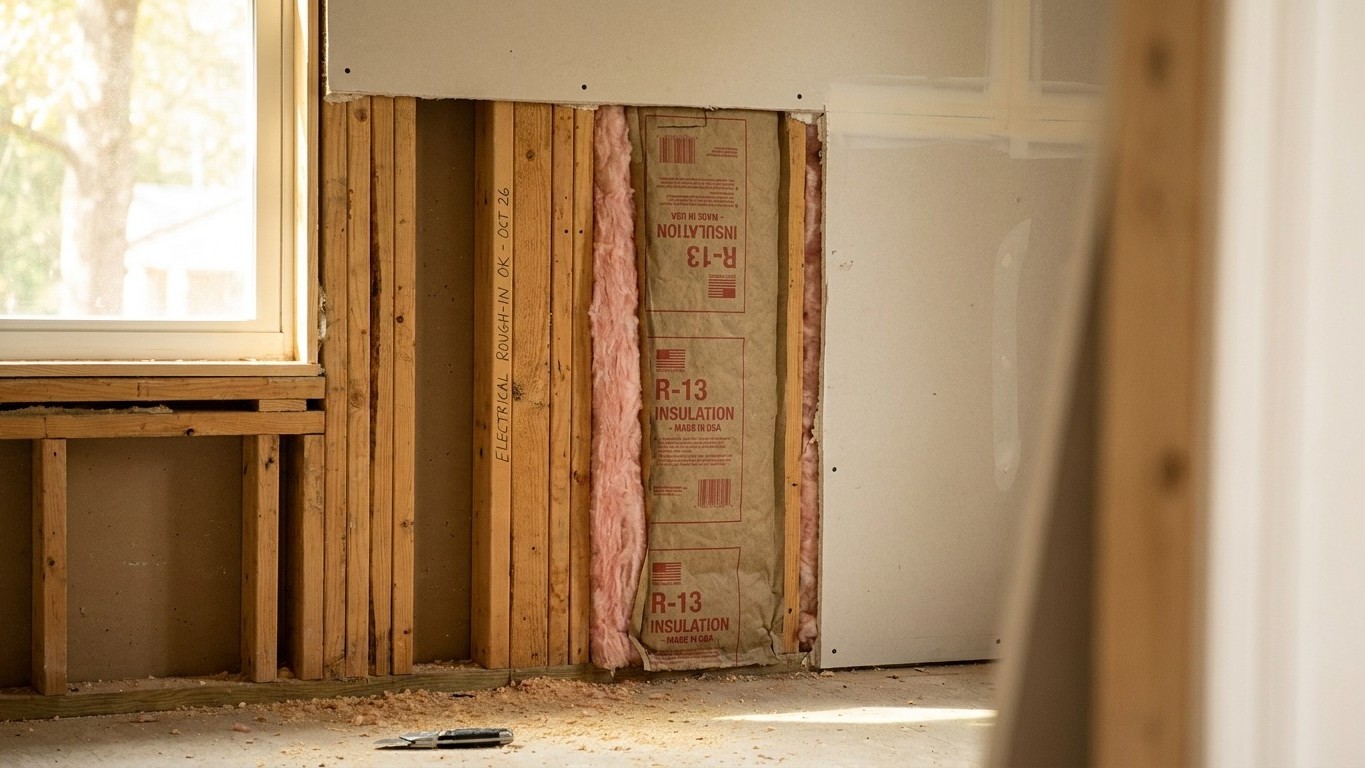

Yes. New York’s frame walls fall under IECC Climate Zones 4A, 5A, and 6A, and the 2021 International Residential Code exempts only Climate Zones 1, 2, and 3 from its vapor retarder requirement. Since no New York county sits in those zones, R702.7 applies statewide: a vapor retarder is required on the interior side of frame walls, with the class set by local table.
What the code asks for in New York

The 2021 International Residential Code, Section R702.7, is direct: a vapor retarder of the class given by Table R702.7(2) shall be provided on the interior side of frame walls. That’s the baseline rule the whole country builds from. The exception that flips the requirement off applies only to Climate Zones 1, 2, and 3, warm zones found in places like South Florida or South Texas, not in New York.
New York’s 62 counties split across three IECC zones: 36 counties in Zone 5A, 18 counties in Zone 6A, and 8 counties in Zone 4A. That’s a real spread, a homeowner near the Canadian border and one on Long Island are not building under identical thermal assumptions. But for this specific question, the spread doesn’t produce a split answer. Zone 4A, 5A, and 6A are all outside the 1-2-3 exception, so the requirement to install a vapor retarder holds across every one of those 62 counties.
Why this matters even though the answer is uniform
“Not required” is not the same as “forbidden.” In zones where the exception applies, builders are free to skip an interior vapor retarder, they are never barred from installing one. New York simply isn’t in that position. Here, the retarder is called for, and the class of material (Class I, II, or III) is what Table R702.7(2) assigns based on the specific wall assembly and climate zone, not something this page can specify for an individual house.
That distinction matters because a wall built with the wrong vapor control doesn’t announce the mistake. There’s no sagging drywall, no obvious stain the week after drywall goes up. The moisture accumulates behind the finish, and the rot shows up years later, when a stud is already compromised and the drywall has to come off to find out why.
Why the answer is the opposite in a warm climate
The direction water vapor travels is the whole story. In a cold climate like most of New York, warm, moisture-laden air sits inside the house all winter. Without a retarder, that vapor pushes through the wall cavity toward the cold sheathing, where it can condense. The interior vapor retarder stops it before it gets there. That’s the logic behind R702.7’s baseline requirement.
Flip the climate and the physics flip with it. In a warm, humid region, the moisture load comes from outside, hot, saturated air pressing against the wall from the exterior for much of the year. If that wall has a Class I vapor retarder (something close to impermeable) on the interior side, the U.S. Department of Energy’s Building America program spells out what happens next: “If the wall contains a vapor retarder on the interior side of the insulation, the water vapor will condense on this cool, impermeable surface.” The result, in the DOE’s own words, is “ruined insulation, mold, and structural rot of framing members.”
That single sentence is why the code doesn’t apply one rule nationwide. It isn’t bureaucratic inconsistency, it’s the code following the water. In Zones 1, 2, and 3, an interior Class I barrier turns the wall’s coolest surface into a condensation point for incoming humidity, so the code removes the requirement rather than force a wall to fail on schedule. In New York’s zones, the moisture threat runs the other direction, so the requirement stays in place.
The three classes, and why the word matters
“Vapor barrier” gets used loosely, but the code doesn’t work that way. It defines three classes by how much moisture they let through, measured in perms. Sheet polyethylene is a Class I material, but calling polyethylene simply “a vapor barrier” skips the number that actually governs where and how it can be used.
| Class | Example materials | Permeance range |
|---|---|---|
| Class I | Sheet polyethylene, nonperforated aluminum foil | 0.1 perm or less |
| Class II | Kraft-faced fiberglass batts, vapor retarder paint | Above 0.1 up to 1.0 perm |
| Class III | Latex or enamel paint | Above 1.0 up to 10.0 perm |
Most homeowners already have a Class III retarder on their walls and don’t realize it, ordinary latex paint qualifies. It’s the loosest of the three classes, letting far more moisture through than polyethylene, but it still counts as a vapor retarder under the code’s definition. That’s the entire disagreement in a nutshell: builders in different climates aren’t arguing about whether a wall needs some form of vapor control. They’re arguing about which class belongs where, because the wrong class in the wrong climate is the DOE’s mold-and-rot scenario waiting to happen.
One more distinction worth keeping straight: a vapor retarder is not an air barrier. They do different jobs, one slows moisture diffusion through a material, the other blocks bulk air movement through gaps and seams — even though the same sheet of polyethylene can sometimes serve both functions at once.
Where the rule stops
R702.7 doesn’t apply everywhere in a house, even in a climate that generally requires it. Four exceptions carve out situations where the interior retarder isn’t required:
- Basement walls
- The below-grade portion of any wall
- Construction where accumulation, condensation, or freezing of moisture will not damage the materials
- Climate Zones 1, 2, and 3 (the exception that doesn’t apply to New York)
The basement exception is the one most New York homeowners actually run into, because so many houses here have full basements. A poured concrete foundation wall holds groundwater moisture and releases it slowly, sometimes for years after the pour. That wall needs to dry inward, toward the conditioned basement space. Sealing an impermeable vapor retarder against the interior face traps that moisture between the concrete and the finish material, with nowhere to go, the same condensation problem the DOE describes for warm climates, just happening below grade instead. For the specifics of how that assembly should be built, the basement wall guide on this site walks through the difference between a foundation wall and an above-grade frame wall in more detail.
Who actually decides, in New York
None of this page substitutes for a call to the local building department. The International Residential Code is a model code, states and municipalities adopt it, sometimes with amendments, sometimes years after a new edition is published. The code in force on a given lot is whatever New York’s jurisdiction has adopted, not necessarily the 2021 edition referenced here.
That gap matters more in a state like New York because the heating demand is real and sustained. At the Central Park weather station, the NOAA 1991-2020 climate normals put the annual heating degree day total at about 4,553, against roughly 1,222 cooling degree days. Heating degree days measure demand, not temperature, they add up how far below 65°F the average day sits, all year, so a bigger number means a longer, colder-leaning heating season driving up fuel use. A total north of 4,500 heating degree days is a serious winter load, and it’s the reason questions about interior vapor control carry real weight in this state rather than being an afterthought, the way they might be in a place with a shorter, milder season.
The building department is the only party that can confirm the code edition in force, the class required for a specific wall assembly, and whether local amendments changed anything from the model language. A wall built on an assumption instead of a confirmed answer doesn’t fail at inspection, it fails quietly, years down the line, when the rot is already inside the stud bay.