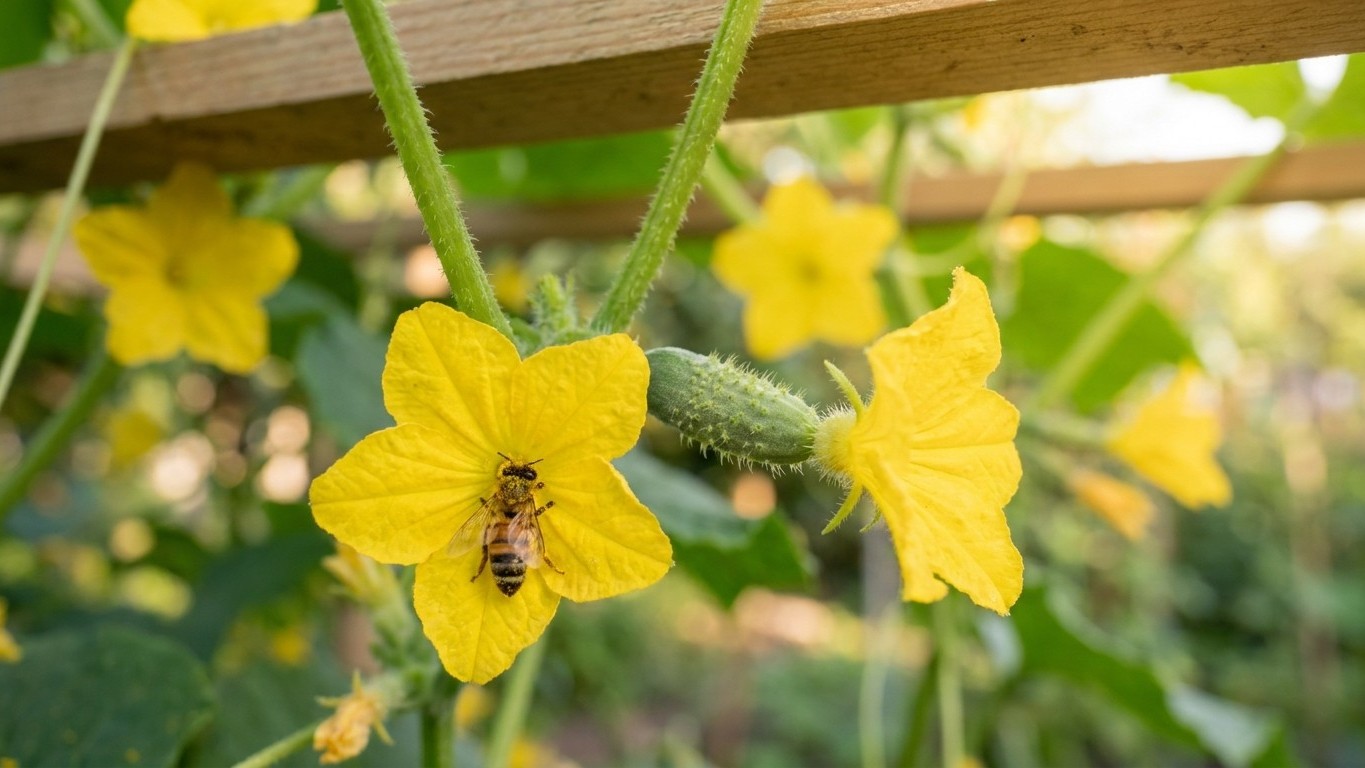

A cucumber vine loaded with blossoms and nothing to show for it usually isn’t broken. Most cucumbers need bees to carry pollen from male flowers to female flowers, and the plant stacks the deck early by opening far more males than females. No fruit yet often just means the ratio, the timing, or the pollinator traffic hasn’t caught up.
What is actually going on

Cucumbers are monoecious, meaning one plant produces two separate kinds of flowers instead of a single perfect bloom. Male flowers show up first, sometimes ten or more before a single female appears, and their only job is to supply pollen. Female flowers are easy to spot once you know the trick: there’s a miniature cucumber, a swollen little ovary, sitting right behind the petals before the flower even opens. If that tiny fruit isn’t there, the flower is male, full stop.
Each flower, male or female, opens for roughly one day. If a bee or other pollinator doesn’t move pollen into that female bloom during its brief window, it closes, yellows, and drops off the vine. No wind is going to save it. Unlike corn, which relies on wind for pollination, cucumber pollen is heavy and sticky. It needs an insect to physically carry it from anther to stigma, and honeybees, bumblebees, and native squash bees all do this work depending on the region and the season.
Heat complicates things further. When daytime temperatures climb into the range that stresses the plant, cucumbers often abort female flowers or fail to complete fertilization even when pollen did get delivered. The plant is triaging: it can’t support fruit development under stress, so it drops the flower instead. This is separate from a pollination failure, but it looks identical from the outside, which is part of why the problem is so confusing to diagnose.
Not every cucumber needs this process at all. Parthenocarpic types, common in greenhouse production and some seedless slicing varieties bred for high tunnels, set fruit without pollination. If planted near other cucumber types, though, stray pollen can still reach them and trigger seedy, sometimes misshapen fruit, so isolation matters more for these than for standard pickling, slicing, or burpless types grown outdoors. Extension trial data for specific varieties suited to a given state is available through the state-by-state growing guides on this site, since regional performance varies more than seed catalogs tend to admit.
In the garden
Most of the diagnosis work happens by watching, not guessing. The table below covers the signs gardeners actually run into, what they mean, and what to do when the situation isn’t the normal, self-correcting kind.
| What you see | What it means | What to do if it’s a problem |
|---|---|---|
| Only male flowers for the first couple of weeks | Normal. Cucumbers front-load male blooms to build up pollinator visits before fruiting starts. | If males alone continue past three or four weeks of bloom, suspect heat stress or check whether the variety is a specialty type that flowers differently. |
| Female flowers open but few bees are around | Low pollinator traffic, common in early spring, in heavily sprayed neighborhoods, or in enclosed spaces like high tunnels. | Hand-pollinate: pick a freshly opened male flower, remove the petals, and dab the pollen-covered center directly onto the female flower’s stigma. A small, soft paintbrush works the same way. |
| Female flower pollinates but the young fruit yellows and shrivels | Incomplete pollination. Each female flower needs multiple grains delivered across several bee visits, not just one touch. | Hand-pollinate more thoroughly, touching the male flower to several points on the female stigma, or repeat over two mornings. |
| Fruit forms oddly shaped, tapered, or bulbous at one end | Usually uneven pollination across the ovary, not a disease or a soil problem. | Improve pollinator access (remove row cover during bloom, reduce broad-spectrum insecticide use) rather than changing fertilizer or watering. |
| Fruit tastes bitter | Environmental stress, most often inconsistent watering or heat, not cross-pollination. Cross-pollination affects seeds in next year’s saved seed, not this year’s fruit flavor. | Keep watering even and consistent rather than swinging from dry to soaked. |
Hand pollination is worth the five minutes it takes in a few specific situations: cucumbers grown under row cover or in a hoop house where insects can’t get in, container plants isolated on a balcony or patio far from other flowering plants, and early-season plantings that bloom before local bee populations are fully active. Outside of those cases, most outdoor gardens with a reasonable mix of flowering plants nearby don’t need help. The bees find the cucumbers.
What it depends on where you are
How much of this problem shows up, and how long it lasts, has almost nothing to do with a single national rule. Season length changes how much overlap there is between bee activity and the cucumber’s bloom window. A short growing season compresses everything, so a slow pollinator start can cost real production time that a longer season would simply absorb. Summer heat determines how often flowers abort regardless of pollination success, and that threshold varies by region and even by microclimate within a single yard. Summer rainfall patterns affect both the plant’s stress levels and how active ground-nesting native bees are during bloom.
Local pollinator populations differ too. Some regions have strong native squash bee activity that pollinates cucumbers efficiently even with modest honeybee numbers nearby, while other areas depend almost entirely on managed or wild honeybee colonies, which can fluctuate year to year for reasons that have nothing to do with a home garden. None of this is something a general guide can pin down without knowing the reader’s location, which is exactly why it’s worth checking the state-specific pages in this collection and, more importantly, the local Cooperative Extension office, which tracks regional pollinator activity, heat stress thresholds, and variety trial results specific to that state’s growing conditions.
The gap between “this technique works” and “this technique works here, now, for this variety” is where most frustration with cucumber pollination actually lives. A hand-pollination routine that’s unnecessary in one climate can be the difference between a harvest and an empty vine in another. Extension offices publish this kind of localized guidance because a national average is close to useless at the level of a single backyard.
The mistake that costs the most
The single most expensive mistake isn’t skipping hand pollination or misidentifying a flower. It’s reaching for extra nitrogen the moment fruit set stalls. A cucumber vine covered in blossoms but producing nothing looks, to a lot of gardeners, like a plant that’s hungry or struggling, and the instinctive fix is more fertilizer, often a high-nitrogen feed meant for leafy growth.
That instinct backfires. Excess nitrogen pushes the plant toward vegetative growth, more leaves, longer vines, and it tends to delay or suppress female flower production even further while doing nothing to speed up pollination. The plant that already had too many male flowers and not enough females ends up with an even worse ratio, buried under more foliage that also makes it harder for bees to find the blooms that are there. Meanwhile the actual bottleneck, pollinator access, goes completely unaddressed.
The better response is patience paired with observation. Confirm whether female flowers are appearing at all (check behind the petals for that miniature fruit), watch for bee activity during the two or three hours after those flowers open in the morning, and only intervene with hand pollination if pollinators genuinely aren’t showing up. If flowering has stalled for a longer stretch and the plant looks otherwise healthy, a light, balanced feeding is reasonable, but it should never be the first move. Most stalled cucumber patches fix themselves once the female flowers arrive in force and the local bee population catches up, and that’s a timing problem, not a nutrition problem.