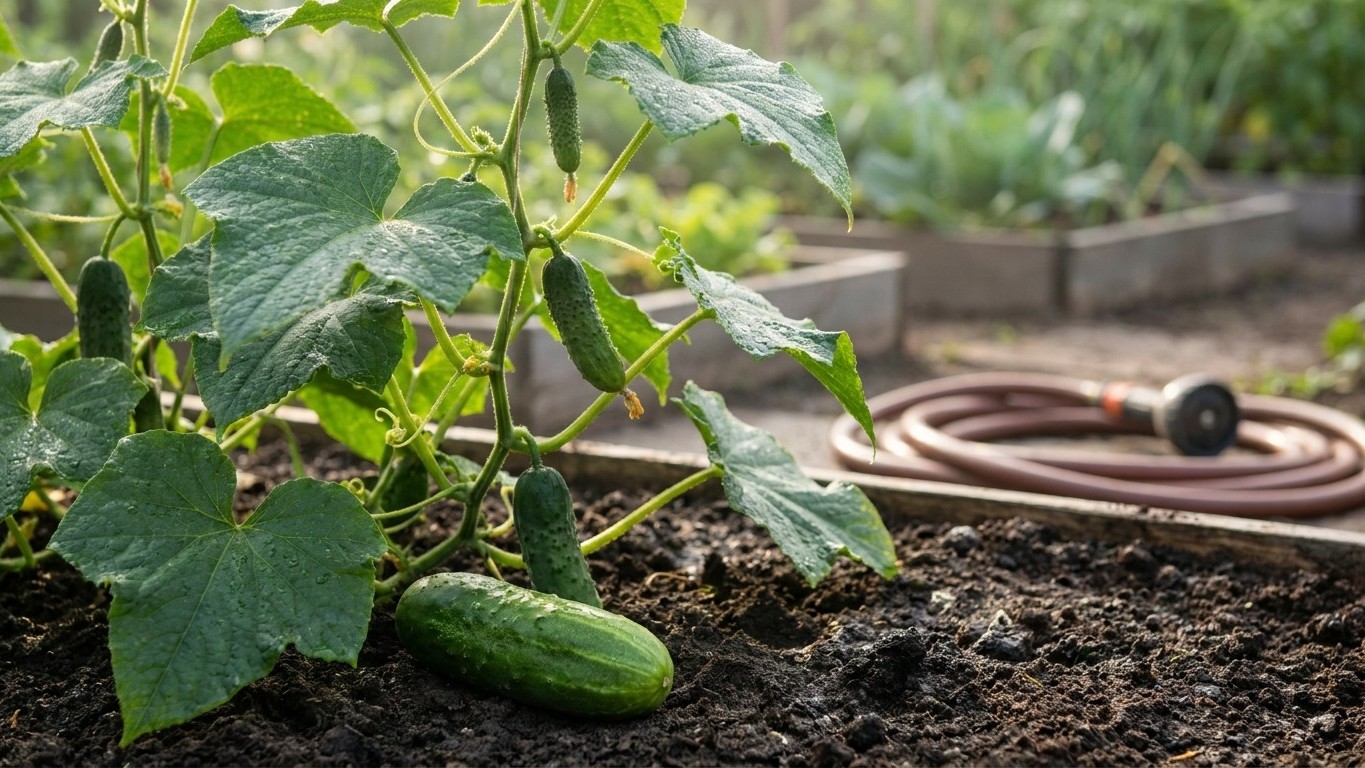

A cucumber plant asks for four things at once: soil that has actually warmed up, water on a steady rhythm rather than a feast-or-famine one, enough air moving through the leaves to dry off dew and rain, and a vine picked over every couple of days so it keeps flowering instead of shutting down. Miss any one of these, and the plant tells you through the fruit.
What a cucumber plant actually asks for
Cold soil is the quiet killer of a cucumber season before it even starts. Seeds dropped into ground that hasn’t warmed up sit and sulk, sometimes rotting before they sprout, sometimes germinating so weakly that the seedling never really catches up to a later, better-timed planting. Cucumber roots want warmth at depth, not just a sunny afternoon on the surface. That’s why a lot of the timing advice on this site keeps circling back to soil temperature instead of a calendar date.
Water works the same way, but through the fruit instead of the roots. A cucumber is mostly water by weight, and the plant builds that fruit on whatever moisture schedule you give it. Feed it in unpredictable bursts, heavy one week and dry the next, and the plant responds by concentrating bitter compounds in the flesh or by growing fruit that curls and pinches instead of filling out straight. Deep, regular watering at the root zone beats a quick daily sprinkle every time, because it teaches the plant to expect consistency rather than scramble for it.
Airflow gets less attention than watering, but it decides whether disease shows up at all. Cucumber leaves are broad and they hold humidity close to the surface, especially in a dense planting or a vine left to sprawl into a tangled mat. Fungal problems move in on that trapped moisture. Spacing plants properly and training vines upward, rather than letting them pile on the ground, lets morning dew and rain evaporate quickly instead of sitting on the foliage all day.
The last demand is the one most new gardeners underestimate: pick often. A cucumber left on the vine past its point sends a signal back to the plant that tells it to slow down or stop setting new flowers. That single overgrown fruit sitting in the leaves can cost you a week of production. Checking the vines every day or two, and taking fruit a little on the early side rather than late, keeps the plant in flowering mode all season.
| What the plant demands | What happens when it’s not met | Where this site treats it |
|---|---|---|
| Warm, evenly moist soil at planting | Seeds rot or stall, seedlings lag and never fully recover | Soil and planting timing |
| Steady water at the root, not sporadic bursts | Bitter, hollow, or curled fruit | Watering cucumbers |
| Airflow around the foliage | Mildew and other fungal disease take hold | Spacing and trellising |
| Frequent, regular harvest | The vine slows flowering or stops producing new fruit | Harvesting cucumbers |
The four kinds of cucumber
Before any of the care details matter, one choice at the seed rack decides most of the outcome: which type of cucumber you’re actually growing. The four working categories are pickling, slicing, burpless, and parthenocarpic. Bush versus vining is a separate question about growth habit and space, not fruit type, but it’s worth knowing that most types come in both forms.
Built for different jobs
Pickling cucumbers are bred to be harvested small, with dense, less watery flesh and thin skin that takes up brine easily. Their spines, which rub off easily, are part of that design. They’re built to be picked young and processed quickly, and they’re a poor choice if what you actually want is a cucumber to slice into a salad, since the harvest window is narrow and the fruit doesn’t hold on the counter well.
Slicing cucumbers go the other direction. They’re bred to grow larger, with a thicker skin and often a light waxy coating that helps them hold up in the refrigerator or on a store shelf. That same thick skin and denser interior structure make them a disappointing pickle, since brine has a harder time penetrating and the finished product tends to stay firmer and blander than a true pickling type.
Burpless types were bred to lower the compounds responsible for both bitterness and the digestive discomfort some people associate with cucumbers. They tend to run long and slender with thin, often smoother skin, and a milder flavor. The tradeoff shows up in storage and handling: that thinner skin bruises faster and the fruit doesn’t hold up to rough handling or long storage the way a thick-skinned slicer does.
Parthenocarpic cucumbers set fruit without needing pollination at all, which makes them the standard choice for greenhouse and high tunnel growers where pollinators can’t get in. Grown outdoors near regular, pollinator-dependent types, they can cross-pollinate and end up seedy or oddly shaped instead of smooth. They shine in covered, controlled environments and lose some of that advantage in an open garden bed full of bees.
| Type | How it’s built | What it’s for | Where it disappoints |
|---|---|---|---|
| Pickling | Small, dense flesh, thin skin, rough spines | Brining and pickling, picked young | Fresh eating, storage, shelf life |
| Slicing | Larger fruit, thicker waxy skin | Fresh eating, salads, longer holding | Pickling; brine penetrates poorly |
| Burpless | Lower bitterness, thin skin, mild flavor | Fresh eating for sensitive digestion | Bruises easily, shorter storage |
| Parthenocarpic | Sets fruit without pollination | Greenhouses, high tunnels, covered beds | Outdoor cross-pollination causes seediness |
Your state’s cooperative extension service publishes lists of specific varieties trialled for local heat, humidity, and disease pressure within each of these types. That’s the right place to pick an actual variety name. This site sticks to the categories, because a variety that thrives in the Southeast can flop in the high desert, and no national page can responsibly claim otherwise.
Reading a cucumber that is going wrong
Most cucumber problems announce themselves before the plant collapses. Learning to read the early signal saves the harvest more often than any single fix does.
Bitter fruit is usually the plant’s response to stress, most often uneven watering or a stretch of heat that outpaced the root system’s ability to keep up. The bitterness concentrates in compounds near the stem end and the skin, and it tends to show up worse in a dry spell that follows a heavy rain rather than in a season of steady moisture. Curled or hook-shaped fruit points to a similar root cause, though sometimes the culprit is uneven pollination rather than water, where one side of the developing fruit gets fertilized before the other and grows faster.
Plenty of flowers but no fruit forming is often just biology working on schedule rather than anything wrong. Cucumber plants produce male flowers first, sometimes for a week or two, before female flowers (the ones with a tiny cucumber shape at the base) start appearing. If female flowers are present and still not setting fruit, the likely cause shifts to poor pollinator activity, which matters more for standard types than for parthenocarpic ones.
A white, powdery coating across the top of the leaves is one of the more recognizable disease signals in the vegetable garden, and it points toward powdery mildew taking hold in still, humid air. Angular yellow patches that stay boxed in by the leaf veins, rather than spreading in a rounded blotch, suggest a different problem, often a bacterial or fungal leaf spot that thrives on wet foliage and splashing water.
A plant that looks completely healthy one evening and wilted the next morning, especially without a matching drought, is the most urgent symptom on this list. That pattern often points to bacterial wilt spread by cucumber beetles feeding on the stems, or to a vine borer working inside the stem itself. Either cause calls for a fast look at the base of the plant rather than waiting to see if it recovers.
| What you see | Likely cause | Where this site treats it |
|---|---|---|
| Bitter fruit | Water stress or heat stress | Watering cucumbers |
| Curled or hooked fruit | Uneven water or incomplete pollination | Pollination problems |
| Flowers with no fruit | Male-only flush or weak pollinator activity | Pollination problems |
| White powder on leaves | Powdery mildew, likely from still, humid air | Cucumber pests and diseases |
| Angular yellow patches on leaves | Bacterial or fungal leaf spot, often from wet foliage | Cucumber pests and diseases |
| Overnight wilting, no drought | Bacterial wilt from cucumber beetles, or a vine borer | Cucumber pests and diseases |
Treat every row here as a likely cause, not a confirmed diagnosis. Two different problems can produce similar symptoms, and the surest way to narrow it down is to look closely at the stem base, the underside of the leaves, and the pattern of damage across the bed.
Why the answer changes with where you garden
Everything laid out on this page shifts once you plug in an actual location. Season length decides how many weeks a plant has to move from seed to steady harvest, and that window runs very differently in a short northern growing season than it does across a long, hot stretch in the Gulf states. Summer heat changes the watering math too: soil that needs a deep soak twice a week in a mild coastal climate can need that same volume every other day once daytime highs push into the 90s.
Rainfall patterns matter just as much as heat, and often more, because they control disease pressure directly. A region with frequent afternoon thunderstorms and high humidity keeps foliage wet longer, which is exactly the condition that favors powdery mildew and bacterial leaf spot. A dry, low-humidity climate with irrigated beds faces a different set of pressures, often centered more on soil moisture consistency than on fungal disease.
None of this changes the four core demands covered above. Warm soil, steady water, airflow, and frequent picking still apply everywhere cucumbers grow. What changes is the timing, the volume, and which failure mode is most likely to show up first in your particular yard.
This is exactly where a state extension service earns its keep. County-level recommendations are built from actual trial data collected on cucumber types performing under local heat, local pest pressure, and local rainfall, which is a level of detail no national page can responsibly provide. If you’re deciding between a pickling, slicing, burpless, or parthenocarpic type, your extension office’s current variety trial results, matched to your county, will tell you more than any general guide can. Explore the broader state and regional guides on this site, starting from the cucumber growing pillar page, and treat this page as the framework you bring with you into that more local conversation.