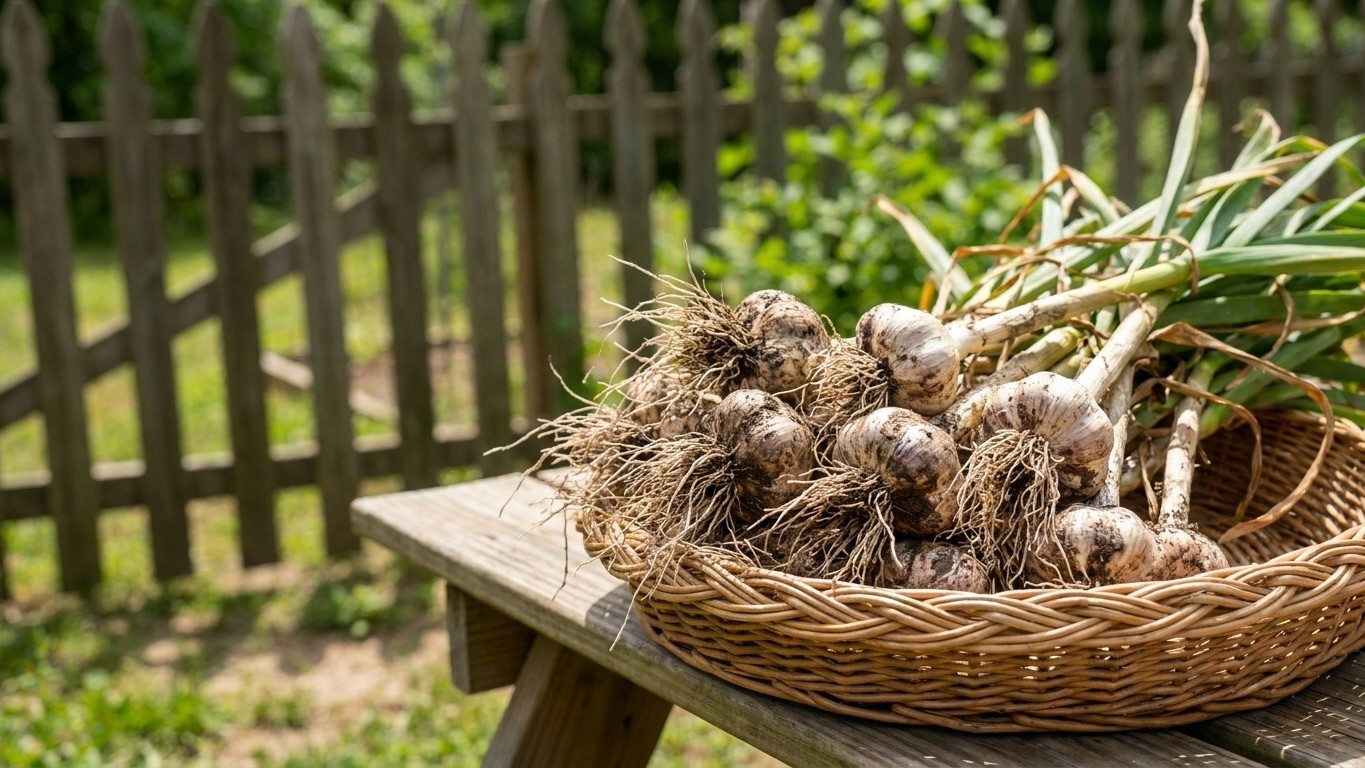

Garlic in New Hampshire is usually ready to lift when the lower third to half of the leaves have browned, generally in mid to late July. After that, the real work starts: two to three weeks of curing in a dry, shaded spot, followed by cool, dark storage that can carry bulbs well into winter if the curing was done right.
When garlic is ready to lift in New Hampshire
Garlic planted in this region goes into the ground in autumn, well before the soil locks up for winter, and it doesn’t come out again until the following summer. That long dormant stretch through a New Hampshire winter is what builds the bulb, so nothing about harvest timing makes sense without remembering the crop spent eight or nine months underground first.
The clue that lifting time has arrived isn’t a date on a calendar. It’s the plant itself. Watch the leaves, not the clock: once roughly half the foliage has turned yellow or brown while the top few leaves are still green, the bulb has usually stopped bulking and started wrapping itself in papery skins. Pull too early and you get small, undercured cloves with loose wrappers. Wait too long, past the point where most leaves have died back, and the wrappers can split underground or rot from excess moisture, leaving bulbs that won’t store.
Confirm before you pull the whole row
Because timing varies from one growing season to the next, and from one garden to another depending on soil and planting date, it’s worth digging a single test bulb before committing to the whole bed. Brush off the soil and look at the wrappers: they should be intact, dry to the touch, and the individual cloves should feel distinct and firm rather than fused into a single mushy mass. If that test bulb looks right, the rest of the row is probably close behind.
Autumn planting timing matters here too, since it sets the clock for everything that follows. Growers in this region typically get cloves in the ground before the ground turns hard, using the arrival of consistent frost as a rough marker. For the reference weather station used by NOAA’s National Centers for Environmental Information, the first fall frost falls somewhere between October 13 and October 26, based on 1991-2020 climate normals. That’s a midpoint, not a guarantee. In roughly one year out of two, the first frost actually lands later than that window. It’s also a single station’s data, and gardens away from that station, especially at higher elevation or in low-lying frost pockets, often see frost arrive a week or two earlier. Check your own county’s typical pattern rather than treating this figure as a fixed date.
Curing it, and where to hang it here
Pulling garlic out of the ground doesn’t make it ready for the pantry. Fresh-dug bulbs are still carrying moisture in the neck and outer layers, and that moisture has to leave slowly, under controlled conditions, or the bulbs will mold instead of drying down properly. This process, curing, is what determines whether garlic lasts through winter or turns soft and spoiled by Thanksgiving.
The basic setup is the same anywhere: pull the bulbs with the leaves and roots still attached, brush off loose soil without washing them, and lay or hang them somewhere shaded, dry, and airy for a couple of weeks. Direct sun is the enemy here. It can scald the outer wrappers and cook the cloves just under the skin, which ruins the very layer that’s supposed to protect the bulb in storage.
Finding dry air in a humid New Hampshire summer
Late July and August in this state can run warm and sticky, which makes curing trickier than the simple advice suggests. A closed-up shed with no airflow traps humidity and invites mold on the necks and roots. A covered porch, an open barn bay, or a garage with the door cracked and a box fan running tends to work better, since moving air does more for curing than a shady corner with still, damp air ever will.
Space matters too. Bulbs piled in a heap cure unevenly, with the ones in the center staying damp long after the outer layer feels papery. Spreading them in a single layer on screens, or hanging them in loose bundles of six to ten plants tied by the stems, gives every bulb equal exposure to air. Once the outer wrappers rustle like paper and the necks have tightened and dried, usually after a couple of weeks depending on humidity that week, the bulbs are ready to have roots and stems trimmed and move into longer-term storage.
Storing it through a New Hampshire winter
Cured garlic still needs the right conditions to make it to spring. The goal is a spot that’s cool, dark, dry, and has some airflow, the opposite of a plastic bag on a kitchen counter or a bowl sitting in direct light. A mudroom, an unheated but insulated closet, or a cool corner of a basement away from the furnace tends to fit the bill better than anywhere in the kitchen itself.
Mesh bags, braids, and what to avoid
Loose mesh bags, old onion sacks, or shallow crates with some ventilation all let air circulate around the bulbs, which matters more for longevity than any single container choice. Softneck varieties, with their flexible stems, can be braided into ropes and hung, a traditional method that also makes it easy to spot a bulb going soft before it affects its neighbors. Hardneck garlic, which many New Hampshire gardeners favor for its cold tolerance, has a stiff central stalk that doesn’t braid, so mesh bags or crates are the more practical route.
- Keep bulbs away from potatoes, which release moisture that speeds up garlic spoilage
- Skip the refrigerator for whole bulbs, since cold, moist air there tends to trigger early sprouting
- Check stored bulbs every few weeks and pull any that feel soft before the softness spreads
- Save the firmest, largest bulbs from the harvest as next autumn’s planting stock
How long a batch lasts depends heavily on how well it cured in the first place. Bulbs that went into storage with fully dried necks and tight wrappers hold up far longer than ones rushed into bags while still slightly green at the stem. That’s the real payoff of taking curing seriously: it’s the difference between garlic that’s still good in February and garlic that’s a soft, sprouting disappointment by November.
What goes wrong here
Most garlic failures in this region trace back to one of two things: bad timing at harvest, or rushed curing. Pulling bulbs too early because the calendar says “July” without checking the leaves is a common misstep, and so is leaving them in wet soil after a stretch of rain because the schedule says it’s not time yet. Soil moisture at lifting matters as much as the date does.
Curing mistakes show up later and are harder to fix once they happen. Garlic cured in a closed, humid space often develops mold at the neck or on the outer wrappers, sometimes not visible until the bulb is already in storage and starting to soften from the inside. There’s no reviving a bulb once that starts. The fix is entirely preventive: airflow and shade during curing, not a rescue after the fact.
On pests, UNH Cooperative Extension documents a number of insects active in the region’s home gardens, including Asiatic garden beetle, brown marmorated stink bug, flea beetles, Japanese beetle, lily leaf beetle, rose chafer, squash vine borer, striped cucumber beetle, and tarnished plant bug. Garlic itself tends to have fewer above-ground pest problems than many other garden crops, but gardeners growing garlic alongside other vegetables in the same beds should watch for this documented list across the whole garden, since several of these insects target nearby crops and can build up in soil that hosts a wide mix of plantings. For questions specific to a particular property or county, the UNH Cooperative Extension is the resource to check.
Common questions
Can I plant garlic in spring instead of autumn in New Hampshire?
Garlic grown in this region is planted in autumn and lifted the following summer. That long cold period underground is part of what triggers bulb formation, so the autumn-to-summer cycle is the standard approach here rather than an option among several.
How do I know if my garlic is undercured before storing it?
Undercured garlic has a neck that still feels soft or slightly damp rather than dry and papery, and the outer wrappers may look dull or loose instead of tight and rustling. Bulbs in that state should go back into a dry, airy space for another week or two rather than straight into a storage bag.
Does the first fall frost date tell me when to plant garlic?
It’s one useful reference point, not a fixed rule. The first fall frost for the reference weather station used by NOAA falls between October 13 and October 26, but that’s a midpoint based on 1991-2020 climate data, and frost arrives later than that window in about half of all years. Local conditions, especially elevation and low-lying spots, can shift that timing earlier.
Why did some of my stored garlic sprout green shoots by midwinter?
Sprouting during storage usually means the bulbs are sitting somewhere too warm, too humid, or exposed to light, or that they were stored in the refrigerator, where cold and moisture together tend to wake up the cloves early. A consistently cool, dark, dry spot with some airflow keeps bulbs dormant much longer.
Related guides
- When to Plant Garlic in New Jersey: Counting Back From the First Frost
- Garlic Varieties That Suit New Jersey Winters
- What to Plant in New Hampshire in April
- Will Parsnips Sweeten in New Hampshire
- When to Plant Melons in New Hampshire
- When to Plant Garlic in New Hampshire: Counting Back From the First Frost