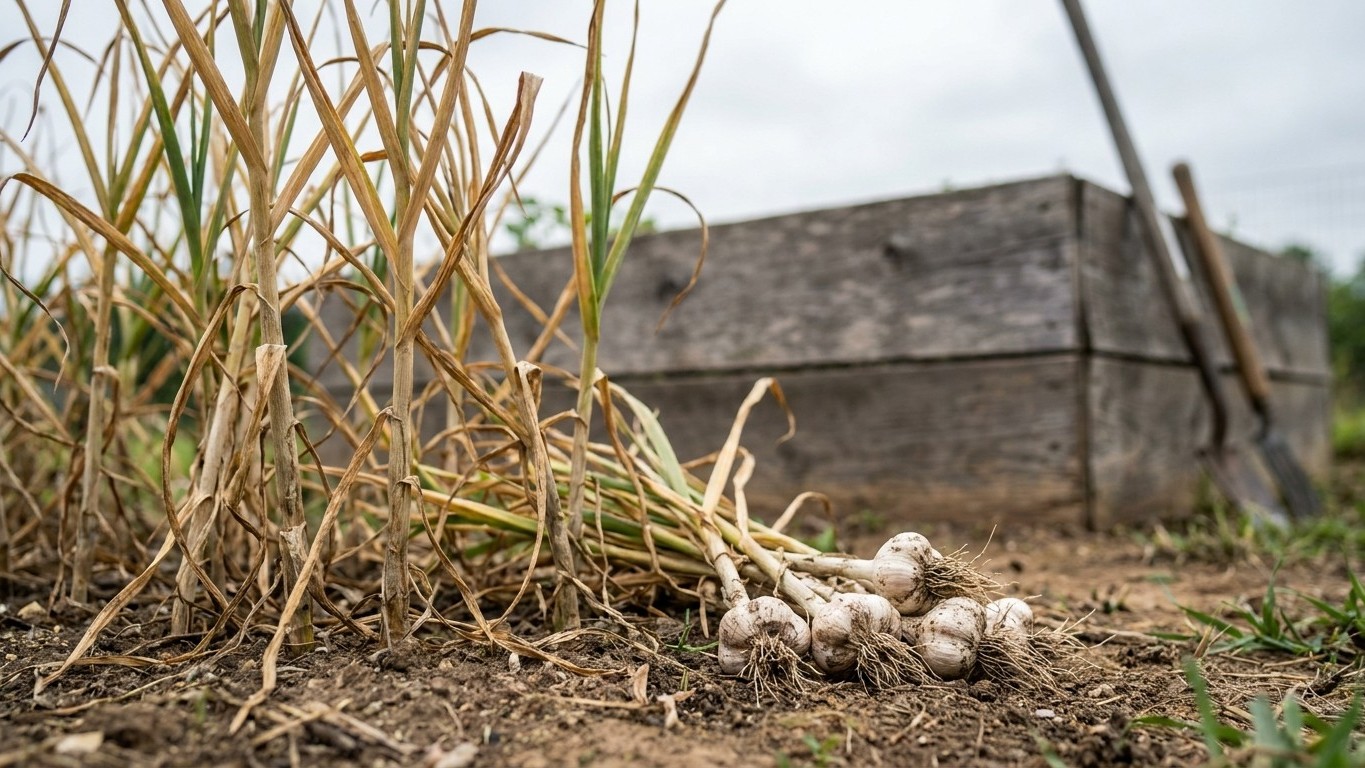

Garlic in Saskatchewan is usually ready to lift between mid-July and early August, once the lower leaves have browned back and five or six green leaves remain up top. From there, curing runs three to four weeks in a dry, shaded, ventilated spot before the bulbs go into winter storage. The exact week shifts with planting date, variety, and how the summer behaved.
When garlic is ready to lift in Saskatchewan
Garlic planted the previous autumn spends the winter dormant underground, then pushes up growth as soon as the soil warms in spring. By midsummer, the plant starts redirecting energy from leaves into the bulb, and that shift shows up as browning from the bottom of the stalk upward. The signal growers actually watch for isn’t a calendar date. It’s leaf count. When roughly five to six leaves are still green at the top and the lower third to half of the plant has died back, the bulb underneath has usually finished sizing up.
Pulling too early leaves bulbs undersized with loose, immature wrappers that won’t cure well. Waiting too long past that point risks the opposite problem: wrappers split open underground, cloves separate, and the bulb loses the protective layers it needs for storage. A test dig on one or two plants, a few days before the main harvest, settles the question faster than guessing from the calendar.
Hardneck vs. softneck timing
Saskatchewan’s cold winters push most growers toward hardneck varieties, which tolerate deep frost better than softnecks. The two types don’t behave identically at harvest, though.
| Type | Typical readiness signal | Storage life after curing |
|---|---|---|
| Hardneck | Scapes removed weeks earlier; 5-6 green leaves remain, lower leaves brown | Shorter, generally a few months |
| Softneck | Leaves flop and yellow more uniformly across the plant | Longer, often stretches toward spring with good storage conditions |
Because hardneck garlic dominates in this climate, most Saskatchewan growers are working against a narrower storage window than gardeners further south, which makes getting the curing step right that much more important.
Curing it, and where to hang it here
Curing is what turns a freshly dug bulb, still full of moisture, into something that will keep for months without rotting. The process is simple in principle: air movement, shade, and low humidity draw moisture out of the outer wrapper layers and seal the neck, without cooking the cloves or bleaching the skins with direct sun.
Saskatchewan’s summer air is typically dry, which works in a grower’s favor here compared to more humid regions. The trick is finding a spot that’s shaded and ventilated but not damp. A detached garage with the door cracked, a shed with a screened window, or a covered porch out of direct sun all work. What doesn’t work is a sealed plastic tote, a sunny deck, or a spot where dew settles overnight and never fully dries during the day.
Bulbs are best hung in small bundles, or spread in a single layer on screens or slatted shelving, so air reaches all sides. Crowding them into a pile traps humidity right where mold starts. The curing period generally runs a few weeks, and it’s finished once the outer wrappers turn papery and the neck above the bulb feels dry and tight rather than fleshy. Roots can be trimmed and dirt brushed off (not washed) once that point is reached, since washing reintroduces moisture right before storage.
One Saskatchewan-specific wrinkle worth planning around: a run of wet or smoky-hazy weather in late July or August, which does happen some seasons, slows curing noticeably. Growers who count on a fixed two-week window sometimes find their garlic still soft-necked at the point they’d planned to move it indoors for winter. Building in slack, and checking neck dryness rather than the calendar, avoids that mismatch.
Storing it through a Saskatchewan winter
Once cured, garlic needs a cool, dark, dry space with steady airflow, and Saskatchewan homes have both good and bad options for this. An unheated but frost-free porch, a cold room off a basement, or a root cellar all tend to work well, since they hold a stable cool temperature without swinging with the outdoor weather. A heated living space is too warm and dry over months, which shrivels cloves faster; an attached but uninsulated garage can swing too cold once deep winter sets in and risks freeze damage to the cloves themselves.
Bulbs store best loose in mesh bags, open baskets, or cardboard boxes with holes, never in sealed plastic, which traps the small amount of moisture bulbs still release and starts rot from the inside out. Braiding softneck varieties and hanging them is a traditional option that also keeps air circulating around each bulb.
Checking stored garlic every few weeks through winter catches problems early. A bulb that’s gone soft, sprouted, or developed a moldy smell should be pulled and used or discarded before it affects its neighbors. Hardneck garlic, the more common choice in this province, generally holds up for a few months in good conditions; softneck holds longer, which is part of why some Saskatchewan growers plant a mix of both, using hardneck first through fall and early winter and saving softneck for later in the season.
Setting aside the largest, healthiest bulbs from this year’s harvest as seed stock for the next autumn planting is standard practice here, since garlic grown from local, acclimated bulbs tends to perform more reliably through Saskatchewan winters than stock brought in from milder regions.
What goes wrong here
The most common misstep is timing the harvest against the wrong marker. Some growers wait for a calendar date rather than watching leaf dieback, and end up either pulling bulbs too early or leaving them in the ground into September, closer to the season’s first frost risk. In Saskatoon, the officially recorded average first fall frost date sits at September 18, and that figure is a midpoint, not a safe cutoff. In one year out of two, frost actually arrives later than that date, and in northern or upland parts of the province it can arrive noticeably earlier. Garlic left in the ground or curing outdoors uncovered when an early frost hits can suffer damage that shows up later as soft, discolored cloves in storage.
Curing in the wrong conditions causes the second most common problem. Direct sun scalds the outer wrappers and can affect flavor, while a damp, unventilated space (a sealed shed with no airflow, for instance) leads to mold before the neck ever dries down properly.
On pests, Saskatchewan growers dealing with stored bulb and root crops should know that thrips are among the pests documented for this region by extension services in neighboring states, including Montana State University Extension’s Urban IPM program and NDSU Extension. Thrips can affect garlic in the field before harvest, showing up as silvery streaking on leaves, though they aren’t a storage-stage problem once bulbs are cured and dry. No other pest on that documented list is specific to garlic bulbs or garlic storage.
Growers wanting region-specific planting and variety guidance can check the Saskatchewan agriculture and agribusiness resources for current recommendations.
Common questions
How do I know if my garlic is ready without pulling the whole crop?
Dig one or two test bulbs when about five to six leaves remain green and the lower leaves have browned. Cut one open; the cloves should fill the wrapper snugly with no gaps.
Can I cure garlic indoors if I don’t have a shed or garage?
A spare room with a fan running and a window cracked can work, as long as it stays out of direct sun and doesn’t hold humidity. The goal is airflow and shade, not any specific building type.
Does hardneck garlic really store shorter than softneck in Saskatchewan?
Generally, yes. Hardneck varieties tend to hold for a few months after curing, while softneck varieties, less common here because they’re less cold-hardy, can often stretch further into the following year under good storage conditions.
Is it risky to leave garlic in the ground into September?
It can be. The average first fall frost for the Saskatoon area lands around September 18, but that’s a midpoint figure, not a guaranteed safe date, and frost arrives later than that in half of all years and earlier in colder pockets of the province. Harvesting based on leaf dieback rather than pushing toward a fall date avoids the gamble entirely.