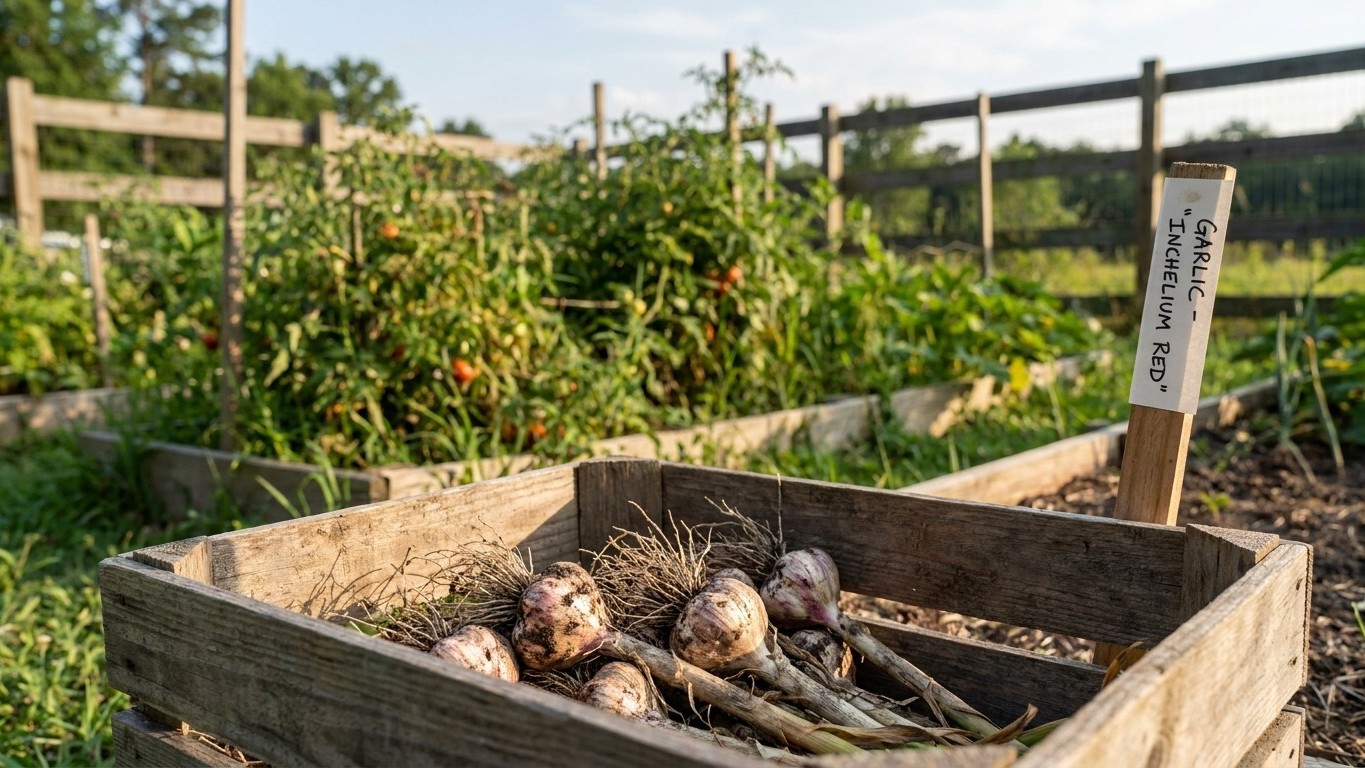

Softneck garlic is the one to plant here, and you want it in the ground between late October and mid November. South Carolina winters rarely stay cold enough, long enough, for hardneck bulbs to split the way they’re supposed to — most of the state gets nowhere near the six to eight weeks below 40°F that hardneck needs, so cloves come up fused into one round bulb instead of a full head. Softneck doesn’t ask for that. So walk out, pick a spot with loose, well-drained soil, and mark your calendar for that late-October window — that’s the one choice that decides how this crop turns out.
The short answer for South Carolina

Why softneck wins here
Softneck garlic is the more reliable choice for most of South Carolina, because it does not depend on a long stretch of hard cold to divide into individual cloves the way hardneck types do. Early Red Italian, Inchelium Red, Italian Late and Lorz Italian are the four softneck options in this territory, and any of them should split cleanly even after a mild Lowcountry winter.
NOAA’s 1991-2020 climate normals, measured at the Charleston-area station, put the first fall frost at November 20 to December 5. That is a midpoint, not a safe date. In roughly one year out of two the first freeze arrives later than this window, so garlic planted in late October to mid November has weeks of mild soil to root through before real cold shows up, which matters more for bulb size the following summer than hitting one exact calendar day.
Hardneck varieties are the harder sell. Chesnok Red, German White, Bavarian Purple, Blue Music, Duganski, Fall Festival, Georgian Crystal, Georgian Fire, German Red and Ivan all need a longer cold spell to force the bulb apart, and University of Georgia Extension bulletin C854 puts that requirement at six to eight weeks below 40°F. Near Charleston, winter delivers only about 4.3 weeks in that range, which is why hardneck bulbs grown there sometimes come up as a single round clove instead of a full head.
| Variety | Neck type | Chill need to divide | Set-out window |
|---|---|---|---|
| Early Red Italian | Softneck | Lower | Late October to mid November |
| Inchelium Red | Softneck | Lower | Late October to mid November |
| Italian Late | Softneck | Lower | Late October to mid November |
| Lorz Italian | Softneck | Lower | Late October to mid November |
| Bavarian Purple | Hardneck | Higher | Late October to mid November |
| Blue Music | Hardneck | Higher | Late October to mid November |
| Chesnok Red | Hardneck | Higher | Late October to mid November |
| Duganski | Hardneck | Higher | Late October to mid November |
| Fall Festival | Hardneck | Higher | Late October to mid November |
| Georgian Crystal | Hardneck | Higher | Late October to mid November |
| Georgian Fire | Hardneck | Higher | Late October to mid November |
| German Red | Hardneck | Higher | Late October to mid November |
| German White | Hardneck | Higher | Late October to mid November |
| Ivan | Hardneck | Higher | Late October to mid November |
Working it out for your own garden
If you haven’t gotten your bed ready yet, start with Growing Garlic in South Carolina.
Counting back from your own frost date
The late-October-to-mid-November window listed for every variety above is not arbitrary. It comes from counting backward roughly three to six weeks from the Charleston-area first frost date. Late October sits about three to four weeks ahead of the November 20 edge of NOAA’s normals, and closer to six weeks ahead of the December 5 edge. Mid-November sits within a few days to about three weeks of both ends. That three-to-six-week gap gives garlic time to grow roots before cold slows it down, without pushing so much top growth that an early freeze burns tender leaves.
To adapt this for your own county, start with your local first-fall-frost figure rather than Charleston’s, and count backward the same span. The planting calendar page walks through pulling that number and doing the countback step by step: see When to Plant Garlic in South Carolina: Counting Back From the First Frost. If your county’s frost date runs two weeks earlier than Charleston’s, as it can through the Upstate, shift the whole planting window two weeks earlier too. A frost that arrives sooner does not mean a shorter root-in period. It means the whole calendar moves.
Elevation, a large lake, and closeness to the coast can each shift the effective frost date by a week or two, sometimes more. Land near open water cools more slowly in autumn because water releases stored summer heat gradually, which is part of why the Charleston peninsula itself runs milder than the airport station where NOAA takes its readings. Higher ground loses heat faster on clear, still nights, so a garden sitting even a few hundred feet above the surrounding valley floor can see its first frost noticeably earlier than a garden in the low ground a short drive away. A large inland lake such as Lake Murray or Lake Marion works the other direction, holding warmth into a nearby garden longer than open fields a few miles off.
What changes across South Carolina
Upstate, Midlands, and the coast
The station behind the frost figures in this guide sits near Charleston, and the state is too large for one number to describe it. Upstate counties such as Greenville and Oconee, sitting at higher elevation inland toward the Blue Ridge foothills, see their first fall frost arrive earlier and their last spring frost linger later, so the whole safe planting season runs tighter at both ends than the Charleston figures suggest. The Midlands, around Columbia, generally falls between the two, closer to the coast’s timing than the Upstate’s but still further from the ocean’s moderating effect.
The coastal Lowcountry, including the Charleston peninsula, Beaufort, and the Sea Islands, is the mildest part of the state, and the peninsula itself runs milder still than the airport station where NOAA collects its normals, since dense urban ground and surrounding tidal water both hold heat longer than open farmland.
That geography has a direct bearing on the softneck-versus-hardneck decision above. The 4.3-week figure for cold below 40°F belongs to the Charleston-area station specifically. Upstate winters run measurably longer and colder, which likely closes some of the gap toward the six-to-eight-week hardneck requirement, though no station figure here confirms that hardnecks reliably divide there either. A grower in Oconee or Greenville counties has more reason to trial Duganski or German Red as a real crop, not just a curiosity row, than a grower on Hilton Head Island does.
The mistakes this climate punishes
Disease pressure and timing errors specific to this climate
Cold is not the only pressure worth watching. The University of California’s IPM Pest Management Guidelines for onion and garlic (UC ANR Publication 3453) publish the temperature ranges where the major garlic diseases are active, and checking those against monthly average air temperatures here is a useful gut check, with three caveats attached: the published ranges are soil temperatures, not air temperatures, which lag and swing less than air does; a monthly average hides a lot of day-to-day variation; and one weather station does not describe conditions statewide.
- White rot (Sclerotium cepivorum): average air temperatures fall inside its published 50-75°F range in seven months of the growing season, including one at the pathogen’s optimum, per UC IPM.
- Fusarium basal rot (Fusarium oxysporum f. sp. cepae): average air temperatures sit inside its 59-90°F range in six months, including one at the optimum.
- Pink root (Setophoma terrestris): three months average inside its 75-85°F optimum band.
- Southern blight (Sclerotium rolfsii): no month averages inside its 86-95°F optimum, which means the disease runs less active here, not that it is absent.
None of this points to one variety over another. It points to seed source. White rot in particular survives in soil for years once introduced, no garlic on the market carries real resistance to it, and the biggest single mistake a South Carolina grower can make is planting an unknown grocery-store Bulb Instead of certified, disease-free seed stock from a garlic-specific supplier.
The other mistake is timing, and it runs the opposite direction from what a colder state would punish. Waiting until early December on the theory that a Charleston-area frost rarely shows up before Thanksgiving leaves a clove only a few weeks of root growth before soil temperatures drop, and a bulb that goes into winter with a thin root system tends to come up small and uneven the following June. Setting out by mid November, rather than pushing toward the December end of NOAA’s frost range, gives roots more of the mild autumn weather to work with.
Checking this against your county
Every figure in this guide comes from a station near Charleston, and a different South Carolina county can run meaningfully warmer or colder in either direction. Clemson Extension keeps county agents and local publications that track conditions more precisely than one statewide guide can (Clemson Extension). Check with the office nearest your garden before locking in a planting date, especially in the Upstate or in a river-bottom spot where cold settles differently than it does on the surrounding high ground.
Common questions
Can I grow hardneck garlic in South Carolina at all, or should I just stick to softneck?
You can try it, and some growers do get decent heads, but softneck is the safer bet for a whole bed. Plant a hardneck like Chesnok Red or German White as a short trial row alongside your main softneck planting rather than betting the season on it.
What actually happens if a hardneck doesn’t get enough cold?
The bulb often comes up as one solid, undivided clove instead of a full head of separate cloves, and you usually can’t tell until you dig and cure it. The plant itself can look completely normal above ground all season.
I missed the mid-November window. Is it too late to plant?
Not necessarily, since NOAA’s normals put the Charleston-area frost as late as December 5 in an average year. Planting into early December is a real gamble on root establishment though, so if you’re that late, favor a softneck variety and expect somewhat smaller bulbs next summer.
Should I use grocery store garlic instead of buying seed garlic?
Skip it if you can. Grocery bulbs are rarely labeled by variety, are sometimes treated to slow sprouting, and carry an unknown disease history, including soil pathogens like white rot that can persist in a bed for years once introduced.