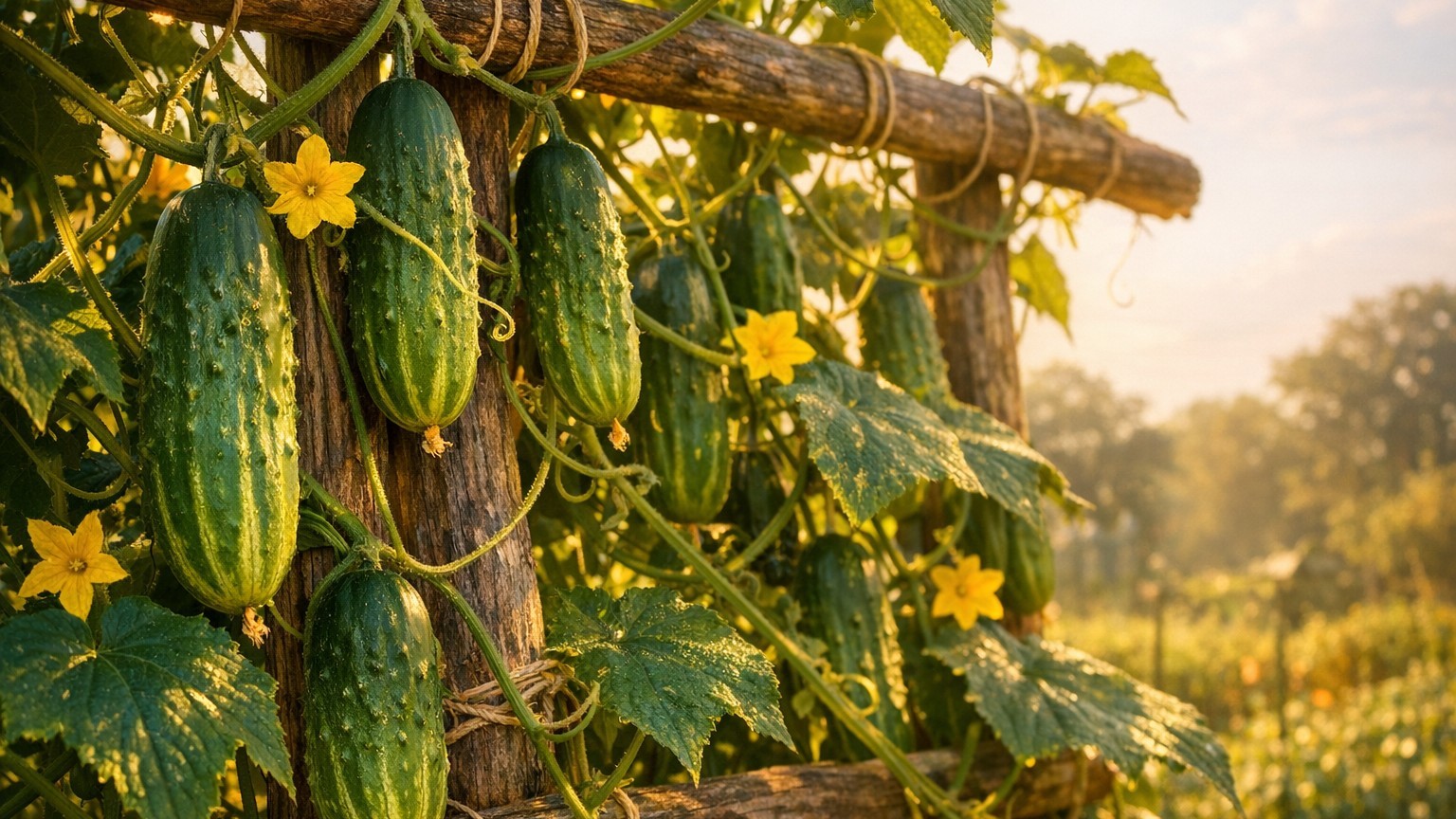

Connecticut’s frost-free window runs long enough, and its summers stay cool enough, that most cucumber types can succeed here: vining slicers and picklers both fit the season, bush types work in small beds or containers, and parthenocarpic types under row cover give the earliest harvest. The choice depends less on variety names than on how you handle humidity, spacing and the state’s short stretch of real heat.
The short answer for Connecticut
Start with the season length, because that’s what actually decides which cucumber types have room to finish. The reference station at Bridgeport shows a last spring frost falling between April 2 and April 12, and a first fall frost arriving between October 28 and November 10. Take the conservative end of both ranges and Connecticut’s frost-free window still runs about 199 days; take the milder end and it stretches past 220. That’s a long season by Northeast standards, and it means both vining slicing cucumbers and vining pickling cucumbers have plenty of time to set and mature multiple flushes of fruit before frost shuts things down.
The second number that matters is heat load, not average temperature. Bridgeport logs a mean of only 6.2 days a year at or above 90F. Cucumbers aren’t fussy about extreme heat the way peppers or melons can be, but that low figure tells you something useful anyway: Connecticut summers rarely punish a garden with the kind of sustained heat stress that causes blossom drop or a bitter, stressed fruit. That works in favor of standard slicing and pickling types without needing to hunt for a heat-specialist variety bred for hotter climates further south.
Matching type to space and timing
Within that long, moderately warm window, the practical decision is about growth habit more than anything else. Vining types, trained up a trellis or fence, make the best use of Connecticut’s ample season and tend to stay cleaner and better-ventilated than fruit sprawling on the ground, which matters given the state’s humid summers (more on that below). Bush types are the right call for raised beds, containers, or any garden where trellis space isn’t practical, and they still have time to produce a full crop inside the frost-free window. Parthenocarpic types, which set fruit without pollination, are worth considering for an early planting under row cover, since they can be tucked in and covered before pollinators are reliably active and still produce.
None of this replaces a variety list. The right cultivar for a Litchfield County hillside garden may not be the right one for a shoreline plot near Bridgeport, and Connecticut’s own agricultural experiment station and university extension network track which specific cultivars perform best where. Think in types first, then let your local extension office point you to named varieties trialled in your conditions.
What will not work here

The clearest failure mode in Connecticut isn’t a cucumber that can’t finish in time, it’s one that rots or mildews before it gets the chance. Summer rainfall averages about 11.1 inches across June, July and August, with June at 3.77 inches, July at 3.32, and August at 3.98. That’s not drought territory, but it’s also not evenly spaced, dry weeks followed by heavy, humid stretches are typical. Cucumber varieties without at least some resistance to powdery mildew or downy mildew struggle in exactly this pattern, especially once foliage stays damp overnight near the Sound or in low-lying inland spots. Vining types left to sprawl on bare soil make the problem worse: leaves stay wet longer, air doesn’t move through the canopy, and fungal disease spreads fast.
Watering on autopilot fails here too. A once-a-week soak might carry a garden through July’s drier 3.32 inches, but it won’t match the heavier, more erratic rain of August, and it definitely won’t account for how differently that rain behaves depending on soil. A sandy raised bed drains a summer thunderstorm within a day; a heavier clay-loam plot common across inland Connecticut holds that same rain for the better part of a week. Treating both soils the same way, whether that means overwatering the clay or under-watering the sand, produces the split, bitter fruit that gardeners often blame on the variety when the real cause is moisture inconsistency.
Long-season types that outrun the calendar
Because the state’s low heat load (just 6.2 days above 90F) means growth slows during any cool stretch, an unusually long-maturing cucumber type pushed too late in spring can end up racing the fall frost window, particularly inland where that window closes earlier than the coastal Bridgeport normals suggest. This is less about the state being too short-season for cucumbers in general and more about timing a slow-maturing type correctly rather than assuming the coastal frost dates apply everywhere.
What changes across Connecticut
Connecticut sits across USDA Hardiness Zones 6a to 7b, and that range on its own tells you the state is not one climate. Zone 7b, the milder end, sits along the Long Island Sound shoreline near stations like Bridgeport, where the ocean moderates both spring warm-up and fall cooldown. Zone 6a, the colder end, covers the Litchfield Hills and other inland, higher-elevation parts of the northwest corner, where cold air settles and lingers.
That spread matters directly for cucumbers because the whole crop depends on soil that’s actually warm, not just air that’s technically frost-free. A shoreline garden in the milder zone can expect the ground to reach cucumber-friendly warmth earlier in spring and stay workable later into fall than a garden in the northwest hills, even though both fall somewhere inside the state’s official frost-date range. A reader gardening near the coast has more room to experiment with a slightly later or longer-season type; a reader at higher elevation or further inland should lean toward starting warm-season crops a bit later than the state average suggests, and should treat the earlier end of the fall frost window (October 28) as the more realistic planning date rather than November 10.
There is no single “Connecticut” answer to when soil is warm enough or when frost risk has passed. The honest version is a spread: coastal gardeners trend toward the Zone 7b, later-fall-frost end of things, and inland or upland gardeners trend toward the Zone 6a, earlier-fall-frost end. Where a specific garden falls inside that spread isn’t something a state-level page can determine, that’s exactly what the USDA’s own hardiness zone map is for, and it’s worth checking directly rather than guessing from a town name.
Where to check this for your own county
Everything above is a state-level pattern built from one reference station’s climate normals. It’s useful for narrowing down cucumber type and general timing, but it is not a substitute for a county-level recommendation, and Connecticut’s own land-grant university runs exactly that kind of local resource. The University of Connecticut’s extension service is the place to check next.
Two things are worth looking for specifically once there. First, a local planting calendar that reflects your particular county rather than the statewide frost-date range cited above, since county offices generally have finer-grained guidance than a single coastal station can offer. Second, and more useful for the actual question in this article’s title, a list of cucumber varieties trialled by UConn or by county Master Gardener programs under Connecticut’s own growing conditions, rather than a national seed catalog’s generic recommendation. That’s where variety names belong, chosen by people who tested them against this state’s actual humidity, rainfall pattern and mildew pressure.
A county-level recommendation will always outrank a state-level one, because it accounts for local soil type, elevation, and microclimate in a way no single article covering all of Connecticut can. This page can tell you which type of cucumber fits the state’s season and heat pattern in general; only a county extension office, or a Master Gardener helpline in your area, can tell you which named cultivar has actually performed well two towns over.
Checking this against your own garden
Climate normals describe an average year, not this year, and not your specific plot. Three things a gardener can check by hand outrank any calendar date.
- Soil warmth by feel: dig down about two inches and press soil against the back of your wrist. If it feels cool rather than merely cool-to-neutral, cucumber seed will sit and rot rather than germinate, regardless of what the calendar says the frost date should be.
- The first flush of male flowers: male blooms typically appear before the female flowers that actually set fruit. Their early appearance is a decent sign the plant considers conditions warm enough to begin reproducing, and a useful check against a spring that felt colder or warmer than usual.
- The first true leaves: the initial rounded seed leaves don’t tell you much, but the first serrated true leaves signal the plant has moved past the fragile seedling stage and is responding to your specific soil and light, not just the seed packet’s average.
None of these require a thermometer or any tool beyond attention. Watched together over a week or two, they tell a gardener more about their own yard’s particular microclimate, shaded by a fence line, warmed by a south-facing wall, cooled by low ground, than any state or even county average ever will.