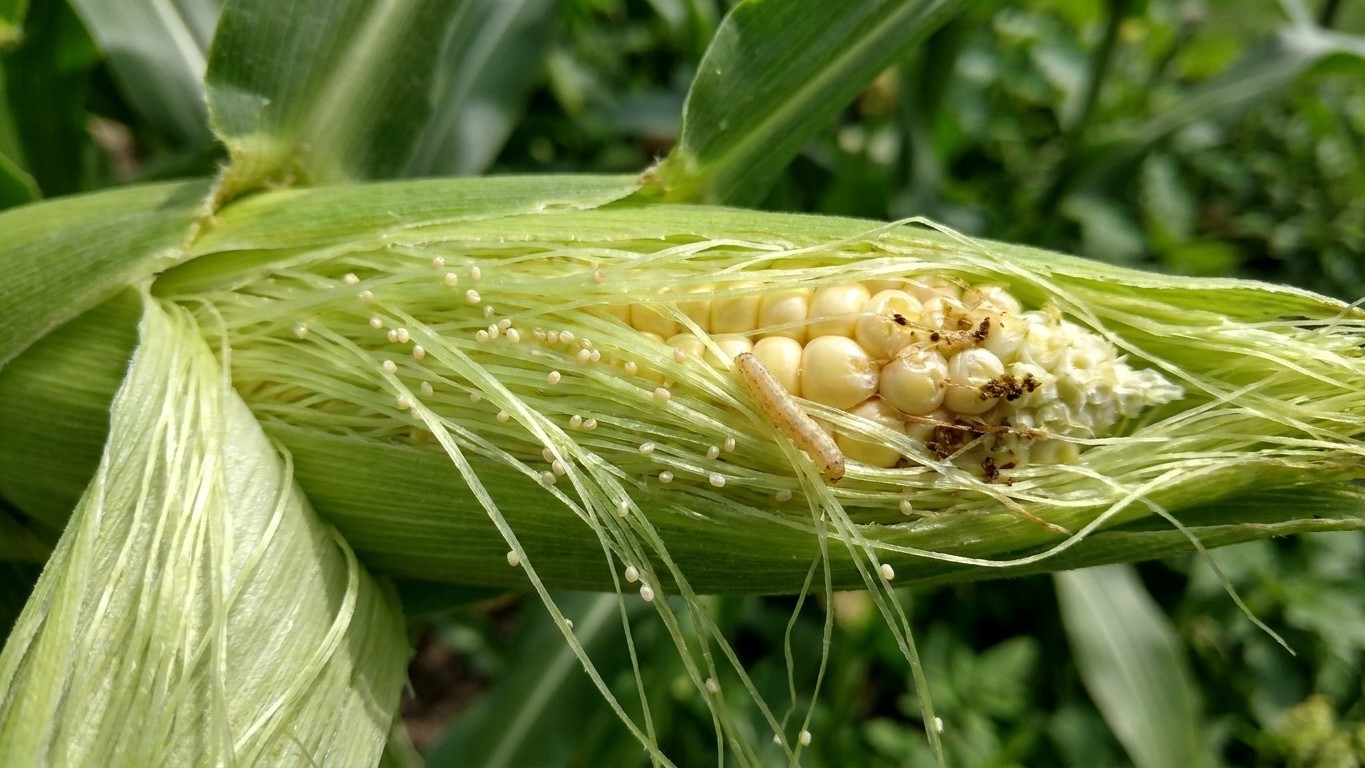

Corn earworm is the pest most directly linked to corn in Colorado, but it doesn’t act alone. Cutworms and seedcorn maggots go after seedlings before the plant is a foot tall, grasshoppers chew leaves through the whole summer, spider mites build up during the hottest stretch, and a spotted cucumber beetle can spend its larval stage feeding on corn roots without ever showing itself above ground.
Which pests attack corn in Colorado

Colorado State University Extension documents ten pests for this territory: Corn earworm, Cutworms and seedcorn maggots, Flea beetles (Phyllotreta and Epitrix spp.), Grasshoppers (Melanoplus spp.), Harlequin bug, Slugs, Spider mites (Tetranychus urticae), Spotted cucumber beetle, Squash bug (Anasa tristis), and Tomato/potato psyllid. That’s the full list for this state. No other species gets added here, and if a neighbor tells you something else is loose in the corn, it isn’t on this record.
Not every name on that list belongs in a corn patch. Flea beetles concentrate on brassicas, eggplant, and potatoes, small shot-hole feeders that skip past corn’s tougher leaf surface. Harlequin bug is a cabbage-family specialist, distinctive black-and-orange shield shape, and it has no reason to be on a corn stalk. Squash bug sticks to squash and pumpkin vines, and Tomato/potato psyllid feeds on nightshades, tomato, potato, pepper, none of which resemble corn’s biology closely enough to draw it in. Naming those four on a corn page would be the kind of mismatch that makes a reader stop trusting the source.
What’s left is a workable shortlist: Corn earworm, Cutworms and seedcorn maggots, Grasshoppers, Slugs, Spider mites, and Spotted cucumber beetle. Corn earworm is the one that goes straight for the ear, tunneling down from the silk end into developing kernels. Cutworms and seedcorn maggots hit earlier, before the plant has much size to lose, clipping stems at the soil line or destroying the seed before it ever sprouts. Grasshoppers are generalists, chewing ragged margins into leaves whenever the population is high enough. Slugs go after tender seedling leaves close to the ground, usually when conditions stay damp. Spider mites thrive on stress, and Denver’s reference station averages 39.6 days a year at 90°F or above, which is exactly the kind of heat load that pushes mite populations up fast on drought-stressed corn. Spotted cucumber beetle larvae feed on corn roots underground, a stage most gardeners never see, while the adults show up later on silks and leaves.
Six species, then, actually belong on a corn-damage checklist here. The other four are documented for Colorado gardens generally, just not for this crop.
When each one shows up, and what it does first
Timing here runs off the frost-free window, not the calendar. The last spring frost typically falls between May 1 and May 11, and soil has to warm past 60°F before corn seed will germinate at all, a threshold that lands well after that frost date, not on it. That gap between frost passing and soil finally warming is exactly when cutworms and seedcorn maggots do their damage: seeds fail to sprout, or seedlings that did emerge get clipped clean at the soil line overnight. A stand with gaps where whole rows should be is the first sign, not a chewed leaf.
Slugs work the same early window, but they leave a different signature: ragged holes in young leaves near the ground, often with a faint slime trail visible in morning light after a damp night. As the soil finishes warming and plants push past the seedling stage, grasshoppers start showing up in growing numbers through the warm months, and their feeding looks like torn leaf margins rather than clean cuts, worse on plants at the edge of a yard near dry grass or weeds.
Corn earworm doesn’t appear until silks emerge, which is a plant-stage marker rather than a date. Once silks show, moth activity picks up fast during the hottest stretch of summer, the same stretch responsible for those 39.6 days above 90°F, and the first visible sign is usually frass or chewed tissue right at the silk tip before any kernel damage is visible from outside the husk. Spider mites show up on the same hot, dry days, but their first sign is on the leaf, not the ear: a fine stippling or bronzing on the underside, sometimes fine webbing in heavy infestations. Spotted cucumber beetle larvae work underground through mid to late summer, and the first visible clue above ground is often a stalk that leans or lodges more than it should, roots weakened by feeding rather than by wind. Adults appear later, feeding on silks and sometimes leaves as the season winds down toward the first fall frost, which arrives between September 30 and October 12 here.
Telling the damage apart from everything else
Not every rough-looking corn plant has an insect on it. Nitrogen deficiency shows up as yellowing that starts on the lower, older leaves and moves upward, a gradual fade rather than a chewed edge. Drought stress shows as leaves rolling inward lengthwise during the heat of the day, often recovering somewhat overnight, a pattern no pest produces. Fungal disease tends to leave spots or streaks with a defined margin, sometimes a powdery or rust-colored coating, spreading plant to plant rather than staying put on one stalk. Hail or wind damage is easy to misread as pest feeding too, but it tends to be uniform across a planting and shredded rather than chewed, since every plant faced the same storm at the same time.
| Symptom | Possible cause | What rules it in or out |
|---|---|---|
| Seeds never sprout, gaps in row | Cutworms/seedcorn maggots or poor soil temp | Dig up a seed: chewed = insect, intact but rotted = soil too cold or wet |
| Ragged leaf margins | Grasshoppers or hail | Hail damage hits every plant uniformly; grasshopper feeding is patchy |
| Stippled, bronzed leaf underside | Spider mites | Look for fine webbing on the underside during a hot, dry stretch |
| Yellowing from the bottom up | Nitrogen deficiency | No chew marks, no insects present, gradual and uniform |
| Leaning or lodged stalk | Root feeding, often spotted cucumber beetle larvae | Pull gently at the base; weakened roots come loose easily |
When a symptom doesn’t clearly match a line on that table, that’s the moment to stop guessing. A local office can look at a sample or a photo and tell you what’s actually happening in your soil and your microclimate, something no statewide chart can do from a distance.
What actually works here, and what is a waste of time
Physical barriers timed to the calendar beat almost anything sprayed on after the fact. A floating row cover set over seedlings before soil reaches that 60°F germination mark keeps cutworms and slugs off the most vulnerable stage of the plant’s life, when a single night of feeding can wipe out a row. The cover has to come off before tasseling, since corn is wind-pollinated and a cover left on through that stage blocks pollen from reaching the silks, trading one problem for another.
Once silks emerge, earworm pressure is hardest to manage with a barrier, since the damage happens inside the husk where nothing physical can reach. This is a case where timing the planting itself matters more than any treatment: an earlier planting date, close to when soil first hits that 60°F mark, tends to finish silking before earworm populations peak later in the hot stretch. Waiting for damage to show before doing anything at all is close to a wasted season, since by the time the tip of the ear looks chewed from outside, the feeding inside has usually been going on for days.
Spraying on a fixed schedule regardless of pest presence is another common waste of effort here. Colorado’s short season means the window for any treatment to matter is narrow, and applying something when a pest isn’t actually active does nothing but cost time and money. What’s registered and legal to use in this state, and at what rate, isn’t something to guess at: that call belongs to the local extension office, which knows current label restrictions for Colorado specifically. This site doesn’t recommend a product or an active ingredient, because that answer changes by state and by year, and the wrong guess here can do more harm than the pest itself.
Where to check this for your own county
Colorado State University Extension is the source for the pest list above, and its county offices are the right next step for anything specific to a particular yard. What’s documented at the state level tells you what’s possible here, not what’s actually present on one property this season. A garden on the eastern plains and a garden on the western slope can face a completely different mix of these pests in the same month.
Elevation changes the whole picture too. Denver sits at 5,280 feet on the plains, but mountain towns run far shorter growing seasons and can see frost even in July, which shifts every pest’s timeline earlier or compresses it into a narrower window. A last-frost date of May 1 to May 11 and a first fall frost of September 30 to October 12 apply to the reference station used for these normals, not to every county in the state, and a gardener at higher elevation should treat those dates as a starting point rather than a guarantee.
The most useful next move is a call or a visit to the county extension office, ideally with a sample or a clear photo of the damage in hand. They can confirm which of these six corn-feeding pests is actually active locally, and when, rather than relying on a statewide average that may or may not match conditions on one particular block.
Common questions
Does frost kill corn earworm for the winter?
The adult moths don’t survive Colorado winters in most of the state; populations rebuild each year from migration and local overwintering pupae in soil, which is part of why earworm pressure tends to build later in the season rather than showing up early.
Can row covers stay on corn the whole season?
No. Corn depends on wind to move pollen from tassel to silk, so a cover left on through tasseling blocks pollination. Covers work best on seedlings and should come off before tassels form.
Why does corn damage look different from tomato or squash damage on the same list of pests?
Because several pests on the statewide list, like flea beetles, harlequin bug, squash bug, and tomato/potato psyllid, target other crop families entirely and aren’t relevant to corn at all, even though they’re documented for Colorado gardens broadly.
Is spider mite damage worse in a dry year?
Yes, heat and drought stress both favor mite population growth, and Colorado’s average of close to 40 days a year at 90°F or higher gives them plenty of opportunity on any corn that’s also short on water.