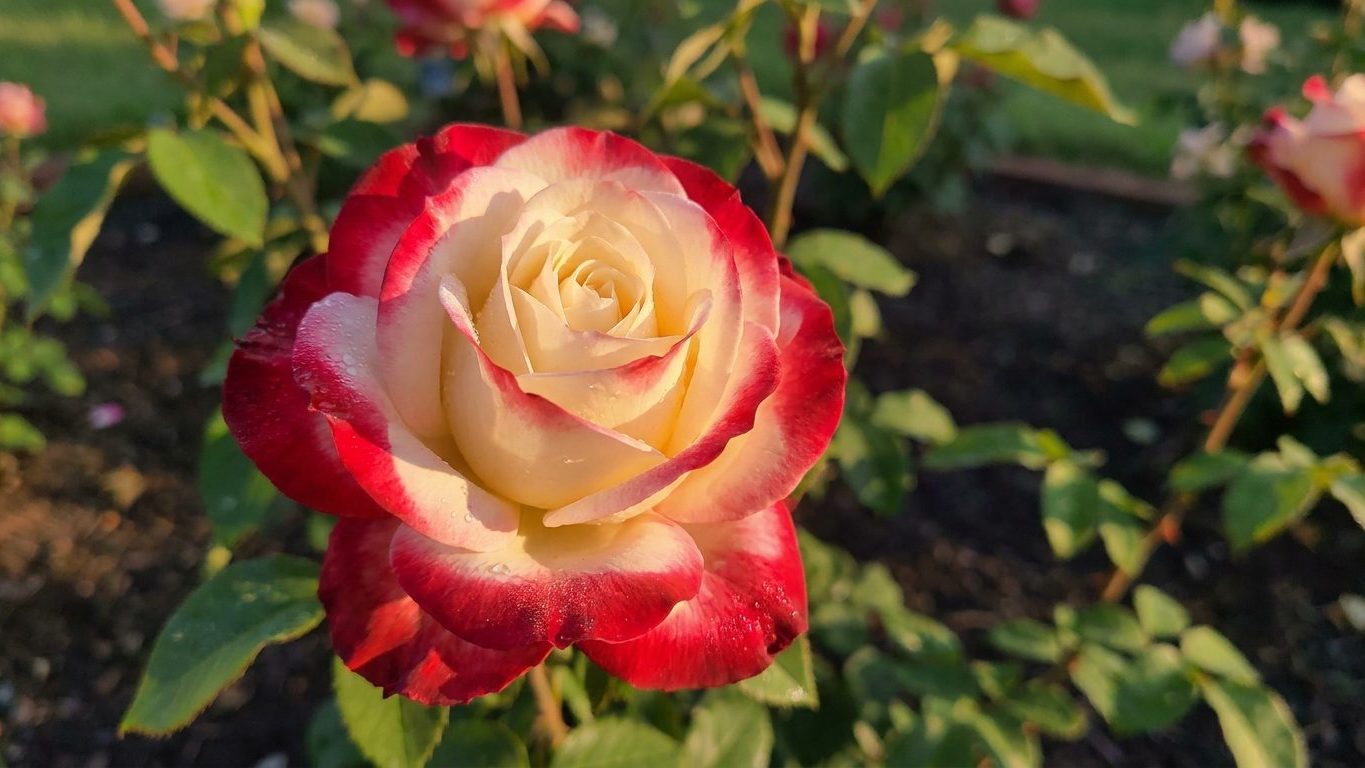

Double Delight is a Hybrid Tea rose grown for its two-tone bloom, cream petals edged in deep red carmine, paired with an intense spicy fragrance that’s unusually strong for a modern rose. It grows across USDA zones 5a through 11b, needs full sun and clay or loam soil, and flowers only on the wood it produces that same year, which is the fact that decides how and when it gets pruned.
What Double Delight actually is
Double Delight belongs to the Hybrid Tea group, one of the main rose groups tracked by the North Carolina Extension Gardener Plant Toolbox, alongside floribunda, grandiflora, shrub, climbing, rambling, miniature, ground cover, old garden, rugosa, hybrid musk and polyantha types. The source describes it plainly: cream petals bordered in red carmine, with an intense spicy fragrance, rare enough among modern roses to be worth planting for on its own.
The genus-level size range documented for Rosa runs from 1 to 8 feet tall and 1 to 6 feet wide, depending on cultivar, so that spread is the boundary the whole genus fits inside, not a promise about this specific plant. Growth rate is medium, but maintenance is rated HIGH, which matters more for a Hybrid Tea than a landscape shrub rose, since it means regular attention rather than a plant-it-and-forget-it habit.
The detail that shapes everything downstream is that Double Delight flowers from new wood. That’s the opposite of a rambler, which blooms on old wood and gets pruned right after flowering. A rose that flowers on new wood gets cut back hard while it’s dormant, because every stem it grows that season is where the flowers come from. The exact calendar month for that cut depends on the reader’s climate zone, not on the variety, so it belongs on the page for your state rather than here.
What Double Delight is good for

The anatomy fact from NC State puts rose flowers on a scale from single, around 5 petals, to double, more than 20 petals. Double Delight sits firmly on the double end, which is what makes it a strong cut flower: a bloom with that many petals holds its shape in a vase far longer than a single-petaled rose, and the spicy fragrance carries into the house in a way a scentless landscape rose never will.
Timing the cut matters more than most gardeners expect. The right moment is once the sepals have folded back and the first one or two petals are starting to unfurl. Cut tighter than that, while the bud is still closed and green-sepaled, and it often never opens, it just sits in the vase as a stalled bud and drops. That’s a mechanical fact about how a rose bud finishes opening, and it applies to Double Delight as much as to any other Hybrid Tea.
There’s a trade-off worth knowing if the goal is cut flowers rather than fall color. NC State notes that the rose hip, the accessory fruit that follows a spent bloom, is edible and turns from green to red in autumn. But a hip only forms after a flower is left on the plant to fade and set seed. Every stem cut for a vase, or deadheaded to push another bloom, is a stem that never becomes a hip. Grown as a cut-flower rose, Double Delight essentially trades its fall hips for a longer, heavier bloom season, and that’s the right trade for most gardeners planting it for the fragrance and the flower.
Where it ripens in time, and where it is a gamble
The documented hardiness range for Double Delight is USDA zones 5a through 11b, and that eight-zone spread covers wildly different growing conditions. What changes from one end to the other isn’t whether the rose survives at all, it’s what limits its performance and what work it demands from the grower.
At the cold end, zones 5a through 6b, covering places like the inland Upper Midwest, interior New England, and higher-elevation Mountain West, winters routinely bring hard freezes that can kill canes back to, or below, the graft union on a budded Hybrid Tea. In that band, winter protection isn’t optional maintenance, it’s the difference between Double Delight coming back as Double Delight next spring or coming back as whatever rootstock was budded underneath it.
The middle of the range, roughly zones 7a through 8b, covers the Mid-Atlantic, the Piedmont, and the lowland Pacific Northwest. This is the most forgiving stretch for a Hybrid Tea: enough cold to force real dormancy and justify the hard yearly prune, without cold severe enough to threaten the union without help.
At the warm end, zones 9a through 11b, including the Gulf Coast, coastal California, low-desert areas, South Florida and Hawaii, winter cold mostly disappears as a threat. But that’s not the same as easy. Without a real cold period, the plant barely goes fully dormant, so the yearly hard prune has to be done deliberately, on a calendar, rather than waited for. A longer growing season with no winter break also means more months for humidity-driven disease and heat-loving pests to build up.
| Zone range | Example region | Main limiting factor | What that changes for the grower |
|---|---|---|---|
| 5a-6b | Upper Midwest, interior New England, mountain West | Hard freezes reaching the graft union | Winter protection of the bud union is critical; check whether the plant is budded |
| 7a-8b | Mid-Atlantic, Piedmont, lowland Pacific Northwest | Balanced dormancy | Straightforward hard prune each dormant season, moderate disease pressure |
| 9a-10b | Gulf Coast, coastal California, low desert | Little true winter dormancy | Prune on a calendar rather than waiting for cold; watch humidity-driven disease |
| 11a-11b | South Florida, Hawaii | Almost no cold at all | Grows nearly year-round as a high-maintenance evergreen shrub |
The two ways a season goes wrong
A wide hardiness range doesn’t mean a season goes smoothly everywhere inside it. Two separate problems can undo a good year, and they sit at opposite ends of the map.
In the coldest part of the range, the risk isn’t a light frost nipping a few buds, it’s cold severe enough to kill canes back past the graft union. Since Hybrid Teas are commonly propagated by budding onto rootstock rather than grown on their own roots, that kind of dieback doesn’t just cost a season of bloom, it can mean the plant that regrows the following spring is the rootstock variety, not Double Delight at all. That’s a permanent loss, not a setback.
In the warmest part of the range, the failure mode is slower. Heat itself isn’t documented as shutting bloom down the way cold dieback does, but the extended warm, humid season gives the diseases named for roses, botrytis, blights, powdery mildew, leaf spots and anthracnose, far more months to establish and spread. Pests such as Japanese beetle and rose thrips also get a longer window to build up numbers.
Given that Double Delight is already rated HIGH maintenance and depends on a graft union for its identity, the northern risk matters more for this variety. Losing a summer’s bloom to disease pressure is a bad season. Losing the union to an unprotected freeze is losing the rose.
What it resists, and what it does not
The source used for this page doesn’t publish a cultivar-specific resistance rating for Double Delight. What it lists are the diseases and pests documented for roses generally: botrytis, blights, powdery mildew, leaf spots and anthracnose on the disease side, and Fuller rose beetle, Japanese beetle, rose chafer, rose thrips, southern red mite and two-spotted mite on the pest side. Without a rating naming Double Delight as resistant to any of these, treat all five diseases as a standing watch list rather than assume the plant carries built-in protection.
Two of the six named pests, the southern red mite and the two-spotted mite, are arachnids, not insects. That distinction changes what actually works against them: a product formulated for insects doesn’t reliably control mites, so a mixed pest problem may need a miticide alongside anything used for the beetles and thrips.
Because no resistance level is documented for this cultivar, the practical move is to keep a regular monitoring routine, checking leaf undersides for mites and thrips, watching for the spotting typical of leaf spot diseases, rather than skipping fungicide checks on the assumption that Double Delight is disease-proof. Nothing in the source supports that assumption.
Growing it without the usual mistakes
Because Double Delight flowers on new wood, the yearly hard prune while it’s dormant isn’t a light trim, it’s the step that determines how much bloom the plant produces that season. A Hybrid Tea pruned too lightly responds with thin, weak canes and smaller flowers, the opposite of the big double blooms the variety is grown for. The exact month for that cut depends on the reader’s zone, so check the planting guide for your state rather than going by a single national date.
Full sun, six or more hours of direct light a day, is non-negotiable for this variety, and clay or loam soil with a pH from acid up to neutral, roughly 6.0 to 8.0, covers the documented range. If leaves start yellowing between the veins, that’s worth testing for, since iron chlorosis shows up on strongly alkaline soil above roughly 7.5, not across the whole documented range.
Deadheading keeps a Hybrid Tea reblooming through the season, but every cut also pushes a fresh shoot, so cuts made too late push soft new growth that won’t ripen before the first freeze. Stopping the deadheading toward the end of the season lets the wood ripen and the plant harden on its own.
Check the plant tag to find out whether Double Delight is budded onto rootstock or grown on its own roots, since Hybrid Teas are commonly budded while many landscape shrub roses today are not. That answer decides what winter protection actually covers, the graft union on a budded plant, or the crown on an own-root one. And when it’s time to prune, expect prickles, not true thorns, since they grow from the stem’s outer skin and snap off sideways rather than the woody, modified-stem thorns some other plants carry. After the final fall cut, leave the stems standing at 12 to 24 inches rather than cutting to the ground; hollow stem stubs at that height are used by stem-nesting native bees over winter.
Common questions
Are Double Delight’s thorns dangerous?
They’re prickles, not true thorns. Prickles grow from the outer skin of the stem, which is why they snap off sideways rather than breaking like woody growth, and why they can be rubbed off entirely on some canes.
Is Double Delight grown on its own roots or grafted?
Hybrid Teas, the group Double Delight belongs to, are commonly budded onto rootstock rather than grown own-root. Check the plant tag to confirm, since that answer decides whether winter protection needs to cover the graft union or the crown.
Does Double Delight need full sun?
Yes. The documented requirement is full sun, six or more hours of direct sunlight a day, with no shade tolerance noted for the genus.
When should I prune Double Delight?
It flowers on new wood, so the plant gets cut back hard while dormant. The exact month depends on your USDA zone, so check the planting guide for your state rather than a single national date.