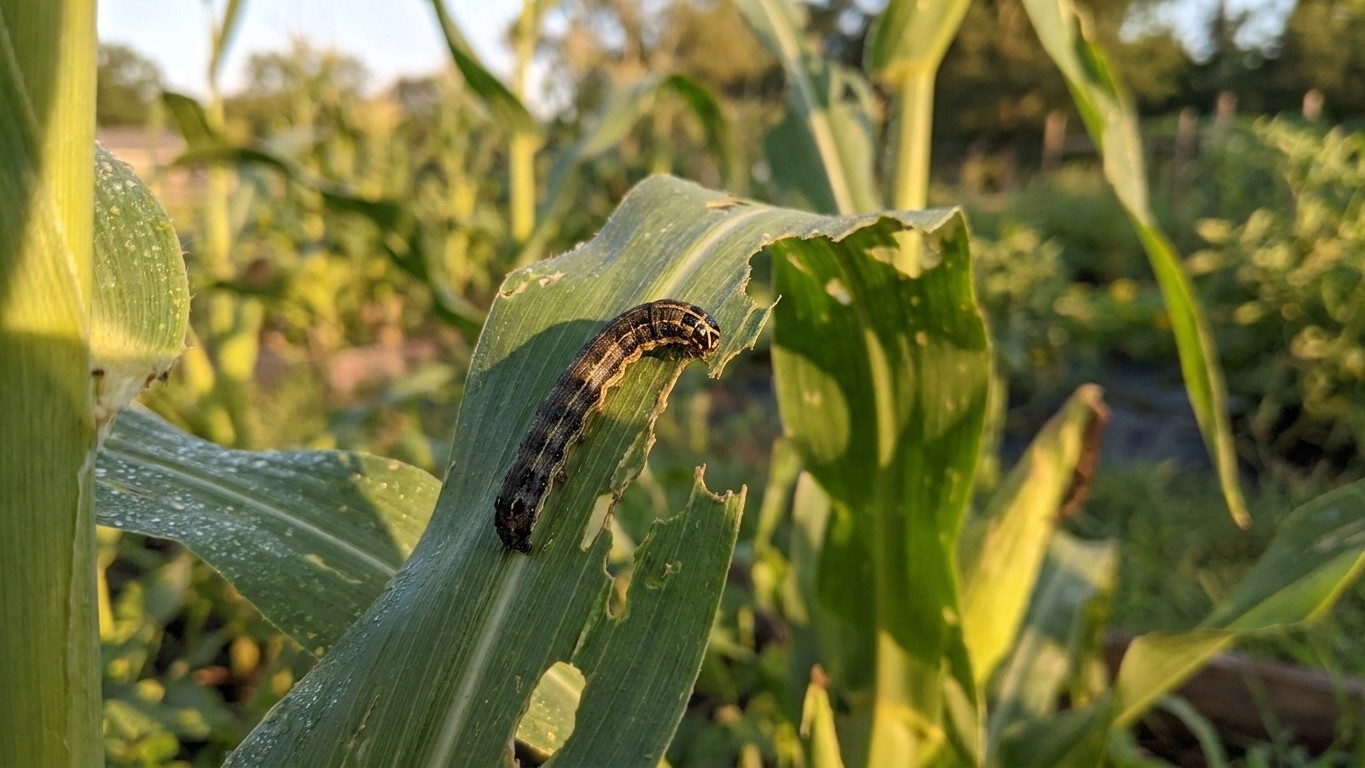

Three of the pests Connecticut’s extension service tracks actually feed on corn: cutworms, which cut down seedlings early in the season; Japanese beetles, which chew the silks during the hottest stretch of summer; and brown marmorated stink bugs, which puncture ripening ears late in the season. The rest of the state’s documented pest list targets other crops entirely.
Which pests attack corn in Connecticut

UConn Extension documents ten pest species for Connecticut gardens: Allium leafminer, Brown marmorated stink bug, Colorado potato beetle, Cutworms, Four-lined plant bug, Japanese beetle, Lily leaf beetle (Lilioceris lilii), Squash bug (Anasa tristis), Squash vine borer (Melittia cucurbitae), and Striped cucumber beetle (Acalymma vittata). That’s the full list for this territory. It is not long, and stretching it with pests that aren’t documented here would do a reader no favors.
Most of that list has nothing to do with a stand of corn. Allium leafminer targets onions, garlic and leeks, not grasses. Colorado potato beetle feeds on nightshades, potatoes, tomatoes and eggplant, and largely ignores corn. Lily leaf beetle is a specialist on true lilies and won’t touch a cornstalk. Squash bug and squash vine borer are both cucurbit feeders, tied to squash and pumpkin vines. Striped cucumber beetle follows the same cucurbit family. Four-lined plant bug works over a wide range of herbaceous plants and garden herbs but isn’t a documented corn feeder either.
A pest documented for a state’s gardens is not automatically a corn pest, and that distinction matters more here than it looks. Sorting the list down this way leaves three species that do go after corn, each targeting a different part of the plant at a different point in the season.
Cutworms attack young corn at the soil line, right as seedlings emerge. Japanese beetle adults go after the silks once the ear starts to form, and their feeding can interfere with pollination if it’s heavy enough. Brown marmorated stink bug punctures the husk later in the season and feeds directly on developing kernels, leaving damage that shows up at harvest. None of the other seven species documented for Connecticut have any reason to be in a cornfield at all, and a gardener spotting one of them on corn should look again before assuming it’s the cause of any damage.
When each one shows up, and what it does first
Timing here runs off the frost-free window, not a fixed date on the calendar. Connecticut’s last spring frost falls between April 2 and April 12, and soil temperature climbs to the 60 degree mark sweet corn needs well after that, not on the same day. Planting happens once the soil clears that threshold, and that’s roughly when cutworm larvae, already active in the soil from overwintering, start feeding on the first seedlings to break the surface. The first sign isn’t a visible insect. It’s a seedling that was standing the evening before and is lying flat at the soil line the next morning, severed cleanly rather than wilted or discolored.
Japanese beetle activity lines up with the hottest stretch of the growing season, the period when the state averages 6.2 days a year at 90 degrees or above. That heat load pushes the crop toward silk emergence, and the beetles show up right around then. The first sign is silks chewed down short and ragged, sometimes with beetles visibly clustered on the ear itself in broad daylight. Because pollination depends on intact silks, heavy feeding at this stage can leave an ear with spotty, uneven kernel fill even if nothing else goes wrong later.
Brown marmorated stink bug moves in later, as the crop works through the 60 to 90 day window from planting toward maturity and the season heads toward the first fall frost, dated between October 28 and November 10. The first sign at this stage is rarely an insect sighting. It’s damage on the ear itself: kernels that look pitted, discolored, or misshapen near where the husk was punctured, discovered when the ear is finally pulled or husked. By the time that damage is visible, the feeding already happened days earlier.
Telling the damage apart from everything else
Corn damage gets misread more often than most garden problems, mostly because several unrelated issues produce similar-looking symptoms at a glance. A stem that looks “eaten” at the base might be cutworm feeding, or it might be damping-off, a soil fungal issue that has nothing to do with insects. Poor kernel fill might be beetle damage on the silks, or it might just be heat and drought stress interfering with pollination on its own.
| What you see | Possible pest cause | Possible look-alike | What tells them apart |
|---|---|---|---|
| Seedling severed near the soil line | Cutworm feeding overnight | Damping-off disease | Cutworm damage leaves a clean, dry cut; damping-off leaves a soft, discolored stem still attached to the root |
| Silks chewed short, spotty kernel fill | Japanese beetle feeding on silks | Poor pollination from heat or drought | Beetle feeding leaves visible chew marks or beetles on the ear; heat-related gaps in kernel fill show no chew marks at all |
| Kernels pitted, discolored, or misshapen | Brown marmorated stink bug feeding through the husk | Nutrient deficiency or a kernel disease | Stink bug damage centers on a single puncture point; deficiency-related problems tend to spread evenly across the whole ear |
None of this replaces an actual look at the plant in front of you. A table can narrow down what’s likely, but it can’t tell a gardener what’s growing in their own row. When damage doesn’t match cleanly to one of these patterns, or when it’s spreading beyond a single plant, that’s the point to bring a photo or a sample to the local extension office rather than guess.
What actually works here, and what is a waste of time
Timing beats treatment on a season this short. A physical collar around the base of each seedling, put in place at planting rather than after damage shows up, keeps cutworms from reaching the stem in the first place. Installing one after seedlings are already cut is a wasted trip to the garden, not a fix. For Japanese beetles, handpicking during the narrow window around silk emergence does more than any repeated schedule of anything else, because the population pressure is concentrated in that one stretch tied to the year’s hottest days rather than spread evenly across the season. For brown marmorated stink bug, exclusion gets harder once ears are formed and husks are open at the tip, so checking ears directly as harvest approaches, rather than relying on a single mid-season pass, catches damage before it spreads to the whole planting.
Planting timed around the frost-free window also decides how long the crop is exposed to each of these pests, which matters more here than any single control method. Gardeners growing more than one type of sweet corn (su, se, or sh2) in the same season should also plant so those types don’t tassel at the same time, since overlapping tassels ruin sweetness regardless of what any pest does. That’s a planting-layout decision, not a pest treatment, but it’s made at the same point in the season as everything above.
What doesn’t work is treating on a fixed calendar date instead of watching the plant. Applying anything before a pest is actually active wastes the material and the trip. Assuming a pest documented for the state is present in a specific yard is the other common mistake, since presence varies block by block, and this site doesn’t recommend specific products or active ingredients. That call, and what’s legally labeled for use in Connecticut, belongs to the local extension office.
Where to check this for your own county
UConn Extension is the source for everything documented on this page, and it operates through county-level offices that see what’s actually showing up locally, not just what’s recorded statewide. A pest list built for the whole state doesn’t mean every species on it is active in every county, or even in every garden within the same county. What’s documented at the state level is a starting point for what to watch for, not a confirmation of what’s in front of you.
The most useful next step is a direct one: contact the county office, describe or photograph the damage, and ask specifically whether the pest in question has been reported nearby recently. Extension offices can also confirm what control options are actually labeled for use on corn in Connecticut, since that changes over time and by product, and it’s not something a general gardening page can responsibly list. A quick call or an email with a photo attached usually gets a faster answer than searching for a match online.
Common questions
Does Connecticut have corn earworm?
It isn’t part of the pest list UConn Extension documents on this page, so this article doesn’t claim it’s present. Anything not on that documented list should be confirmed directly with the local extension office rather than assumed.
What time of year is corn most at risk from Japanese beetles in Connecticut?
Risk peaks around silk emergence, which lines up with the hottest stretch of the growing season, the stretch that averages 6.2 days a year at 90 degrees or above statewide.
Can a barrier stop stink bugs on corn?
Exclusion gets difficult once the husk tip opens for silking, since that’s exactly where the bug feeds. Checking ears directly as harvest nears matters more than trying to physically block access at that stage.
Does a pest being documented statewide mean it’s in my yard?
No. Presence varies by county and even within a county, so a statewide list is a starting point, not a confirmation. The local extension office can speak to what’s actually been reported nearby.