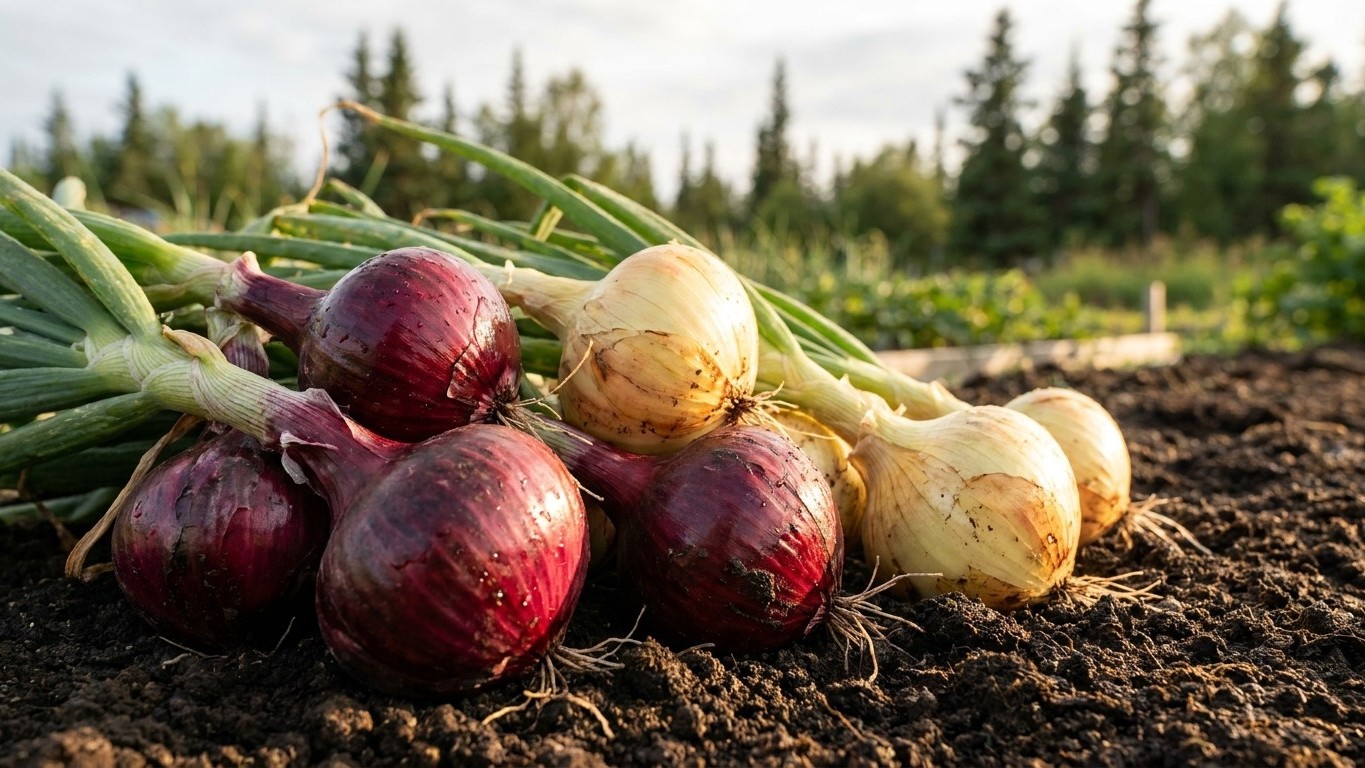

Connecticut gardeners lose onion crops to two insects, not the dozen you might expect from a general pest list: allium leafminer and cutworms. One tunnels through leaves and down into the bulb neck, showing up twice a season; the other severs young transplants right at the soil line within their first weeks in the ground. Everything else the state tracks feeds on tomatoes, squash, lilies, or turf grass, not the onion bed.
Which pests attack onion in Connecticut

UConn Extension documents ten pest species active in home gardens across the state: Allium leafminer, Brown marmorated stink bug, Colorado potato beetle, Cutworms, Four-lined plant bug, Japanese beetle, Lily leaf beetle (Lilioceris lilii), Squash bug (Anasa tristis), Squash vine borer (Melittia cucurbitae), and Striped cucumber beetle (Acalymma vittata). Of those ten, only two actually feed on onion.
The other eight belong to other gardens entirely. Brown marmorated stink bug goes after fruiting crops like tomatoes and tree fruit, piercing soft flesh rather than fibrous onion leaves. Colorado potato beetle is a nightshade specialist, built for potato and eggplant foliage, and has no reason to touch an allium. Four-lined plant bug favors mint, dahlias, and other soft-leaved perennials, leaving the waxy, upright leaves of an onion alone. Japanese beetle skeletonizes broad-leaved plants like roses and grapes, and its jaws don’t get much traction on an onion’s slick, tubular foliage.
Lily leaf beetle sounds like it could be a match, given how often people lump onions and lilies together, but it feeds exclusively on true lilies in the genus Lilium and on fritillaria. An onion is an Allium, a different genus entirely, and the beetle has no documented interest in it. The last three, squash bug, squash vine borer, and striped cucumber beetle, are all cucurbit specialists that live and die by squash, pumpkin, and cucumber vines. None of them has any documented reason to land in an onion row.
That leaves allium leafminer, a relatively recent arrival in the Northeast that mines directly into onion, leek, and garlic leaves, and cutworms, which are generalist soil-dwelling caterpillars that will clip almost any thin-stemmed seedling, onion transplants included. Two pests is a short list, and that’s simply what UConn Extension documents for this crop here, not a gap in the reporting.
When each one shows up, and what it does first
Allium leafminer runs on two separate windows in a season, not one long stretch of activity. The first wave arrives while onion tops are still short and tender, before the crop has put on much growth. Adults lay eggs by puncturing leaf tissue, and the earliest sign is a single, tidy row of small white dots running up one side of a leaf, not scattered damage across the whole plant. That row of punctures is the feeding and egg-laying scars left by the adult fly, and it shows up before any larva is visible inside the leaf.
A second wave follows later in the season, once the crop has moved past its leafy stage. By then, Connecticut’s day length has already climbed toward its yearly peak of 14 hours and 58 minutes, the point at which onion plants shift from building leaves to building bulbs. Leafminer larvae from this later flight tunnel downward through the leaf and into the neck of the bulb itself, which is the more damaging phase because it opens the bulb to rot rather than just cosmetically marking a leaf.
Cutworms work on a completely different schedule and target a completely different part of the plant. They’re active in the soil at night, and the damage they do is concentrated in the first stretch after onion sets or transplants go into the ground, while stems are still thin and haven’t toughened up. A caterpillar curls around the base of a seedling and chews through it at, or just below, the soil line. The plant doesn’t wilt gradually; it’s simply toppled over one morning, cut clean through, sometimes with the top lying a few inches away from where it was severed. Once onion stems thicken past that early stage, cutworm damage becomes far less likely, which is part of why the timing of transplanting matters more here than any spray schedule.
Telling the damage apart from everything else
Onion leaves show stress in a limited number of ways, and not all of them mean an insect is involved. Pale, yellowing tips can be a nitrogen shortage or a stretch of dry weather just as easily as a pest problem. Torn, ragged leaf edges are often wind whip or hail, not a chewing insect. The detail that separates real insect damage from everything else is pattern: a straight line of punctures or a visible tunnel means a pest, while blotchy, random discoloration usually points to soil, water, or weather.
| Symptom | Likely cause | What tells them apart |
|---|---|---|
| Row of small white dots up one side of a leaf | Allium leafminer feeding/egg-laying marks | Punctures line up in a single row; wind or hail damage is scattered and irregular |
| Hollow track visible when a leaf is sliced open, leading toward the bulb neck | Allium leafminer larva mining downward | A visible tunnel with no tunnel means the yellowing is nutritional or drought-related instead |
| Seedling toppled over, stem severed cleanly at soil level | Cutworm feeding overnight | A clean cut means cutworm; a soft, water-soaked stem points to a soil-borne disease instead |
| General pale or yellow leaf tips across the whole bed | Nitrogen deficiency or drought stress | No punctures, no tunnels, and it usually affects every plant evenly rather than a few scattered ones |
None of this replaces an actual look at the plant in front of you. If the pattern doesn’t match cleanly to one of these categories, or if damage keeps spreading after a control step has already been tried, that’s the point to send a sample or photo to a local extension office rather than guess.
What actually works here, and what is a waste of time
For allium leafminer, timing beats any product decision. A lightweight physical barrier placed over the onion bed before the first spring flight of adults keeps the flies from reaching the leaves to lay eggs in the first place, and it can come off once that window has passed. Once a larva has already tunneled inside a leaf, no treatment applied to the surface can reach it, which is the main reason spraying after damage is already visible tends to waste both time and money. Cleaning up onion, leek, and garlic debris at the end of the season also matters, since pupae can overwinter in leftover plant material left in the bed.
For cutworms, a simple collar around each transplant, something as basic as a cut section of cardboard or a paper cup pushed into the soil around the stem, blocks the caterpillar from reaching the stem at the vulnerable height. Turning the soil over before planting exposes overwintering larvae to birds and weather, which thins out the population before transplants ever go in. Both of these are mechanical fixes, done at planting time, not chemical ones done afterward.
What doesn’t help: broad insecticide applications aimed at a general “garden pest” problem when the actual culprit hasn’t been identified, since most of what’s marketed that way targets beetles and stink bugs that were never going to touch the onion bed anyway. There’s also a storage angle worth knowing: a bulb wounded by a leafminer tunnel is more prone to rot once it’s in the root cellar, and that risk lands harder on sweet varieties, which carry fewer of the volatile sulfur compounds that give pungent onions their natural keeping power. A pungent variety with leaf damage still has a fighting chance in storage; a sweet one with the same damage often doesn’t. For anything beyond physical barriers and sanitation, a county extension office is the right place to ask what’s actually labeled for use in Connecticut, rather than guessing at a product off a shelf.
Where to check this for your own county
Everything above comes from what UConn Extension documents at the state level, and a state-level list doesn’t tell you what’s actually present in a specific yard. Pest pressure inside Connecticut varies by county, by microclimate, and even by what was planted in that same bed the year before, so a leafminer outbreak reported in one town says nothing certain about a garden thirty miles away.
The most useful next move is contacting the local UConn Extension county office directly, either with a photo of the damage or a physical sample if the office accepts one. Extension staff can confirm whether a leaf pattern really is allium leafminer or something else entirely, and they’re the ones who know which controls are currently labeled for use on onion in the state, which changes over time in ways a static article can’t track.
Bring the timing details along when asking: how many days ago the transplants went in, whether the marks form a straight line or a scattered pattern, and whether the plant collapsed overnight or wilted gradually over several days. That handful of details turns a vague “something’s eating my onions” into a diagnosis someone can actually act on.