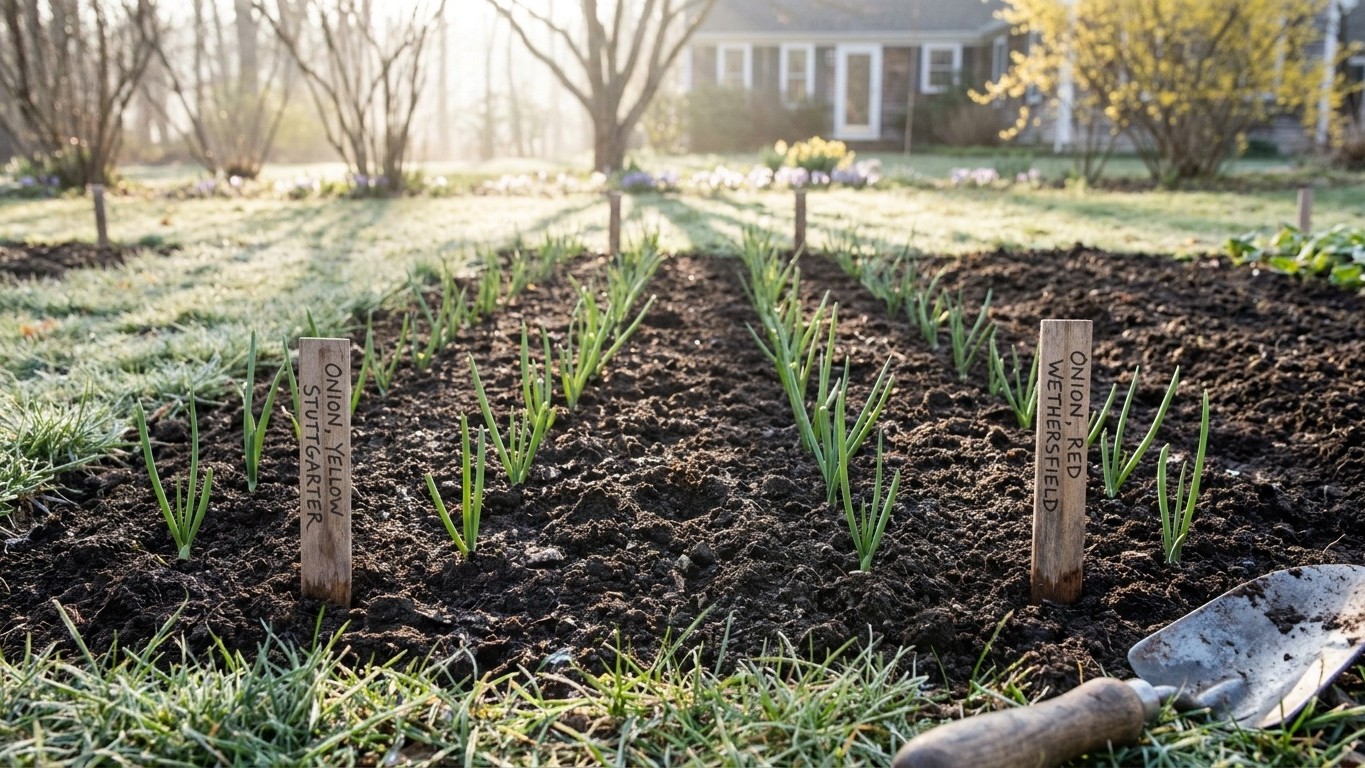

Connecticut sits at 41.16 degrees north latitude, measured at the reference station near Hartford, and the longest day of the year there brings 14 hours and 58 minutes of daylight. That single number decides almost everything about growing onions in this state: the season you plant them, the varieties that will actually form a bulb, and whether your harvest lasts through the winter or gets eaten by Thanksgiving.
The short answer for Connecticut

Onions bulb on a schedule set by day length, not by temperature, and Connecticut’s climate makes that fact unavoidable. With winters too harsh for the fall-planting approach used in the Deep South, Connecticut gardeners plant in late winter to early spring: seeds started indoors in February, transplants or sets going into the ground from late March through April, once the soil can be worked and the worst frost risk has passed. That’s a different calendar than a Georgia or Florida garden, where mild winters allow onions to go in the ground in October and overwinter as small plants.
The variety question and the timing question are actually the same question, because 14 hours and 58 minutes of summer daylight puts Connecticut squarely in long-day and intermediate-day territory. Long-day onions need 14 to 16 hours of daylight before they’ll stop making leaves and start making a bulb; intermediate-day types trigger a bit earlier, around 12 to 14 hours. Both groups work here. Short-day onions, which bulb at around 12 hours regardless of where they’re planted, are a mismatch this far north.
Nineteen of the twenty-eight onion varieties documented on this site have published latitude ranges that cover 41.16N, which means Connecticut gardeners have real choice. Among the long-day group: Ailsa Craig, Barolo, Blush, Bridger, Frontier, New York Early, Patterson, Red Carpet, Red Long of Florence, Red Long of Tropea, Rossa di Milano, and Walla Walla Sweet. Among the intermediate-day group: Cabernet, Calibra, Elsye, Expression, Monastrell, Scout, and Sierra Blanca. That’s a wide enough field to choose based on flavor and storage life rather than settling for whatever happens to bulb.
What will not work here
Planting the wrong variety in Connecticut doesn’t produce a smaller onion out of caution. It produces one of two failures, and both are avoidable by checking a catalog’s day-length rating before ordering.
The first failure is short-day onions planted too far north. These varieties are built to trigger bulbing at around 12 hours of daylight, a threshold Connecticut reaches well before the plant has had time to grow much leaf mass. The bulb that forms is whatever size the plant happened to be at that moment, usually the size of a golf ball rather than a fist. Four varieties documented on this site fall into this trap for a Connecticut latitude:
- Gabriella (short-day, published range 20-35N), bulbs while the plant is still tiny; expect small onions, not none
- Madalyn (short-day, published range 20-35N), same short-day trigger, same undersized result
- Red Rock (short-day, published range 30-36N), closer to Connecticut’s latitude but still south of where it belongs
- White Castle (short-day, published range 30-38N), will bulb far too early for the plant it has grown
The second failure runs the opposite direction and is worse: varieties bred for latitudes north of Connecticut. Two long-day varieties on this site, Powell (43-47N) and Redwing (43-65N), need more daylight than Connecticut’s sky ever provides. These plants don’t just underperform, they never receive the day-length trigger at all. The result isn’t a small onion. It’s no onion, just leaves all season and a rotting bulb base by fall, because the plant never gets the signal to stop vegetative growth and start storing sugars in a bulb.
There’s a broader timing mistake worth naming here too: planting late doesn’t push the harvest back, it shrinks it. An onion bulbs at whatever size the plant has reached the moment day length crosses its threshold. Get transplants in the ground three weeks late, and the plant simply bulbs smaller, on schedule, rather than bulbing large three weeks later.
What changes across Connecticut
Connecticut is a small state, but it isn’t a single point on a map. The shoreline along Long Island Sound sits close to 41.0 degrees north, while the northwestern hills near the Massachusetts border push up toward 42.05 degrees. That’s roughly a one-degree spread, modest compared to states that stretch across five or six degrees, but still enough to matter for a plant that responds to daylight down to the minute.
| Location | Approximate latitude | What it changes |
|---|---|---|
| Shoreline towns (Stamford, New Haven, Long Island Sound) | ~41.0N | Slightly less than 14h58 of summer daylight; a touch milder in early spring, allowing transplants a few days earlier |
| Hartford area (reference station) | 41.16N | 14h58 on the longest day; the baseline figure used throughout this page |
| Northwest hills (Norfolk, Salisbury, near the MA border) | ~42.05N | Slightly more than 14h58 of summer daylight; colder soil in spring, later frost-free date |
A gardener on the shoreline is working with marginally less daylight and a friendlier spring, while someone in the northwest corner gets marginally more daylight but a later start. Neither shift is large enough to move most varieties out of the long-day or intermediate-day groups that suit Hartford’s figure. But three varieties documented on this site sit close enough to a published boundary that the answer genuinely depends on which end of the state you’re in: Candy (intermediate-day, 33-40N), Safrane (long-day, 42-50N), and Talon (long-day, 42-50N). These aren’t flat yes-or-no cases. A gardener in the far northwest corner, closer to 42N, is at the low edge of Safrane and Talon’s published range and may see them bulb reliably where a shoreline gardener at 41N would not.
Sweet now, or onions that last
Connecticut’s long-day lean sets up a real choice at the seed rack, and it isn’t a matter of taste alone. It’s chemistry. The compounds that give an onion its bite are volatile sulfur compounds, and those same compounds are what protect the bulb from rot in storage. A variety bred to be mild has fewer of them, which makes it better eaten fresh and worse at surviving a Connecticut winter in a pantry or root cellar.
According to University of Missouri Extension, sweet onion varieties do not store as well as more pungent types, a rule that holds regardless of where the onion was grown. Among the long-day varieties that suit Connecticut, Walla Walla Sweet and Ailsa Craig lean toward the sweet, short-keeping end, best planned for eating within weeks of harvest rather than storing into the new year. Varieties like Patterson, Bridger, and Red Carpet trend sharper and hold up longer in storage, the kind of onion still solid in March when the sweet ones from the same August harvest have gone soft.
The day-length pattern reinforces this: southern gardens, running short-day and sweet, produce onions meant to be eaten soon. Northern gardens, running long-day and sharper, are set up by geography itself to produce onions meant to last the winter. A Connecticut gardener who wants a full pantry come March should choose the keeper varieties on purpose, not by accident, and accept that the sweetest bulbs from the same garden won’t be the ones still good by late winter.
Checking this against your own garden
Every figure on this page comes from one reference station near Hartford. That’s a fine baseline for most of Connecticut, but a garden near the shoreline or tucked into the northwest hills is working with a slightly different latitude and a different frost calendar than the number quoted here. Before ordering seed or setting a planting date, it’s worth confirming a few things locally.
- Look up your own latitude if you’re near the shoreline or the Massachusetts border, since a degree either way shifts which day-length varieties are a safe bet
- Check your local last frost date, which varies more across Connecticut’s microclimates than the latitude alone suggests
- Contact your county’s UConn Extension office for frost-date data specific to your town and soil conditions
- Confirm a variety’s published day-length range against its seed packet or catalog listing before planting, especially for anything near the borderline group named above
A state-wide figure is a starting point, not a guarantee for every backyard in it.