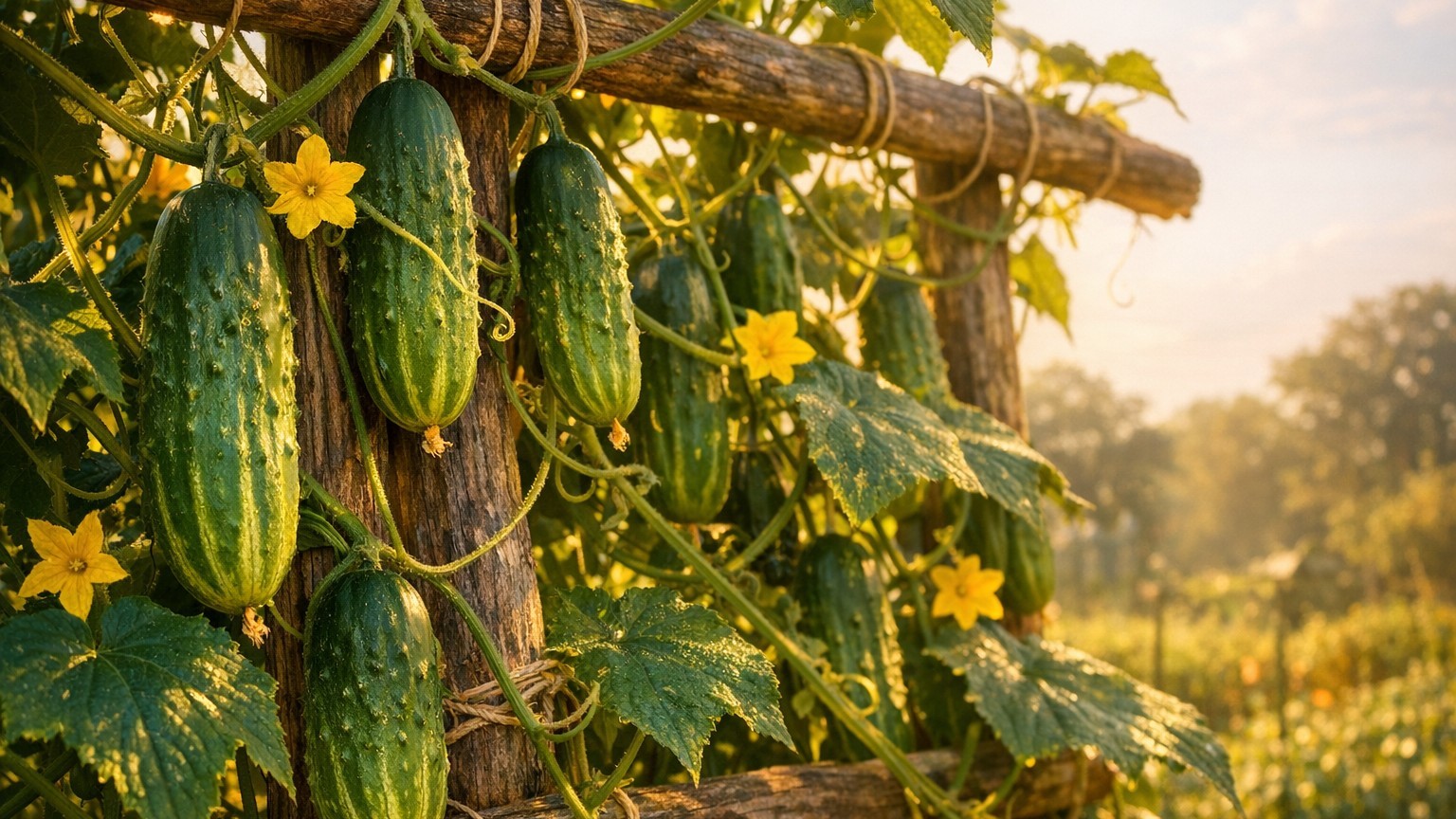

Ohio’s frost-free window runs long enough that nearly every cucumber type can mature here: pickling, slicing, burpless, parthenocarpic, bush or vining. The real decision isn’t season length, it’s Ohio’s humid, occasionally scorching summer, which favors types and habits built to shed moisture and shrug off heat spikes rather than any single named variety.
The short answer for Ohio
Start with the calendar. Ohio State University Extension puts the last spring frost between May 5 and May 15 and the first fall frost between October 5 and October 15, both figures tied to zone 6a. That’s a frost-free stretch of roughly five months, which is more than enough time for any cucumber type, fast or slow, to size up and produce a real harvest, even with a second succession planting worked in for July.
So the choice isn’t about whether there’s time. It’s about which habit and fruit type handles Ohio’s particular summer. With 15.3 days a year hitting 90°F or above at the Columbus reference station, afternoon heat stress is a real factor in July and August, and it hits pollination hardest. Parthenocarpic and burpless types, which set fruit without needing consistent bee activity, tend to keep producing through those heat spikes when standard slicers stall out or drop blossoms.
Bush types make sense for anyone gardening in containers or a small raised bed, since they don’t need a trellis and finish their growth cycle in a tighter footprint. Vining types ask for more structure, a trellis, a fence, cattle panel, something to lift the foliage off the ground, but they reward that effort with a longer, heavier picking window across a humid Ohio summer. Pickling types, bred for smaller, thinner-skinned fruit picked young and often, suit gardeners planning to can or ferment, while slicing types are the ones meant to size up for the table.
None of this points to a specific cultivar, and this page won’t invent one. The types above are the decision that Ohio’s season length and heat load actually support. Which named varieties perform best in a given county is a separate question, and it’s one your state extension service tracks through actual field trials, not a general climate profile.
What will not work here

Season length isn’t what trips up Ohio cucumber growers. Humidity is. Summer rainfall averages about 12.7 inches across June, July and August, split unevenly: 4.33 inches in June, 4.67 in July, then a drop to 3.74 in August, the driest of the three. That swing matters more than the total. A cucumber vine that’s been coasting on regular June and July moisture, then hits a drier, still-humid August, is exactly the kind of stress that produces bitter or misshapen fruit and encourages splitting when a heavy rain finally does land on a stressed plant.
Dense, ground-sprawled vines are the clearest failure mode in this climate. Ohio’s humid air holds moisture on leaf surfaces long after a rain or a heavy dew, and cucumber foliage planted close together, low to the soil, stays wet longer than it should. That’s the exact condition powdery and downy mildew need to take hold, and once mildew establishes on a shaded, crowded planting, there’s no rescuing that section of the row. Trellising, wider spacing, or a bush habit with room to breathe all reduce that leaf-wetness window; a thick mat of vines on bare ground does not.
Heat load plays its own separate role. Fifteen days a year at or above 90°F doesn’t sound like much until those days cluster in late July, right when vines are setting their heaviest flush of fruit. Standard slicing types that depend on steady bee visitation can drop blossoms during a multi-day heat run, since pollinators slow down in extreme heat right along with the plant. That’s a second, independent reason parthenocarpic types earn a place in an Ohio garden: they’re not dodging humidity, they’re dodging a pollination gap that has nothing to do with bee populations and everything to do with a thermometer.
What genuinely fails here is a planting treated like it’s growing in a dry, mild climate: watered on a fixed weekly schedule regardless of that June-to-August rainfall swing, packed tight on open ground, and left to rely on pollinators during the hottest stretch of summer. Ohio’s humidity and heat don’t rule out any type outright. They punish habits, not names.
What changes across Ohio
Ohio isn’t one garden, and the USDA Plant Hardiness Zone Map (2023, built on 1991-2020 normals) makes that explicit: the state spans zone 5b to 6b. That’s a real spread, not a rounding error. Zone 5b describes colder average annual extreme minimum temperatures, typically found in the state’s northern reaches and higher inland spots, while 6b describes milder winter extremes, more common toward the Ohio River valley in the south.
That range doesn’t just describe winter survival for perennials, it’s a proxy for how much earlier or later a season can safely start and end from one part of the state to another. A gardener working land closer to the 5b end of that spread is working with a tighter margin against a late spring cold snap or an early fall frost than someone gardening closer to 6b, even though both fall inside the same state-level frost date range published by OSU Extension. The zone spread is also a reminder that a single statewide frost date range, May 5 to May 15 for the last spring frost, October 5 to October 15 for the first fall frost, is itself an average drawn from stations across that whole 5b-6b territory, not a promise for any one yard.
None of this tells an individual reader which zone they’re actually gardening in, and this page won’t guess. What it does say is that a planting decision that looks safe on a statewide date range could still run a plant right into an early frost in a colder pocket of the state, or leave harvest days on the table in a milder one. Checking the USDA map directly for a specific address is the only way to know where a given garden actually sits inside that 5b-6b spread, and that placement should inform how much buffer to build around the frost dates cited above, not replace them.
Where to check this for your own county
This page describes Ohio at the state level, and a state-level answer is a starting point, not a finish line. Ohio State University Extension runs county offices precisely because a Columbus-area frost date and a northeast Ohio one, or a southern Ohio River valley one, aren’t interchangeable, even inside the same zone 6a reference used for the statewide calendar cited above.
Ohio State University Extension is the starting point for finding that county-level detail. Two things are worth looking for there specifically. First, a local planting calendar, if the county office publishes one, which will reflect actual observed frost patterns for that specific area rather than the broader zone 6a range used statewide. Second, and more valuable for the exact question this page opened with, any list of cucumber varieties that county’s extension office or a nearby university trial has actually grown and evaluated under Ohio conditions. That’s the level of detail this cluster page can’t provide, since a named variety’s real performance depends on soil, local disease pressure and microclimate in a way a statewide climate profile never captures.
A county recommendation will beat a state one every time, for the simple reason that it’s been tested closer to the actual garden in question. This page has laid out the types that fit Ohio’s season length and its humid, heat-spiked summer pattern, pickling versus slicing, bush versus vining, parthenocarpic versus standard, and why each of those distinctions matters here specifically. Turning that into an actual shopping list of cultivar names is exactly the job the county extension office is set up to do, and it’s worth the phone call or site visit before seed catalogs get ordered.
Checking this against your own garden
Every date and average on this page is a regional pattern, not a promise about one particular patch of soil. The garden itself will say more than any calendar once the season actually starts, and three simple observations do most of that work.
Soil warmth by feel is the first. Cucumber seed and transplants stall in cold soil regardless of what the air temperature or the calendar date says, so a gardener who reaches into the top few inches of bed and finds it still cool and damp in mid-May, even after that OSU-cited frost window has passed, is looking at a signal to wait, not a reason to distrust the date range.
The first flush of male flowers is the second thing to watch. Cucumber plants typically produce male blossoms before female ones, and a heavy early show of males with no females yet forming is normal, not a failure. What matters is watching for that shift toward female flowers, recognizable by the tiny swollen bulge at the base, since that’s the point pollination and fruit set actually become possible.
The first true leaves, the second set that emerges after the rounder seed leaves, are the third marker. Their size, color and speed of appearance say more about that specific bed’s fertility, drainage and sun exposure than any regional rainfall average can. Pale, slow-to-develop true leaves point toward a nutrient or drainage issue worth checking before blaming the season or the variety. A garden that’s consistently a week or two ahead of or behind these three markers compared to a neighbor down the street isn’t wrong: it’s revealing its own microclimate, and that’s the detail worth tracking from one season to the next.