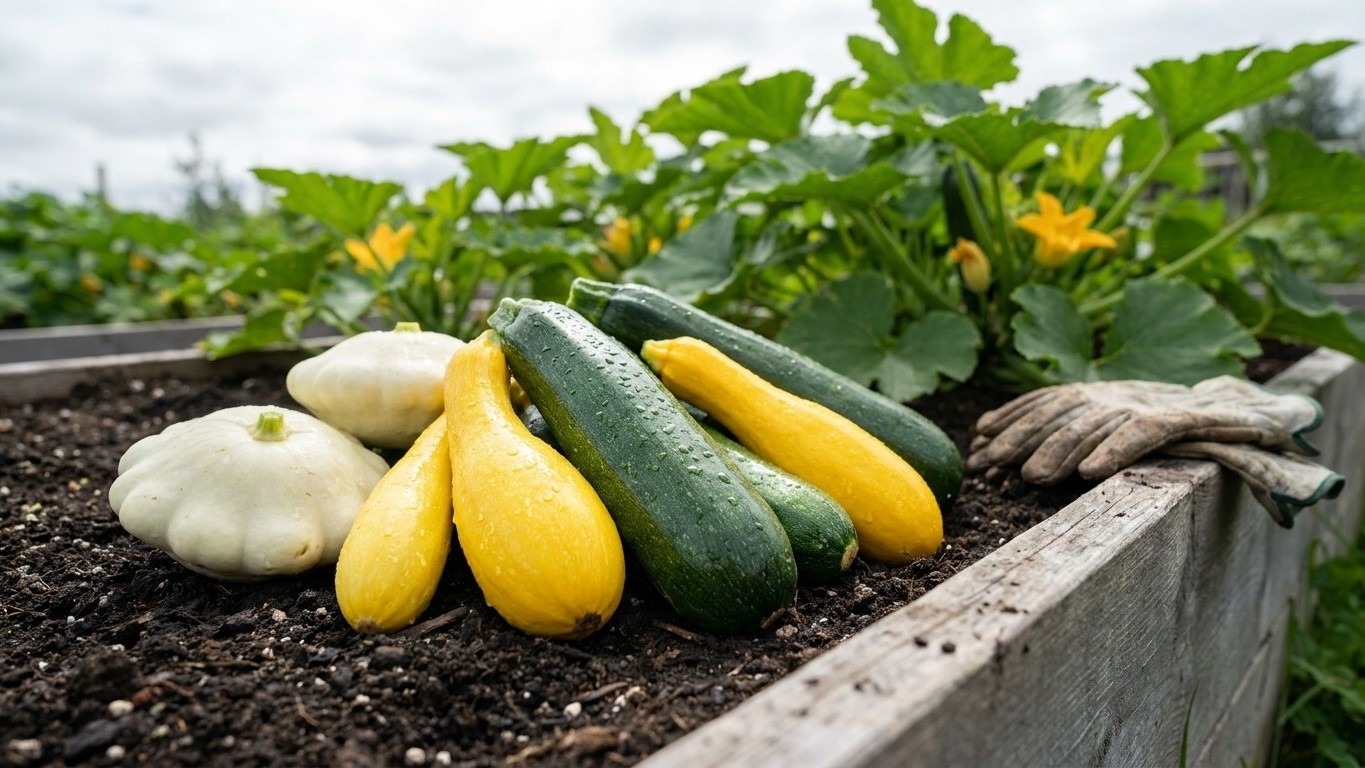

Alberta’s short, cool growing season calls for fast-maturing bush-type summer squash: zucchini, yellow crookneck, yellow straightneck, and patty pan (scallop) types bred for 45 to 55 days to harvest. Longer-season summer squash varieties rarely have enough runway between Alberta’s mean frost dates to reliably produce a full harvest.
The short answer for Alberta
Start with the two dates that frame everything: Environment and Climate Change Canada puts Calgary’s average last spring frost at May 21 and the average first fall frost at September 16. That’s a mean frost-free window of roughly 118 days. But a mean is not a guarantee. In one year out of two, that fall frost arrives later than September 16, which sounds like good news until you remember the flip side: means work both ways, and a frost can just as easily show up earlier in a cooler year. Treat both dates as the midpoint of a moving target, not a safe bracket.
That 118-day figure is also the theoretical maximum, not the practical one. Soil doesn’t hit squash-friendly temperatures the instant the last frost passes. Most Alberta gardeners wait one to two weeks past May 21 before seed goes in the ground, because summer squash seed rots in cold, wet soil rather than germinating. So the real usable window most years lands closer to 90 to 100 days, not 118.
That’s the number that should drive variety choice. Zucchini, yellow crookneck, yellow straightneck, and patty pan squash are almost all bush-habit plants bred to fruit in 45 to 55 days, and they fit comfortably inside even a tightened 90-day season with room to spare for a slow start or a cool spell mid-summer. This is not a season for exploratory patience with an unfamiliar cultivar rated at 65 or 70 days: there is little buffer built in.
The other number worth naming here is heat, or the near-total absence of it. Calgary’s normals show 0.0 days a year at or above 90°F. Summer squash isn’t a desert crop, but it does want warmth to germinate fast, set fruit, and ripen on schedule. With essentially no hot days to push things along, the fastest-maturing types carry less risk than anything marketed for its size, flavor complexity, or heirloom pedigree at the cost of extra days on the calendar. In Alberta, days to maturity is the first filter, not the last.
What will not work here
The clearest failure mode is a variety chosen for taste or novelty over speed. A 65-to-70-day summer squash sounds like a small stretch beyond a 50-day zucchini, but stacked against a realistic 90-to-100-day working season, that’s a third of the available time gone before the plant even starts producing reliably. Add one week of cool, wet soil delaying germination in spring, and one early cold snap in September, and a 65-day variety can end the season with fruit still sizing up on the vine.
Cool soil does double duty against slower squash. Germination in cucurbits slows sharply below roughly 60°F, and Calgary’s spring normals don’t push soil into that comfort zone quickly. A fast bush zucchini shrugs this off because it has margin to spare; a longer-season type does not, because its clock is already running behind before the first true leaf appears.
Pollination is the other quiet casualty of a cool, short season. Summer squash needs bees moving between male and female flowers on warm mornings. With zero days a year reaching 90°F, Alberta isn’t fighting heat stress that shuts pollinators down at midday the way parts of the U.S. Southwest do. But a run of cool, overcast days, more common here than a heat problem, can suppress bee activity just as effectively, and a variety already running late on maturity has fewer days left to recover from a poorly pollinated week.
Water management here doesn’t look like the classic hot-and-dry failure pattern. Summer rainfall averages about 8.5 inches across June, July and August, with August as the driest month at 2.24 inches. That’s a moderate figure, not a drought figure, and paired with a near-absent heat load, the evaporation demand pulling moisture out of soil is genuinely lower than in hotter regions. Weekly watering that would leave a squash bed stressed in a 90-plus-degree month is a smaller risk here. Where it does fail is on light, sandy soil in August specifically, the driest stretch of the summer, where a week without checking soil moisture by hand can catch a gardener off guard even in a mild-heat climate.
What changes across Alberta
Calgary’s numbers describe one reference station, and Alberta is not one climate wearing a single label. Natural Resources Canada places the Calgary area at Canadian hardiness zone 4a, a rating built from seven climate variables rather than the single winter-minimum figure the USDA system uses. NRCan is explicit that there’s no clean conversion between the two systems, and a single Canadian zone like 4a can overlap nine different USDA zones, spanning roughly 3a to 7a. That spread alone signals how much variation sits inside one province.
Practically, that means a gardener near Calgary is working with meaningfully different conditions than one farther north toward Grande Prairie or Peace River, or one gardening at higher elevation in the foothills. Northern latitude and altitude both push the growing season in the same direction: later last frost in spring, earlier first frost in fall, and a shorter window than the Calgary-based averages already suggest. A 90-to-100-day working season near Calgary can easily shrink to 75 or 80 days farther north or higher up.
There is no single answer for “Alberta” as a whole, and this page can’t responsibly hand one to an individual reader. What it can do is point to the tool built for that job: Natural Resources Canada’s Plant Hardiness Site lets a gardener look up the zone for their own municipality rather than borrowing Calgary’s. Given the zone spread already documented for 4a alone, a reader gardening even 100 miles from Calgary, or a few hundred feet higher, owes it to their squash bed to check their own location before locking in a variety based on this page’s numbers alone.
Where to check this for your own county
Alberta’s provincial agriculture ministry, reachable at alberta.ca/agriculture-and-irrigation, is the right next stop, and it’s worth being specific about what to look for once there rather than browsing generally.
Two things matter most. First, a local planting calendar, if one exists for the reader’s region, will reflect the actual frost pattern of their municipal district rather than the Calgary Int’l A station’s normals used throughout this page. Second, look for varieties actually trialled in that county or region. Provincial and municipal extension programs in Alberta periodically test summer squash cultivars under local soil and season conditions, and a variety that performed well in a trial plot near the reader’s own municipal district is a stronger recommendation than any general “fast-maturing bush type” advice offered here.
That distinction matters more than it might seem. This page works from a single reference station’s normals, useful for framing the province-wide picture but blind to the microclimate of any one county, coulee, or river valley. A county-level or regional recommendation, grounded in local trial data and local frost records, will always outrank a provincial generalization built on Calgary’s numbers. This page is, deliberately, the provincial-level answer: broad enough to set expectations, not fine-grained enough to replace what a reader’s own regional office can tell them about their specific ground.
Anyone gardening well outside the Calgary area, particularly north toward the Peace Country or up in foothill elevations, should treat that extension check as a required step rather than an optional one, given how far Alberta’s frost dates and season length can drift from the reference figures used above.
Checking this against your own garden
Every date on this page is an average pulled from one weather station. A gardener’s own plot will confirm or contradict it faster than any calendar, and three simple observations do most of that work.
Soil warmth by feel comes first. Summer squash seed wants soil that feels comfortably warm to bare skin, not just frost-free air above it. If the soil still feels cool and damp a hand’s-width down in late May, that’s a more honest signal than the calendar date, and it means waiting matters more than rushing to plant on schedule.
The first flush of male flowers is the second marker. Summer squash plants typically produce several male flowers before the first female flower appears, and a long gap between that first flush and any female blooms setting fruit often points to a cool stretch slowing the plant’s pace, exactly the kind of delay a fast-maturing variety is bought to absorb.
The first true leaves, the second set that appears after the initial seed leaves, mark real establishment. Slow, pale, or stunted true leaves in a bed that’s supposedly past its cold risk usually mean the microclimate of that specific spot, shaded morning sun, low ground holding cold air, heavy clay slow to warm, is running behind the reference station’s numbers. That’s useful information for next year’s planting date, and it’s more reliable than anything printed on a seed packet or a provincial calendar.