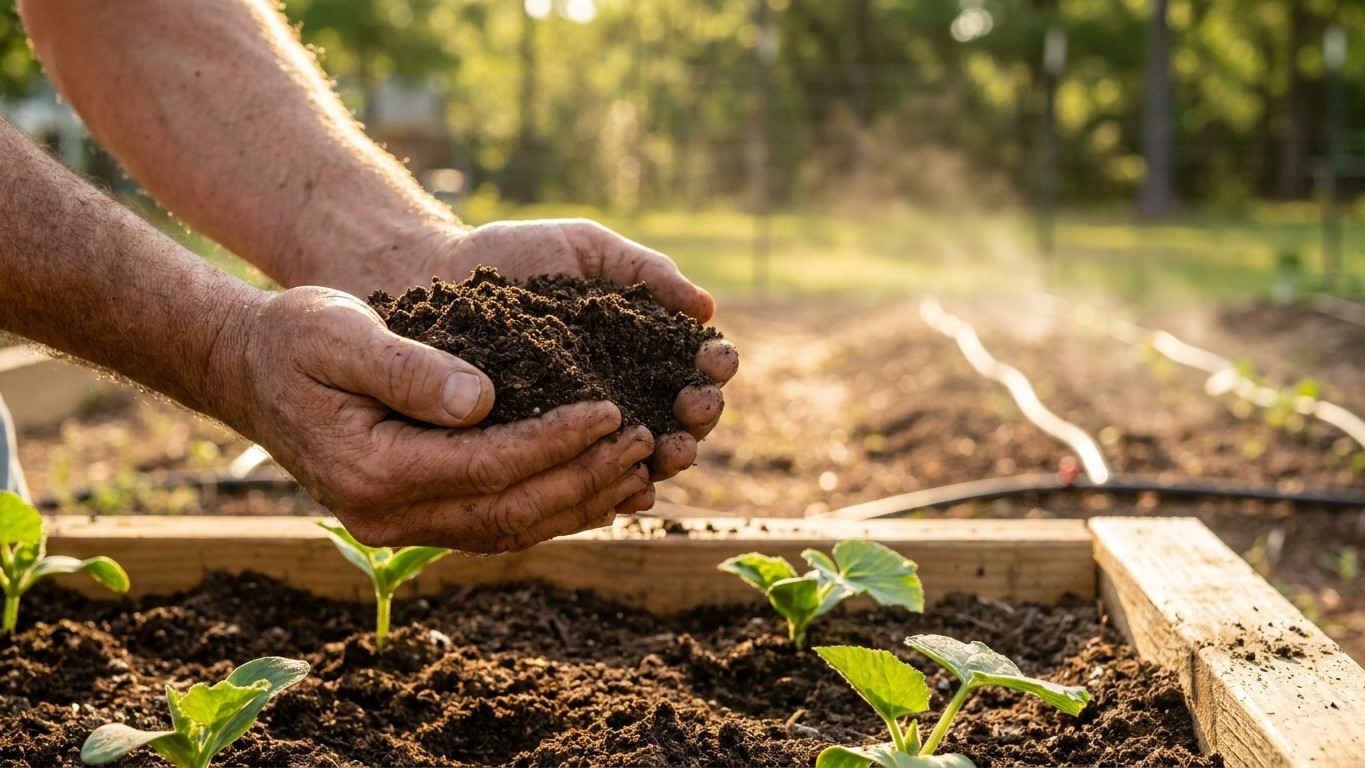

Alberta gardeners get one shot at summer squash timing that matters: wait for the soil to warm past the danger of chill, not just past the calendar date locals repeat every spring. In most of the province that means holding off until late May or early June, then watching the plants sprint through a summer window that closes again by mid-September. Soil temperature, not frost alone, decides success.
When the soil is warm enough in Alberta
The number gardeners lean on is the average last spring frost, and for the Calgary area that date is May 21, according to Environment and Climate Change Canada’s Canadian Climate Normals for 1981-2010, recorded at the Calgary Int’l A station. That figure is a mean, not a guarantee. Half the years on record saw frost arrive later than May 21, so treating it as a hard planting deadline is where a lot of squash starts go wrong.
Frost dates get used as a shortcut for a different question entirely: is the soil warm enough for a squash seed to germinate without rotting, or a transplant to grow instead of sulking in cold ground? Summer squash seeds need soil in the mid-60s Fahrenheit to break dormancy reliably, and that threshold is almost always reached days or even a couple of weeks after the air stops flirting with frost. In a short-season, zone 4a climate (the Canadian hardiness rating for the Calgary reference area, built from seven climate variables and not convertible to a USDA number), the gap between “frost risk has passed” and “soil has actually warmed” is the detail that decides whether a direct-sown seed sits doing nothing for ten days or takes off within four or five.
This is also the argument for starting squash indoors under lights a few weeks ahead, then hardening off transplants before setting them out once night temperatures settle. Squash resent root disturbance, so anyone transplanting should use a system that lets them slide the whole root mass out intact, rather than pulling bare-root seedlings from open trays. Checking the actual root ball for white, active growth (rather than a mat of tangled brown roots) before planting out is a better indicator of readiness than any date on a seed packet.
Skip the temptation to rush a warm April stretch. Alberta springs are notorious for a run of 70-degree afternoons followed by a hard overnight freeze, and a squash seedling with no frost tolerance at all can be wiped out in one bad night. Given that the May 21 average is a midpoint, not a safe line, many experienced growers in the region wait until the very end of May or the first days of June before committing seedlings to open ground, accepting a slightly shorter season in exchange for not losing the whole planting to a late cold snap.
How long the season lasts here
Run the two averages together and the frost-free window in the Calgary area comes out to roughly 118 days, counting from the average last spring frost of May 21 to the average first fall frost of September 16. Both dates come from the same Environment and Climate Change Canada normals (1981-2010, Calgary Int’l A station), so the subtraction holds up, but remember both ends are averages: some years hand gardeners a longer run, others cut it short from either direction.
A 118-day window is workable for summer squash, but it is not generous. It is long enough to carry one planting from seed or transplant through to a full harvest cycle, with enough margin most years to keep picking into early September before the first real cold arrives. It is not, in most cases, long enough to comfortably fit two separate sowings the way a grower in a longer, milder region might.
That changes the planting strategy in a specific way. Instead of staggering a second sowing three or four weeks after the first, the smarter move in this window is usually to make the single planting count: stagger transplant dates by a week or so within the same batch, or set out plants of slightly different maturity habits at once, rather than banking on a true second round later in summer. For gardeners who want to understand how succession sowing works where the season allows more room, the succession sowing guide for summer squash on this site lays out how the timing shifts in longer-season territories, and why Alberta’s compressed window calls for a different approach.
The tighter window is also the strongest argument for transplanting rather than direct-seeding in this province. Every week saved by setting out a stocky, four-week-old seedling instead of waiting for a direct-sown seed to germinate and establish is a week added back onto a harvest season that is already working with less slack than most of the squash-growing regions this site covers.
Heat and water in Alberta
Here is the number that separates Alberta from most of the territories in this series: the Calgary reference station records an average of 0.0 days a year above 90°F, per the 1981-2010 Canadian Climate Normals. Summer squash pollen loses viability fast once temperatures push into the high 90s, which causes blossoms to drop or fruit to set poorly in hot climates. That failure mode essentially does not apply here. Heat stress on pollen is not the risk Alberta gardeners need to plan around.
What replaces it is the opposite problem: a cool, often damp growing season that favors mildew, slows ripening, and gives fungal disease more opportunity than heat-driven wilting ever would. Summer rainfall across the June-July-August stretch averages about 8.5 inches at the Calgary station, broken down as follows.
| Month | Average rainfall |
|---|---|
| June | 3.7 inches |
| July | 2.58 inches |
| August | 2.24 inches |
That pattern, a wetter June easing into a drier August, means the disease pressure and the watering need actually move in opposite directions through the season. Early summer’s higher rainfall, combined with cool nights, is prime territory for powdery mildew and other leaf fungus once plants fill in and airflow drops between them. Spacing plants generously and watering at the soil line rather than overhead does more to manage that risk than anything else available to a home gardener.
By August, the driest of the three summer months, the calculus flips: rainfall alone is unlikely to keep a large-leaved, shallow-rooted squash plant fully hydrated, especially through a dry stretch. This is not a heat-driven irrigation need the way it would be in a hot southern state; it is a straightforward moisture-supply gap that a consistent watering schedule closes without much drama. A rain gauge on the actual plot, rather than relying on the regional average, is the only way to know week to week whether supplemental water is needed.
Which summer squash suit Alberta
Three facts from this province point toward the same kind of plant, without pointing toward any single variety. The short, roughly 118-day frost-free window favors the earliest-maturing types within the summer squash category, since a slower-growing type simply has less room to work with here than it would in a longer season. The essentially heat-free summer (zero days above 90°F on average) removes any pressure to choose types bred for heat tolerance, but it raises the priority on disease resistance and airflow, given how favorable cool, damp conditions are for mildew.
Put together, that means Alberta gardeners are generally better served by earlier types with open, less sprawling growth habits that let air move between plants, rather than the largest, latest-maturing types bred for regions with a long, hot season to spare. Vigorous but compact habits, wide spacing, and attention to airflow do more for a crop here than any single variety choice.
None of that amounts to naming a specific cultivar, and it should not. Variety trials run by provincial and state extension services test dozens of named types against local disease pressure, local frost timing, and local soil, and the results shift from year to year and region to region within a province as large and climatically varied as Alberta. A variety that performs well in the Calgary area’s zone 4a conditions is not automatically the right pick for a garden further north or at higher elevation, where both frost dates in this article would run later still.
The right next step for choosing an actual variety is Alberta’s provincial agriculture and irrigation service, which tracks the types trialled and recommended for local conditions. That is a more reliable source than any general guide, this one included, because it reflects results gathered in the province itself rather than averages drawn from a single reference station.